
Today’s itinerary took us to more sites in the Sacred Valley, most of them terraced in one form or another.
Chinchero was the morning’s first destination. It boasts Inca agricultural terraces surmounted by a Spanish church. Although the farmed any more, the locals do use the largest open space at the top for drying potatoes in the sun. The process takes weeks but afterward the potato is small and hard and can keep for up to ten years.
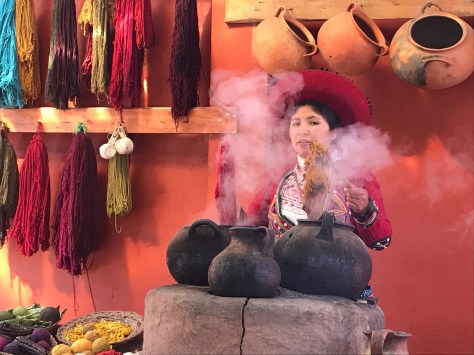
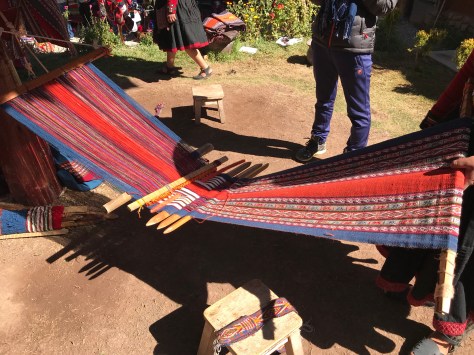
Chinchero is also known for its weaving collaboratives and we had the chance to visit one. The women gave a well-practiced presentation on the textile-making process, from shearing to cleaning to spinning to dyeing to weaving. All steps use natural materials local to the area, including grated yucca root for wool-washing detergent, and crushed beetle (cochineal) for the red dye. Weaving a large piece can take over a month of nearly full-time work.
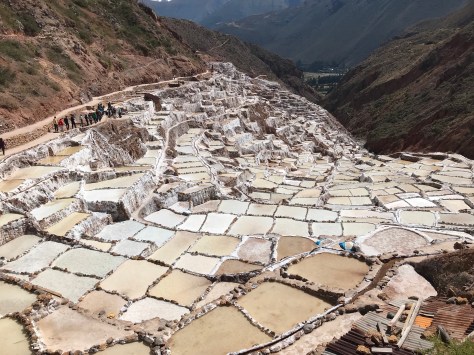
On our next stop we encountered a site that hasn’t changed much since pre-Inca times, and seemed like something out of another world. A spring issuing from the rock in one particular small Andean valley happens to carry brine picked up from passing through buried salt deposits. The local inhabitants have been diverting the water of this stream for centuries into small evaporating ponds to make salt. The Maras salt mine is the only active one in Peru, and currently contains 5000 ponds, each owned and operated by individual families. A back-of-the-envelope calculation suggests that the entire facility produces salt at a rate of around 50 tons per day during the dry season. Wow!
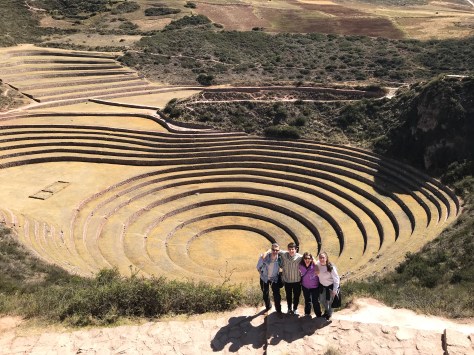
The last archeological site of the day also features terraces but is unique among Inca sites for another reason. The terraces at the Moray ruins make full circles, filling three amphitheater-like bowls of different sizes. Like several sites we had visited, the terraces at Moray were still cultivated for agriculture as recently as 15 years ago, but since the archeological sites were nationalized by the government, all such activity has ceased and today they grow only grass. Archeologists have noted that the microclimate at Moray differs greatly between the three bowls and their various levels – up to 9 degrees F – and this has led to theories that the site was used by the Incas for agricultural experimentation and selective breeding. We just thought the place looked really cool!
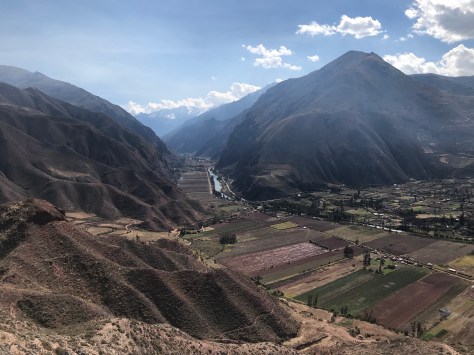
We wound up the day by reaching Ollantaytambo, a key town in the Sacred Valley that we will explore more tomorrow. On the way to the town, we caught a great view of the valley itself, full of fertile soil along the Urubamba river.
 Howes' Doings