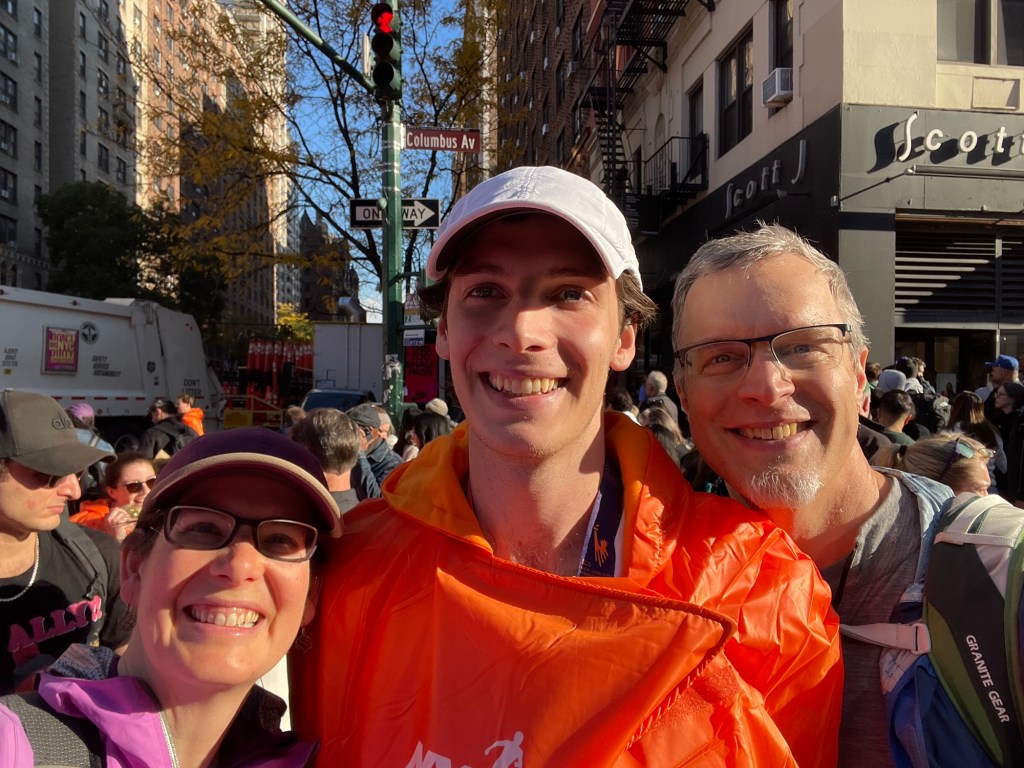
We have a surprise blog installment today detailing our day trip to NYC. Ben was running the New York City Marathon today – his first – and we took the train down to see him, and try our hand at the new-to-us sport of marathon spectating.
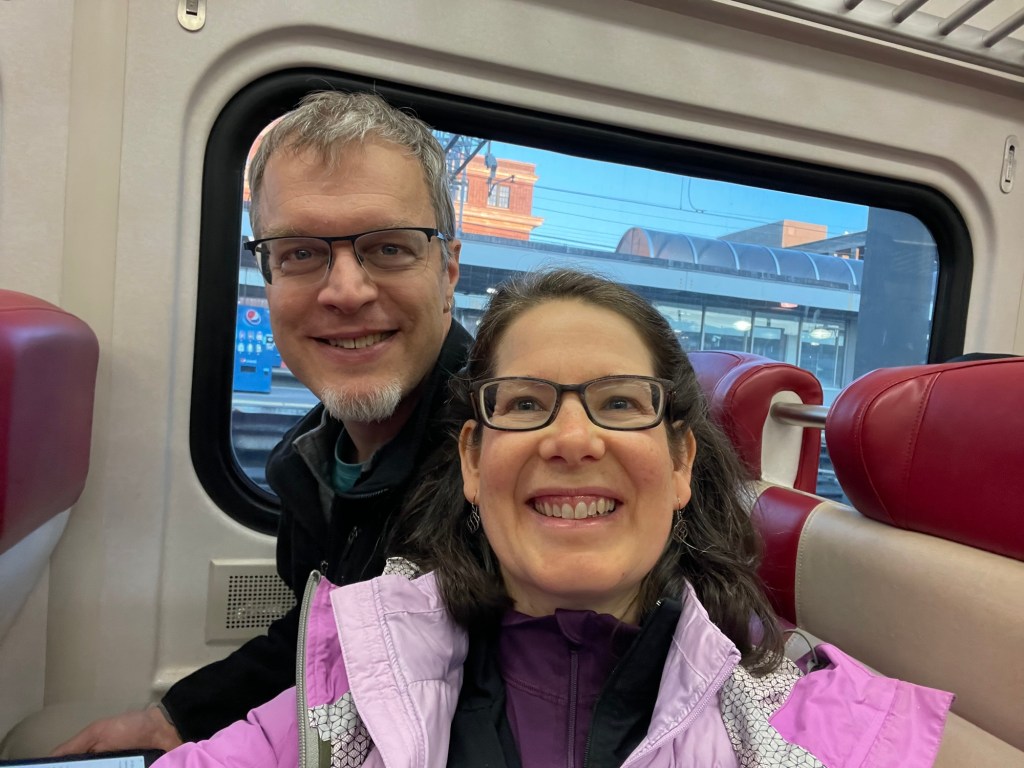
Taking the 6:40 AM train from New Haven
Ben’s job was physically demanding but the navigation was simple: just follow the runner in front of you. Ours required far less physical conditioning (just take the subway!) but was a challenge of logistical planning. In the end, we saw and cheered for Ben at four discrete points along the course: Mile 4, Mile 11.5, Mile 18, and the finish.
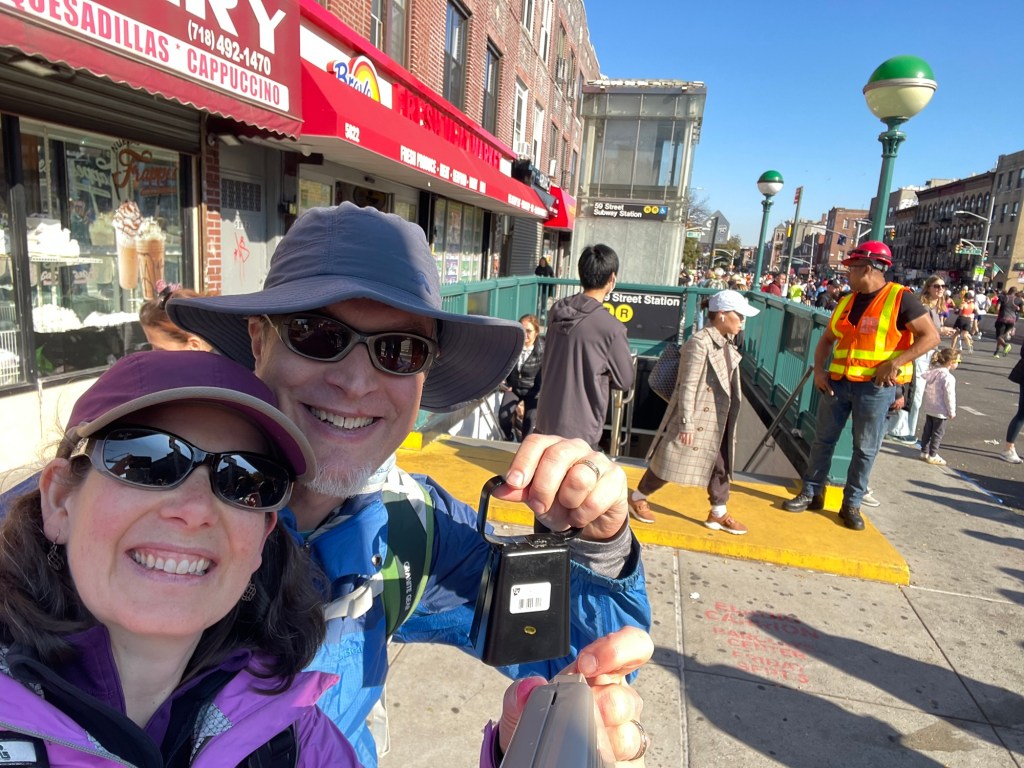
Cowbells in hand at Mile 4Happy Ben at Mile 11.5
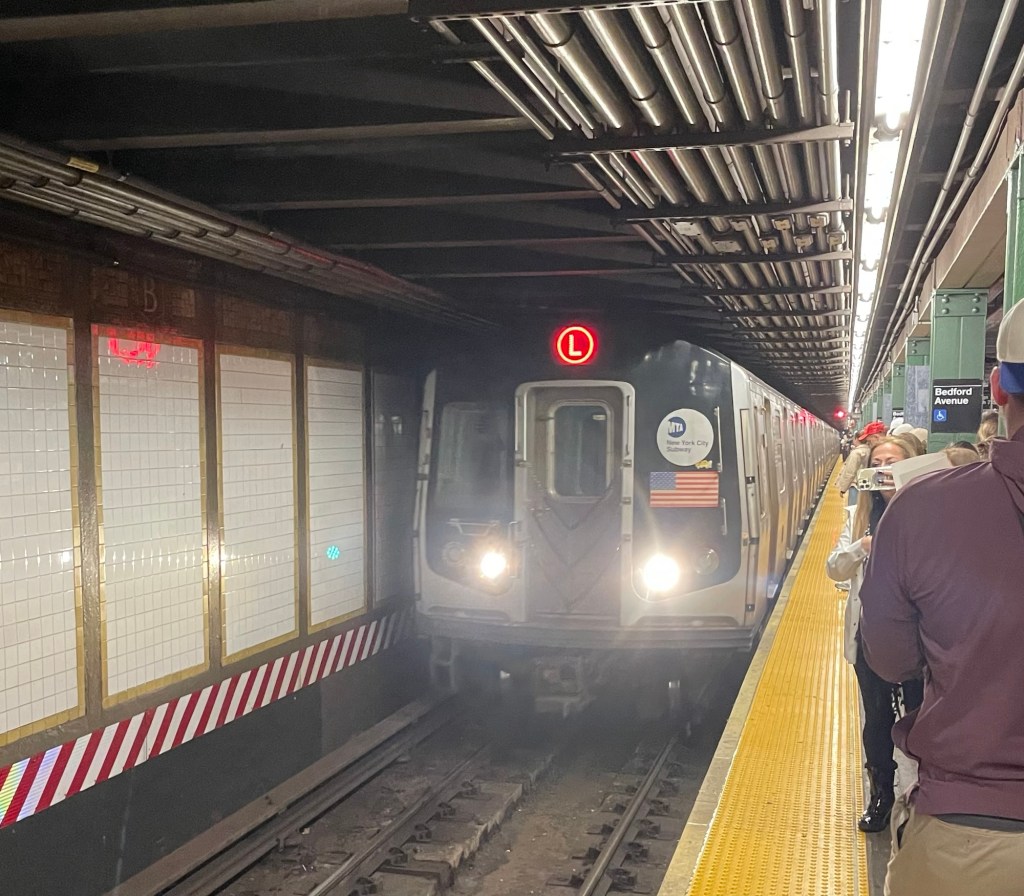
Turns out the subway travels faster than runners, but not by much; after factoring in the time spent waiting for trains, one must travel a fair distance to be certain to catch the runner again. Just as marathon running takes training in advance, marathon spectating (great sport that it is!) takes planning in advance. Susannah spent several happy hours the night before (with help from Nick) creating a detailed spreadsheet of mile markers, estimated time splits, and subway routes. And it all paid off: we were able to predict Ben’s appearance accurately within a five-minute window each time. We also gained much more experience with navigating the NYC subway system, including the 1, 4, G, L, N, Q, and R lines.
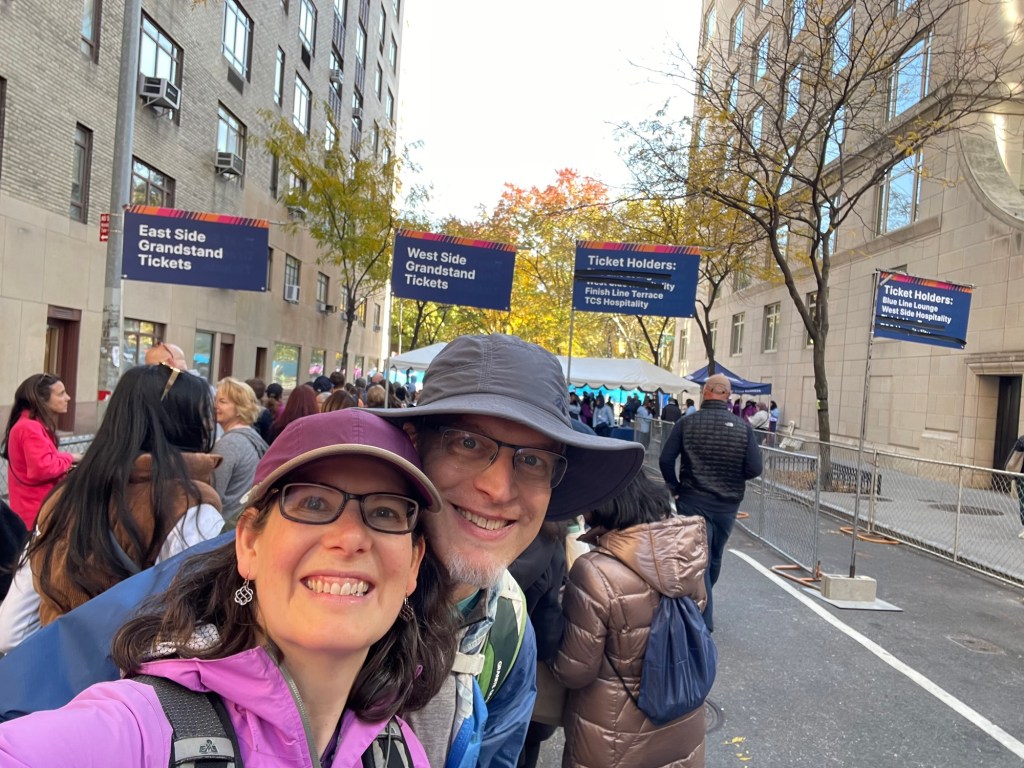
Just one in our alphabet of subway trains todayStill going strong at Mile 18!Part of the planning challenge was accounting for the 30-minute wait at the security line to get into the finish area
The weather could not have been nicer for running or spectating – cool but not cold, sunny and clear – and the crowds were out enjoying the day and the festivities.
Ben ran a marvelous race, finishing in 3:48, well under his target time of 4 hours and feeling strong!
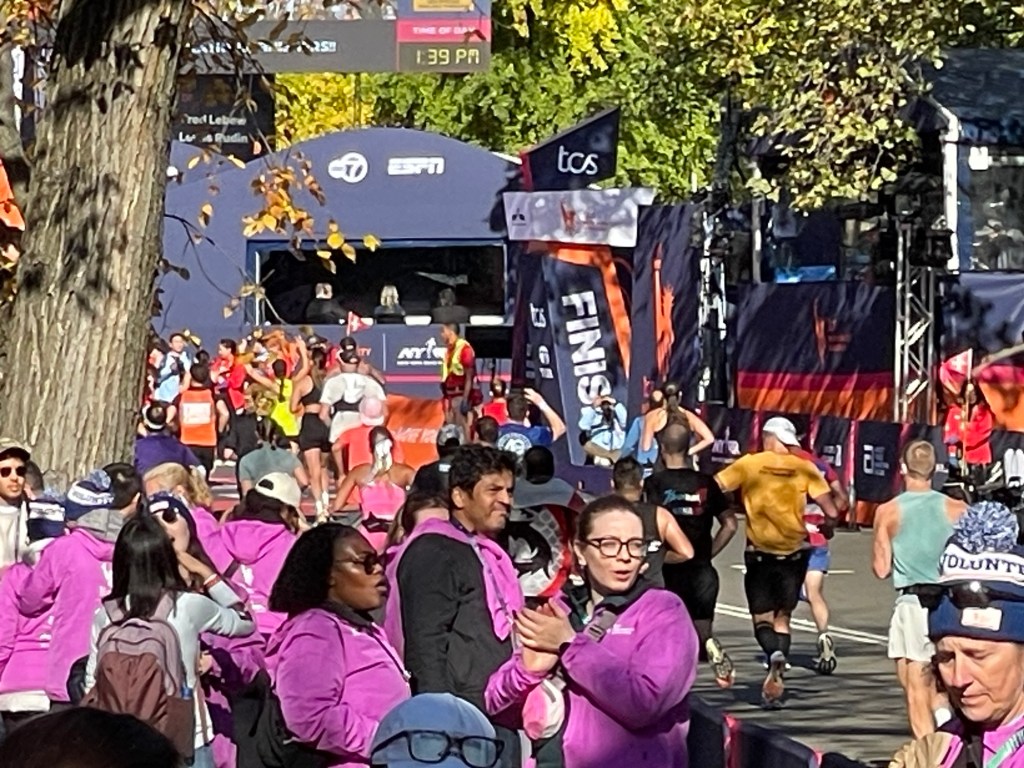
Just 100 yards to the finish – and he even gave us a hug as he ran by!Finish achieved!Post-race glow
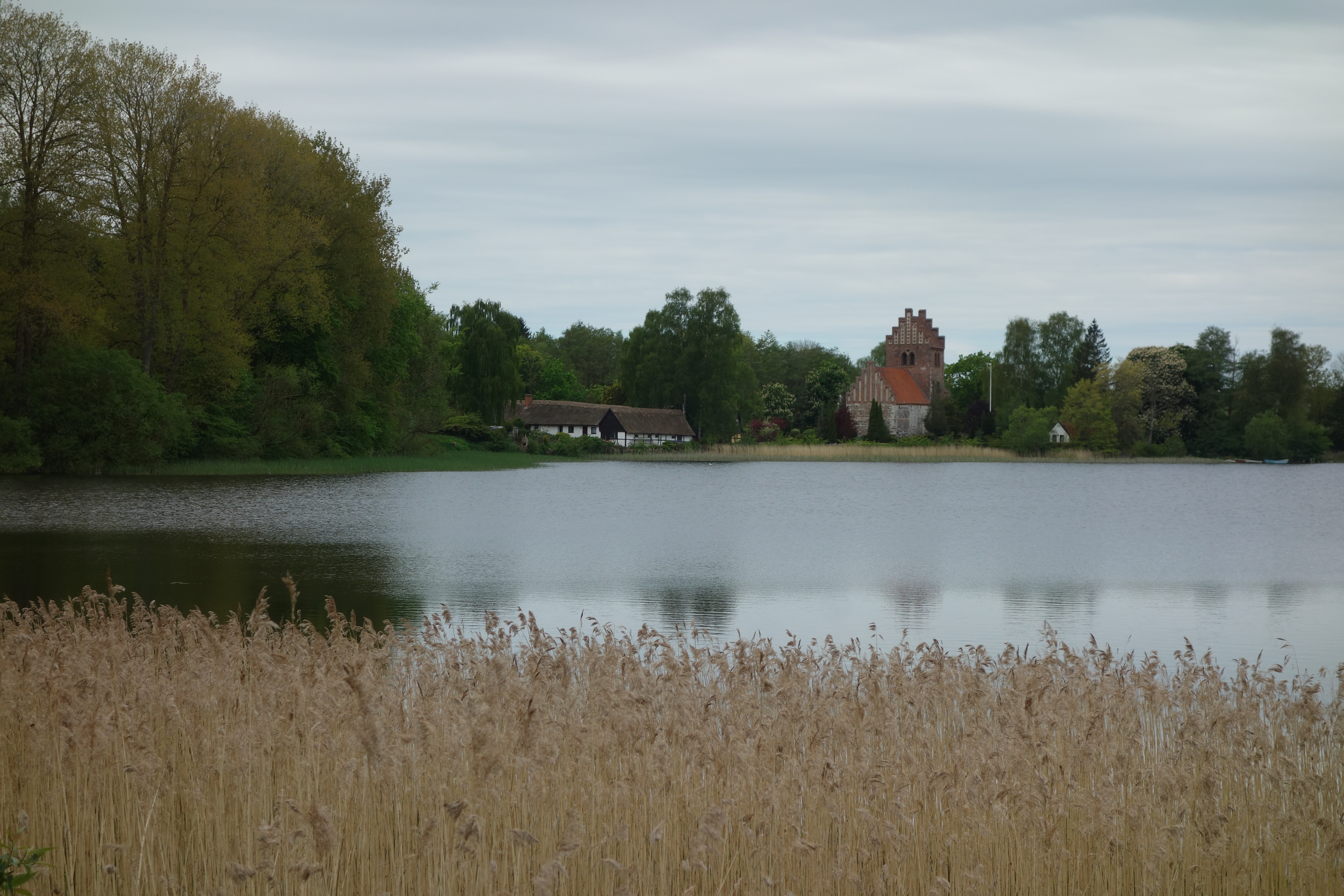
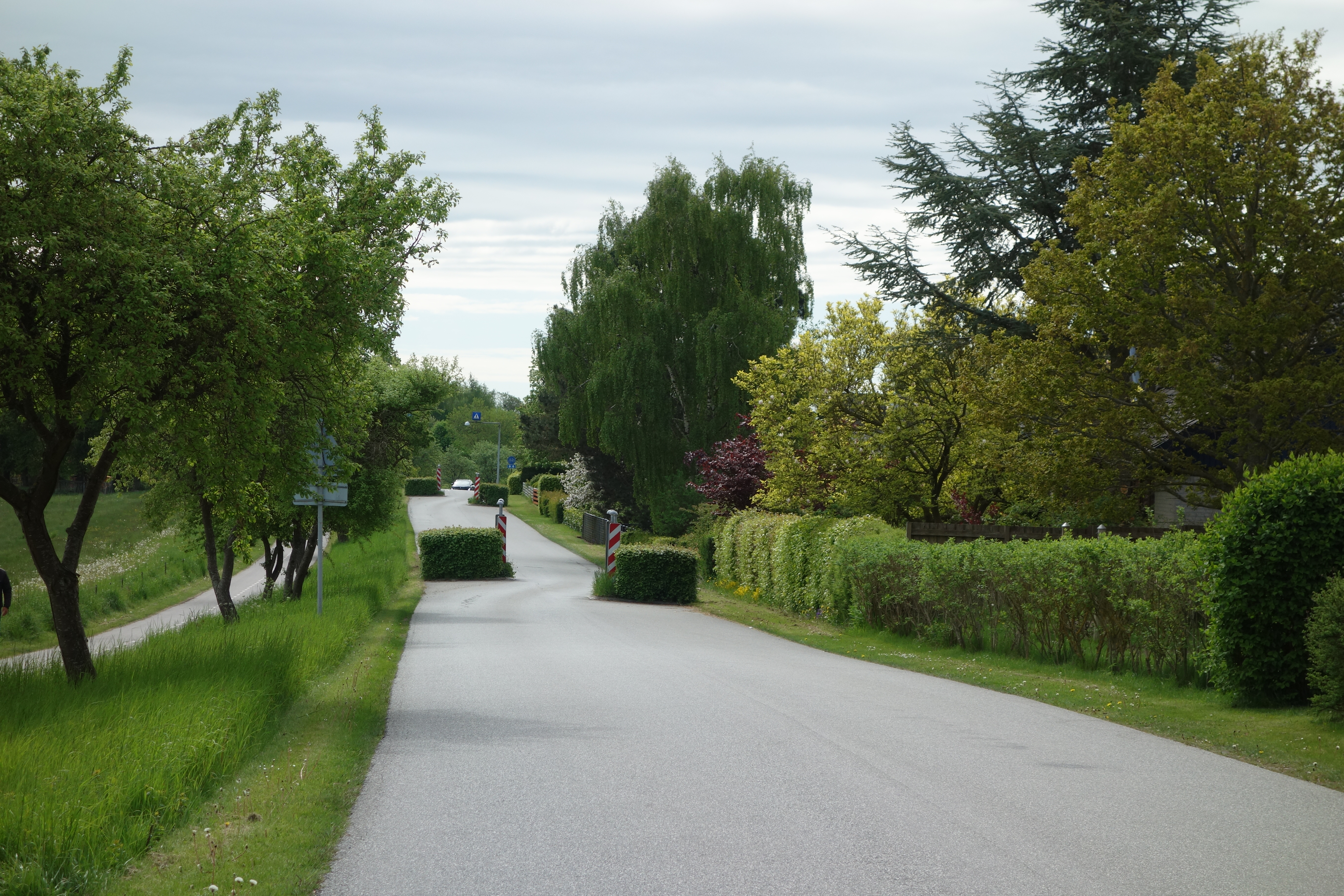
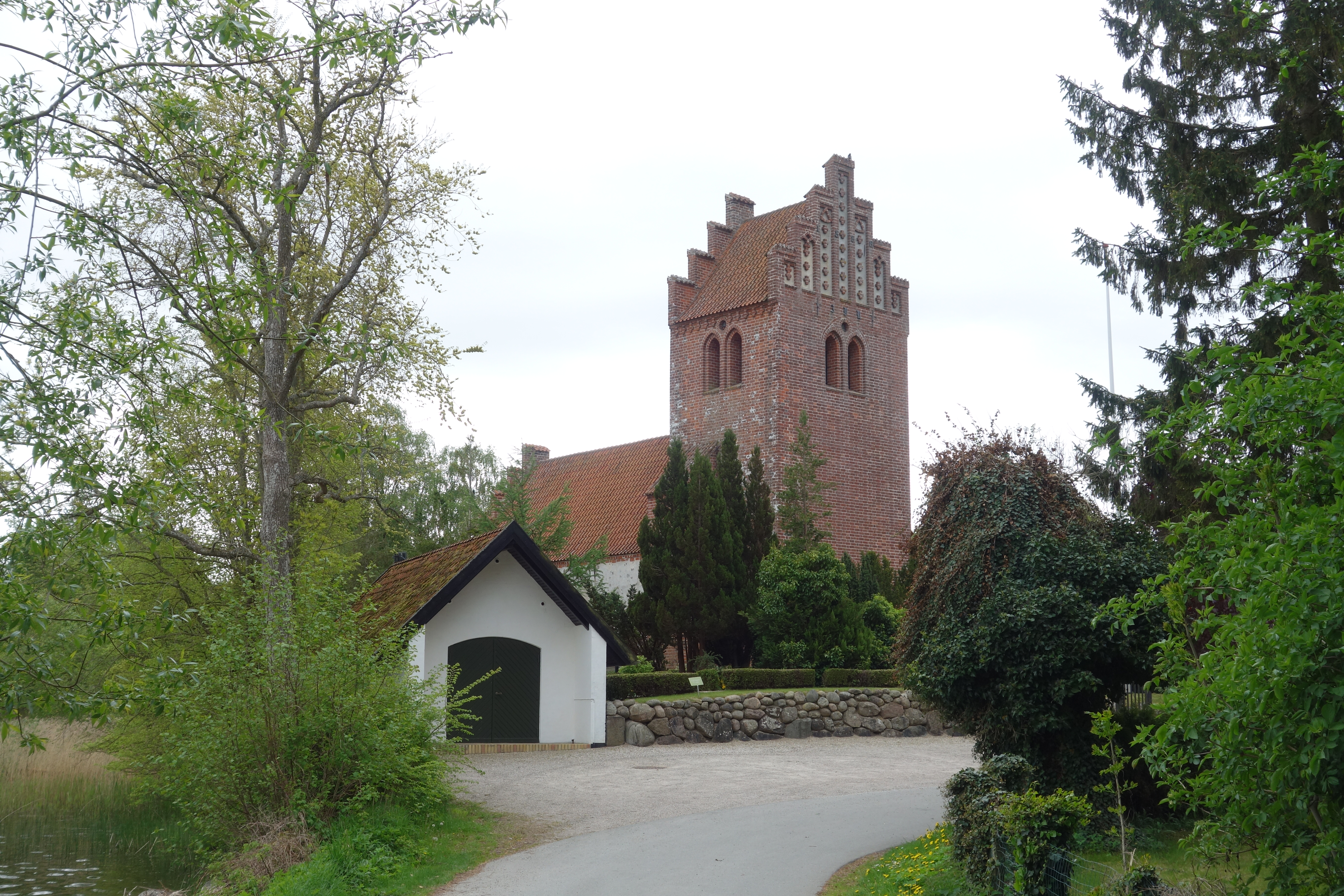
Today is our last full day in Denmark, and our last blog post for this trip. Nick and Susannah split up, with Nick exploring the area around Borup and Susannah making a visit to the Danish Meteorological Institute. Nick’s wanderings took him first round the lake near Thomas and Christina’s house and past the local church of Kimmerslev, where they were married 22 years ago.
The road through Kimmerslev has very attractive traffic calming measuresThis alluring dock area was tucked in behind some bushes and would have gone unnoticed if a kind local passing by had not pointed it outView from the far side of the lakeKimmerslev church
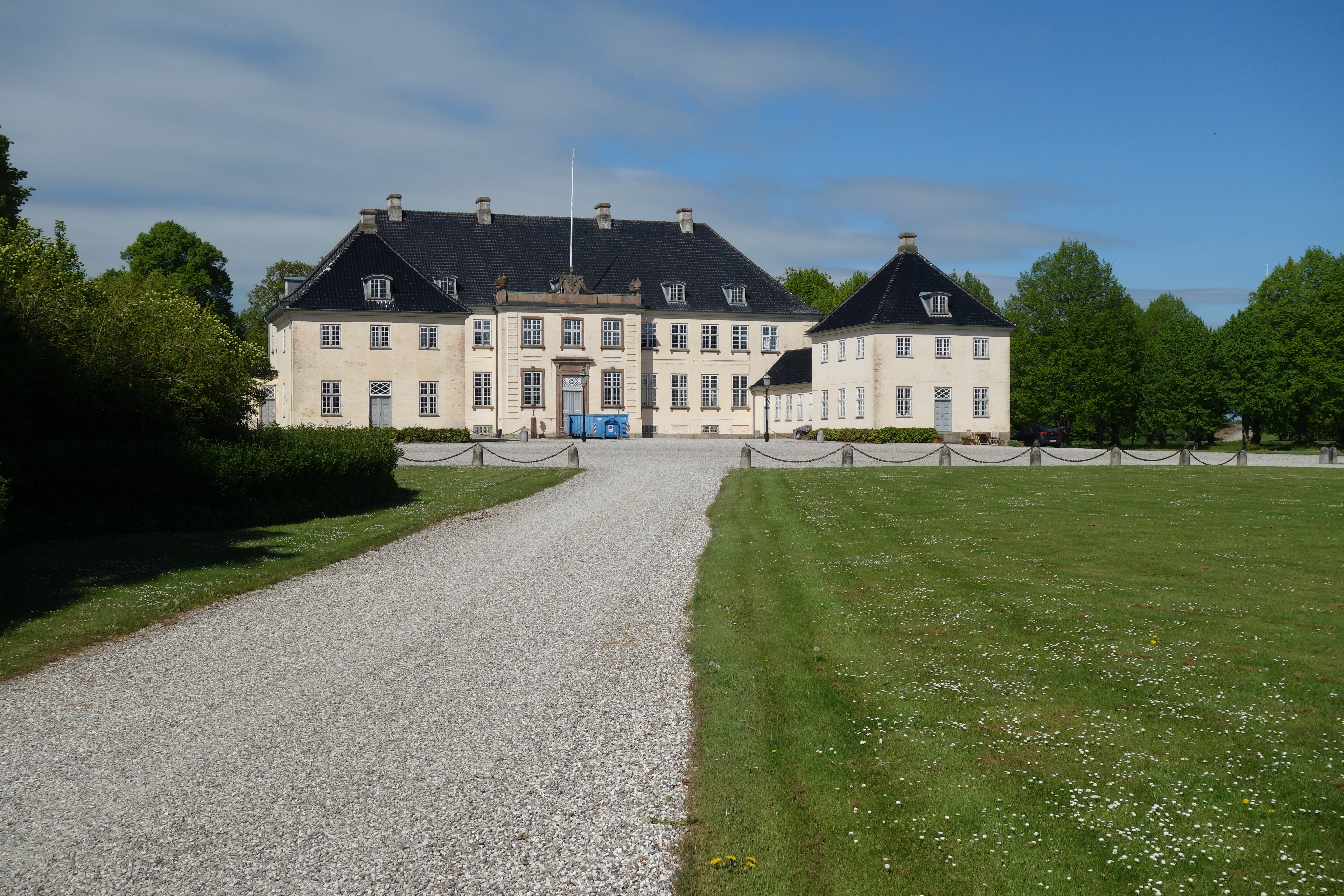
In the afternoon, Thomas took Nick to the forest belonging to the local noble family, which is open for the public to walk through. The land has been in the same family for eleven generations, and today supports a number of agricultural activities, including a large pig-raising operation. It also has many old gnarled and picturesque trees.
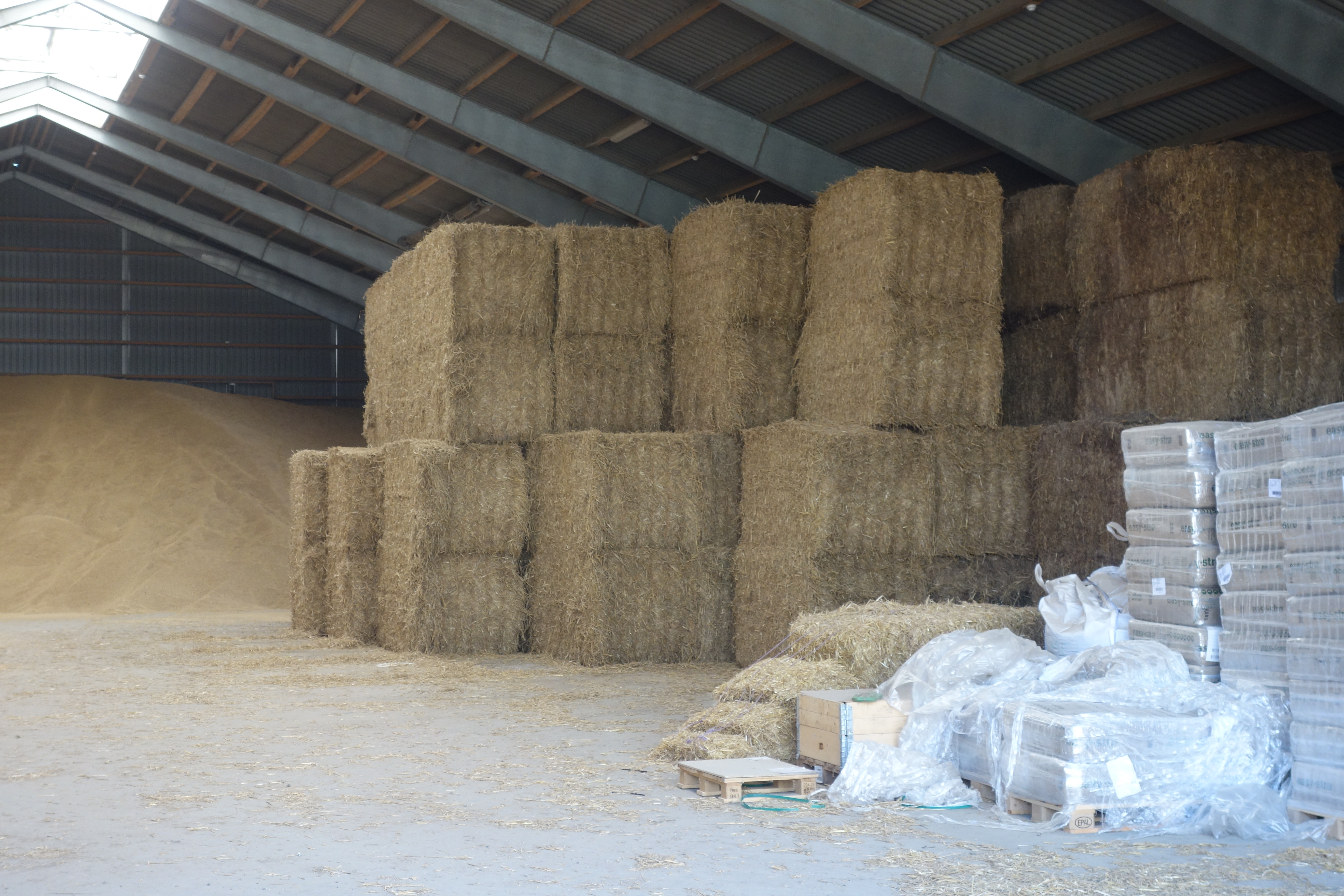
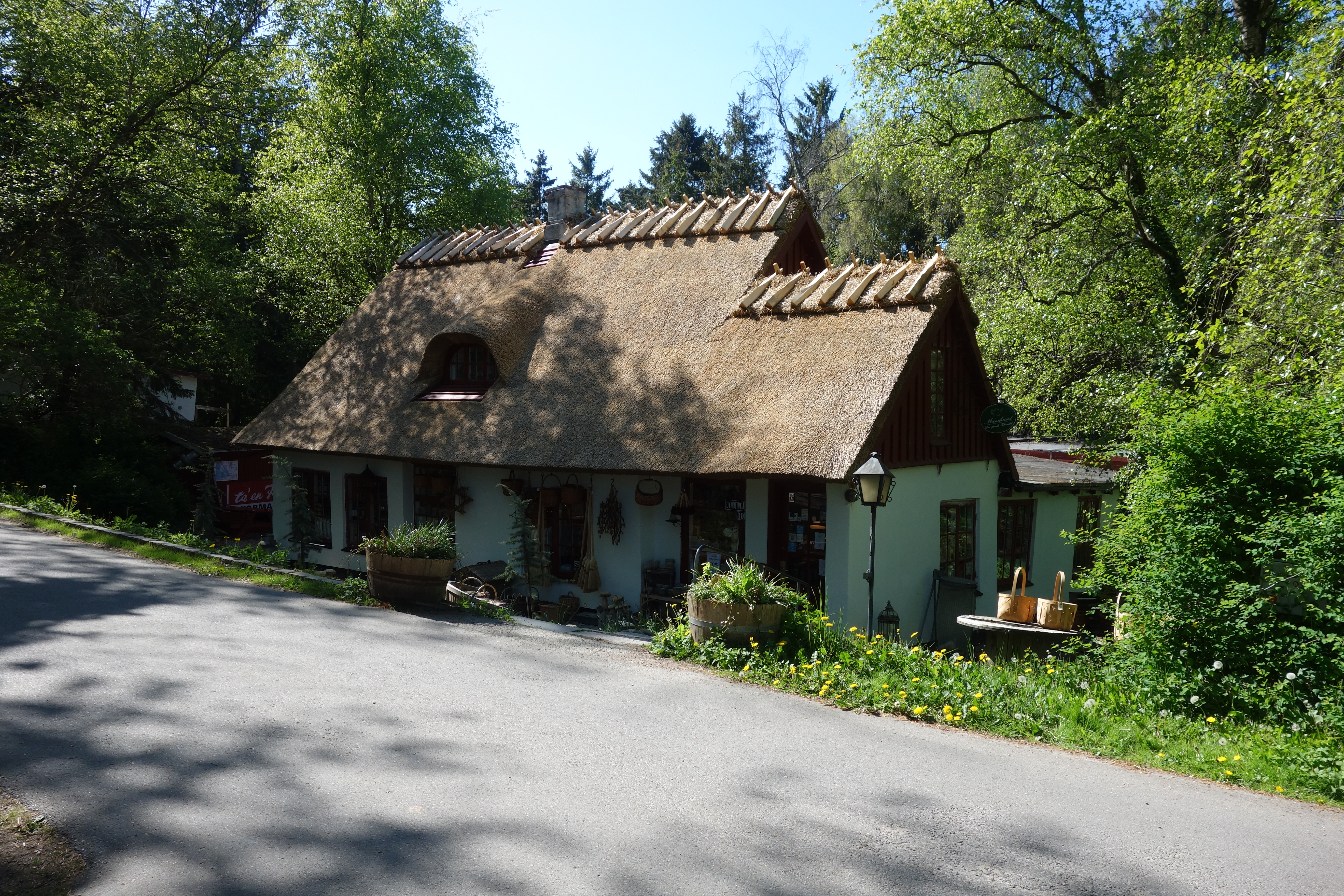
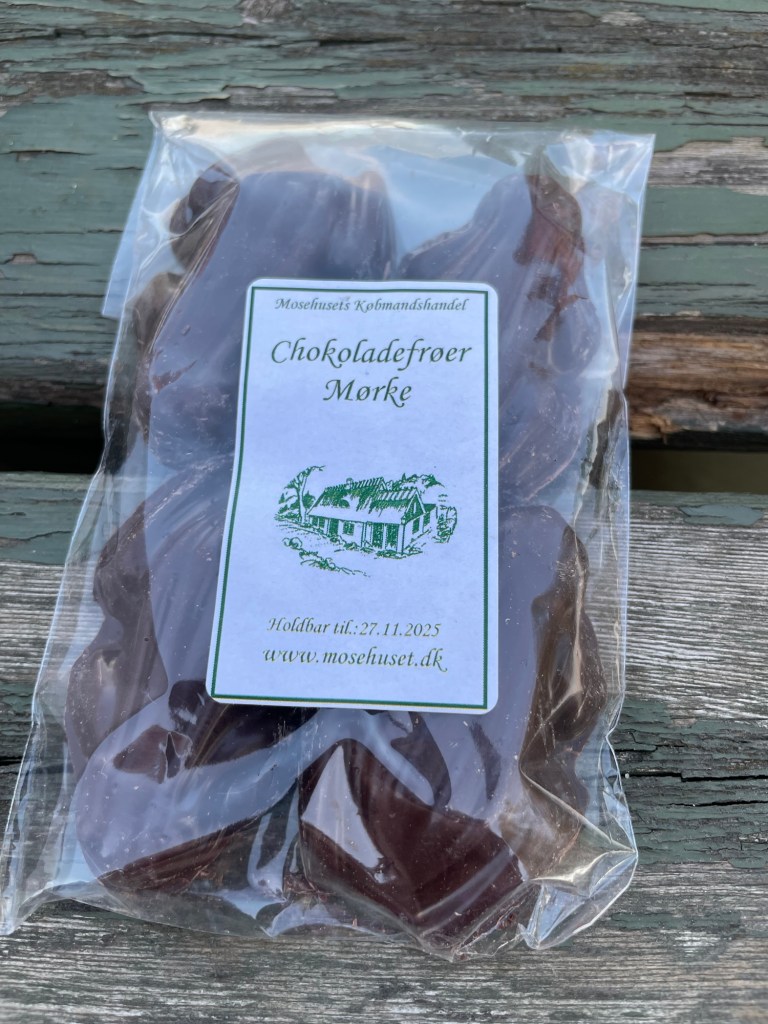
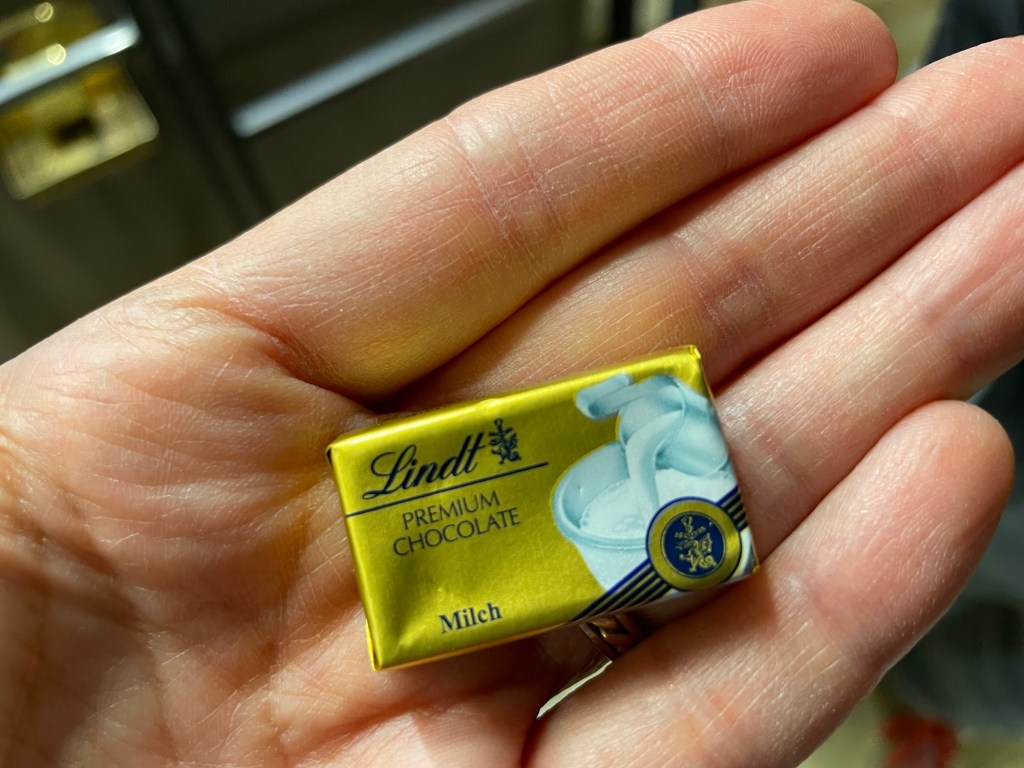
The manor house of Baroness Wedell-NeergaardRoad through the baroness’s forestOne of the storehouses held these large bales of straw, which are burned in the local heating plant. Many communities in Denmark use district heating instead of individual furnaces in each house.After our hike in the forest, we visited this tea shop called the Mosehuset (Marsh House). In addition to more than 350 blends of tea, they also sell chocolates (see below).
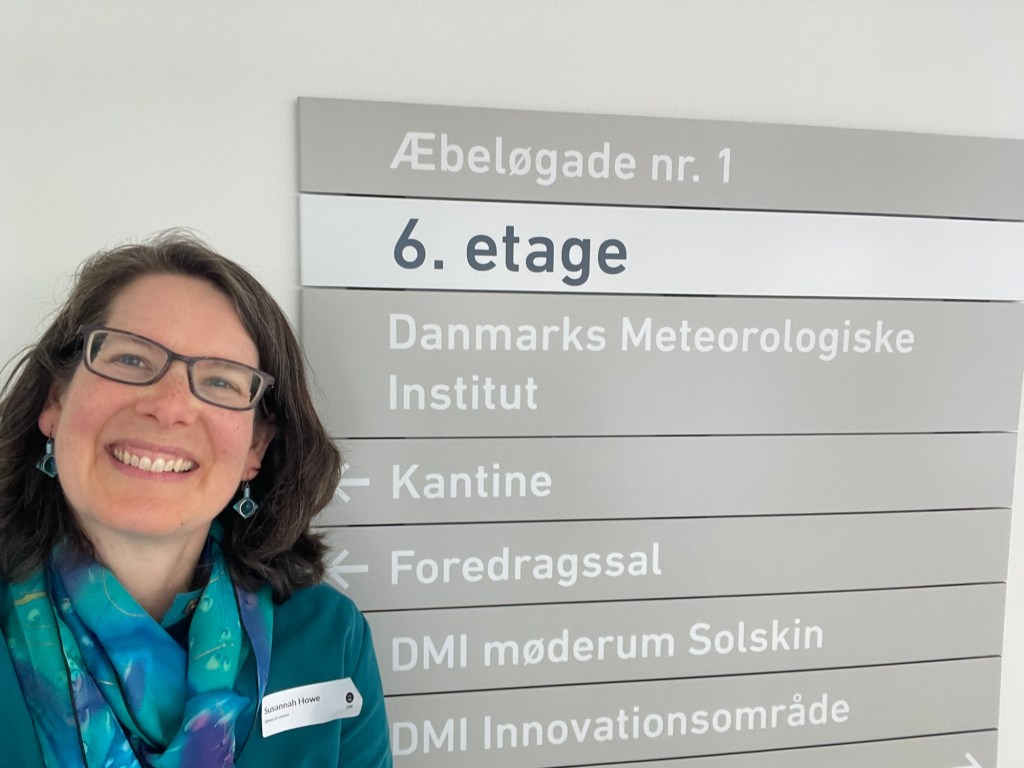
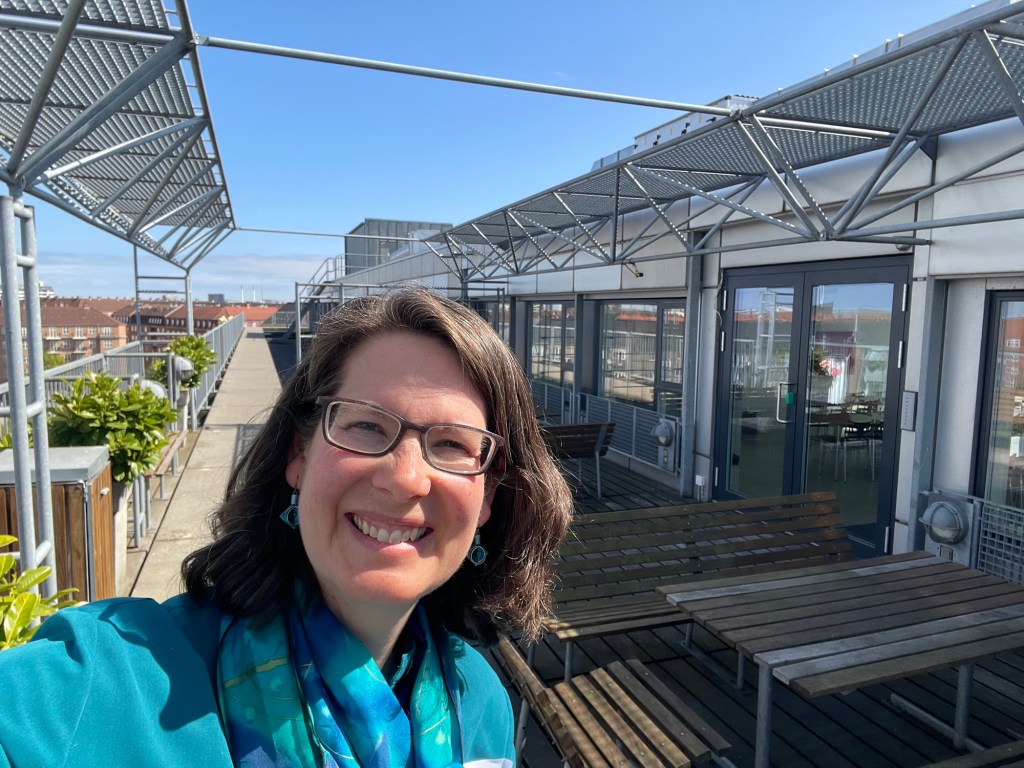
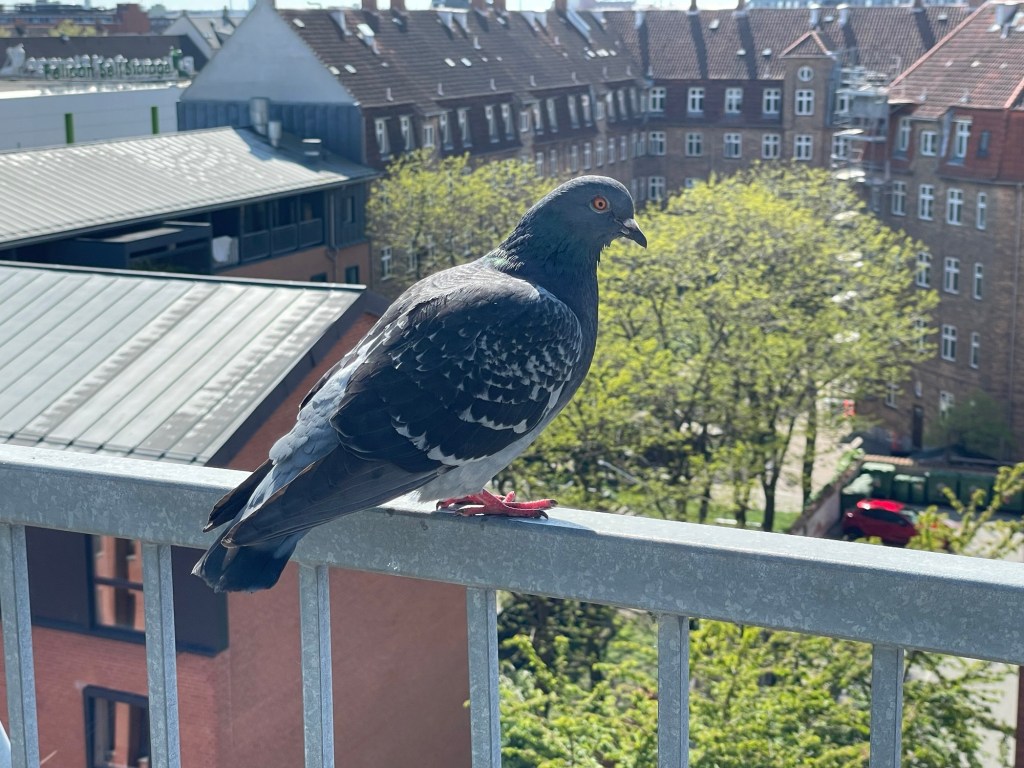
Meanwhile, Susannah spent the day at the DMI office, which is on the sixth floor of a large brick building in Copenhagen. They have an outdoor terrace wrapping around all sides of the building, offering great views of the city and sometimes inviting visits from birds. The employees often walk around the terrace for phone calls or meetings, and in nicer weather they eat outside.
Finding the DMIOutdoor terraceBird of the day: DMI pigeon
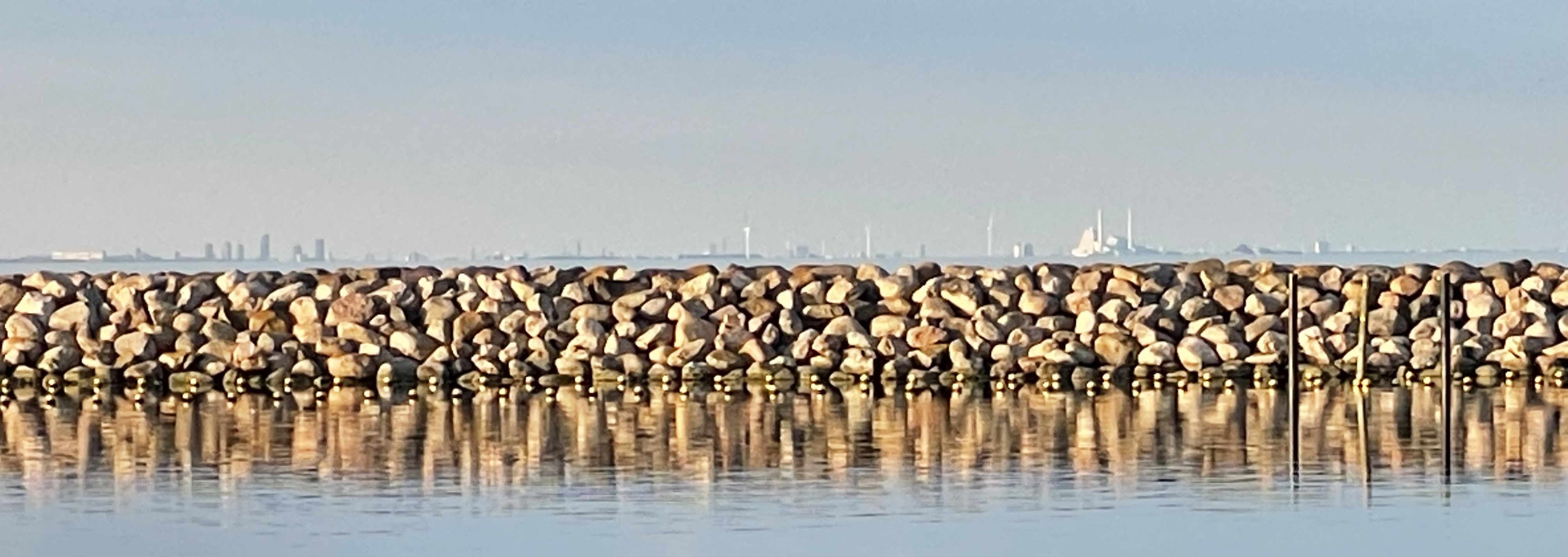
After reuniting for a delicious home-cooked dinner with Thomas, Christina, and their son Emil, we drove east to see the harbor city of Køge at sunset. You can see the Copenhagen skyline here from across the water, although it doesn’t show up very well in a photograph. We brought the chocolates from the Mosehuset with us to eat for dessert.
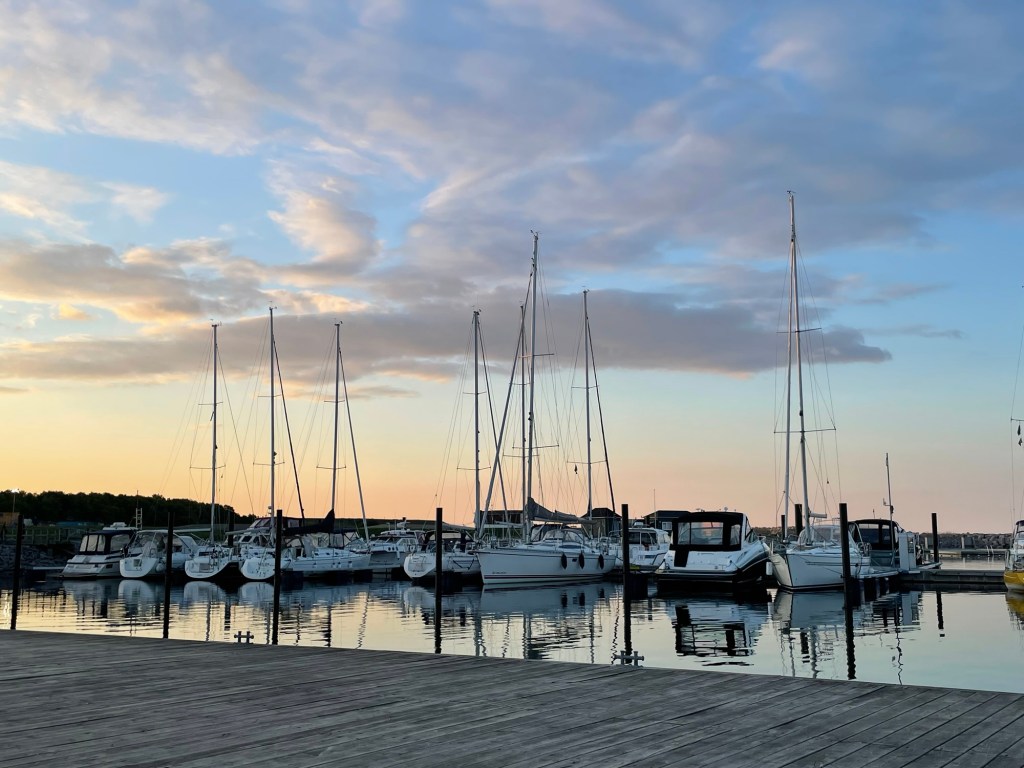
At the Køge harborBuildings of Copenhagen are visible just above the stone breakwaterFlødeboller are chocolate covered domes filled with soft marshmallow on a wafer or marzipan base. They are sometimes served on top of ice cream cones.Chocolate frogs are a real thing!The marina at KøgeSunset from the car on the ride home
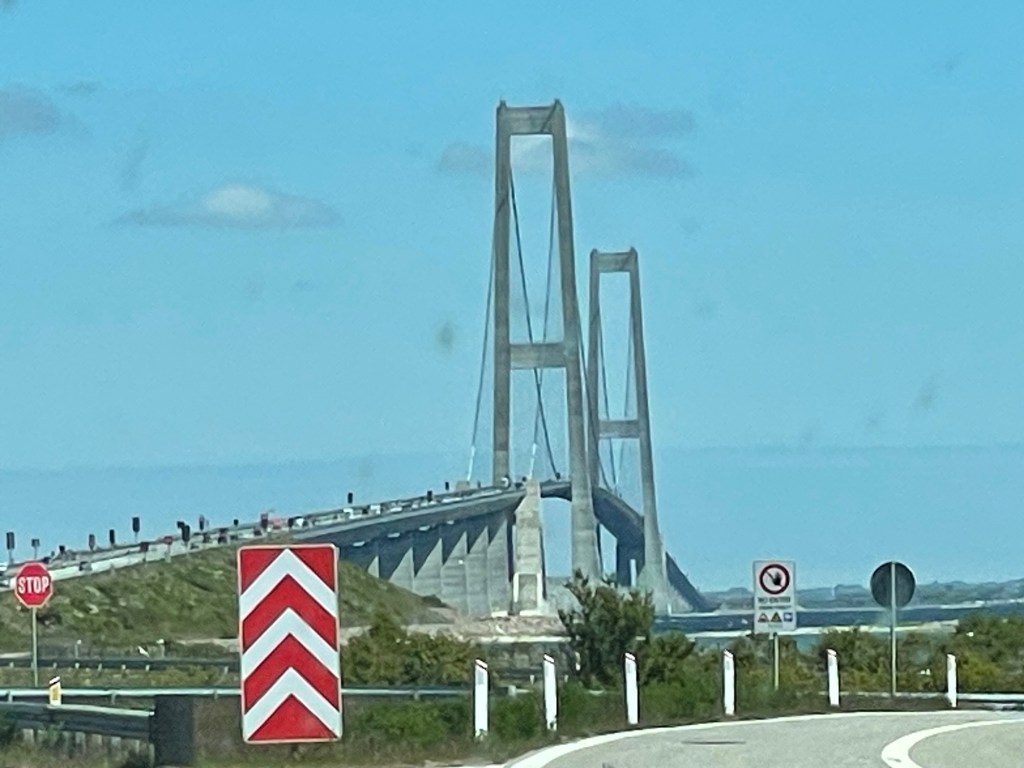
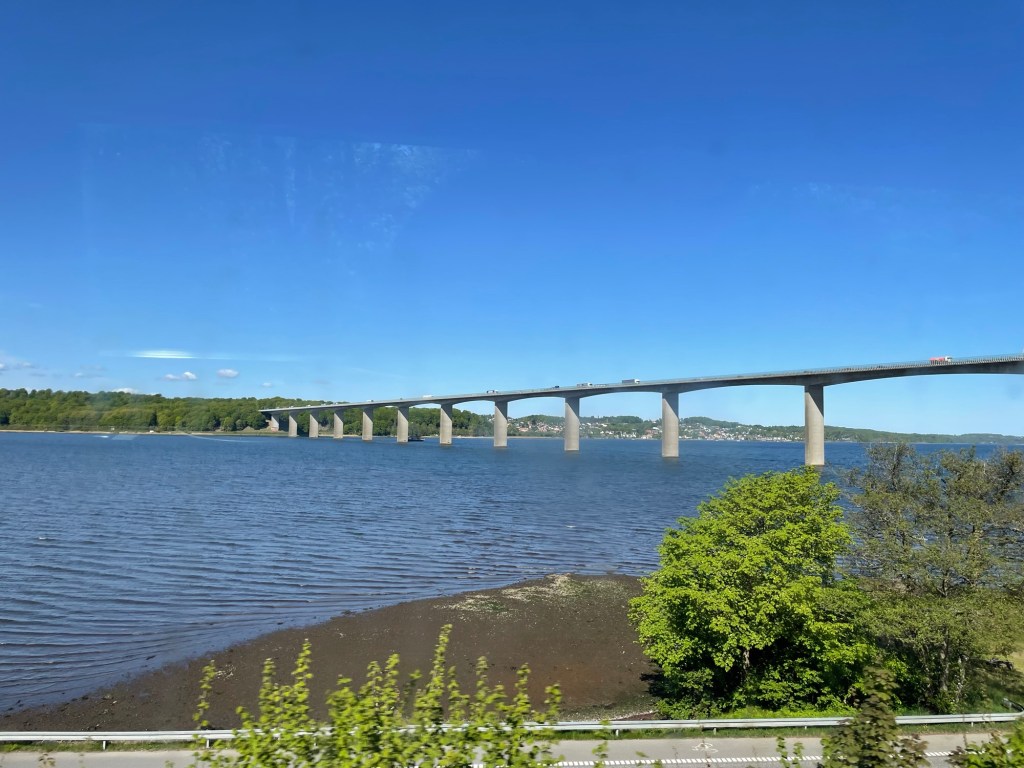
Today we said goodbye to our lovely sommerhus and hit the road with Christina and Thomas en route to their house west of Copenhagen. They live on Zealand, the largest of the Danish isles. Until less than 30 years ago this trip would not have been possible entirely by road: travel from Jutland to Zealand would have required a ferry trip. Today it is possible, thanks to the Storebæltsbroen — the impressive bridge spanning the Storebælt (Great Belt) strait between Zealand and the smaller island of Fyn / Funen (which in turn is connected to Jutland by bridge across the Lillebælt or Little Belt). The ferries that used to crisscross the strait no longer run.
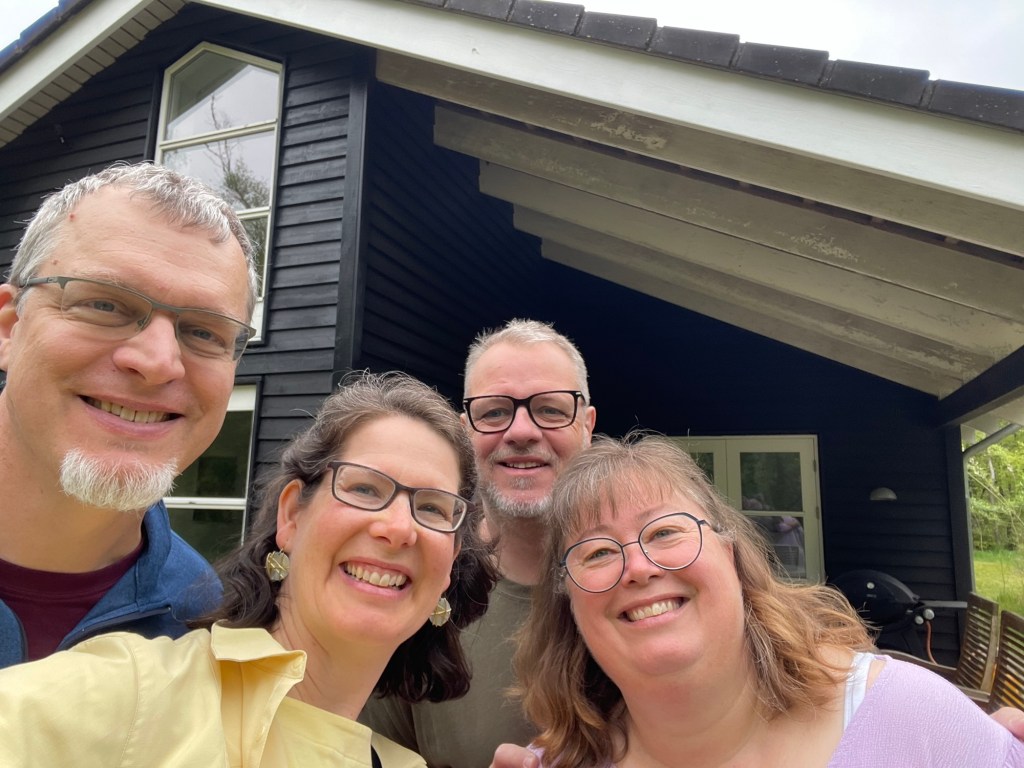
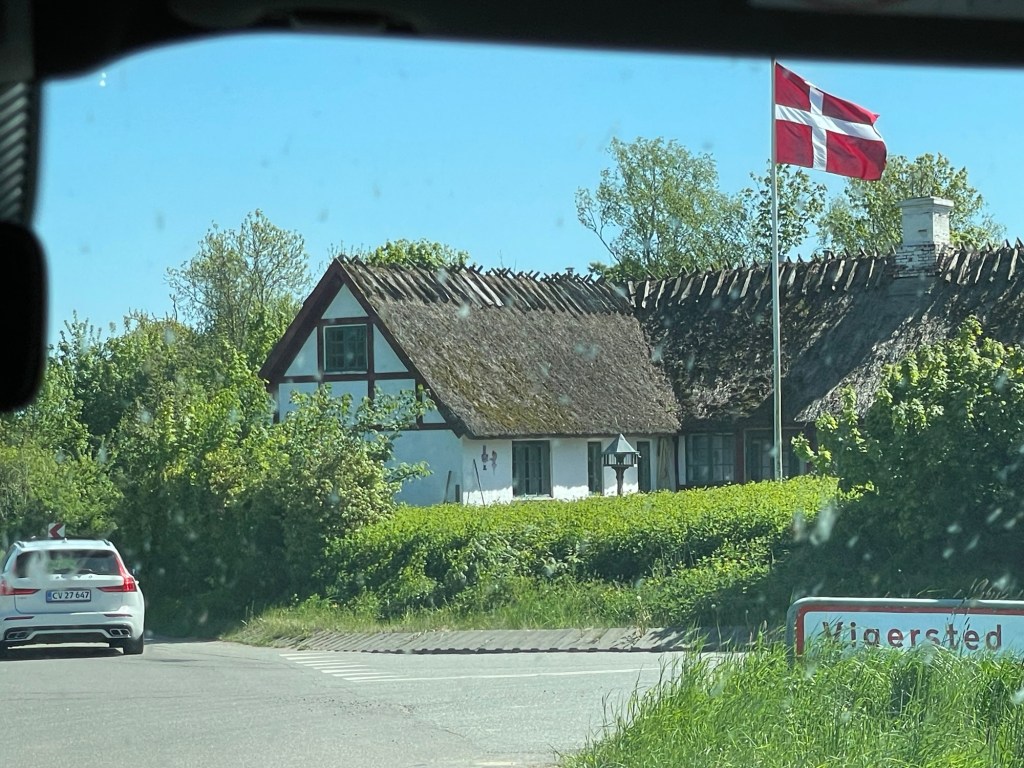
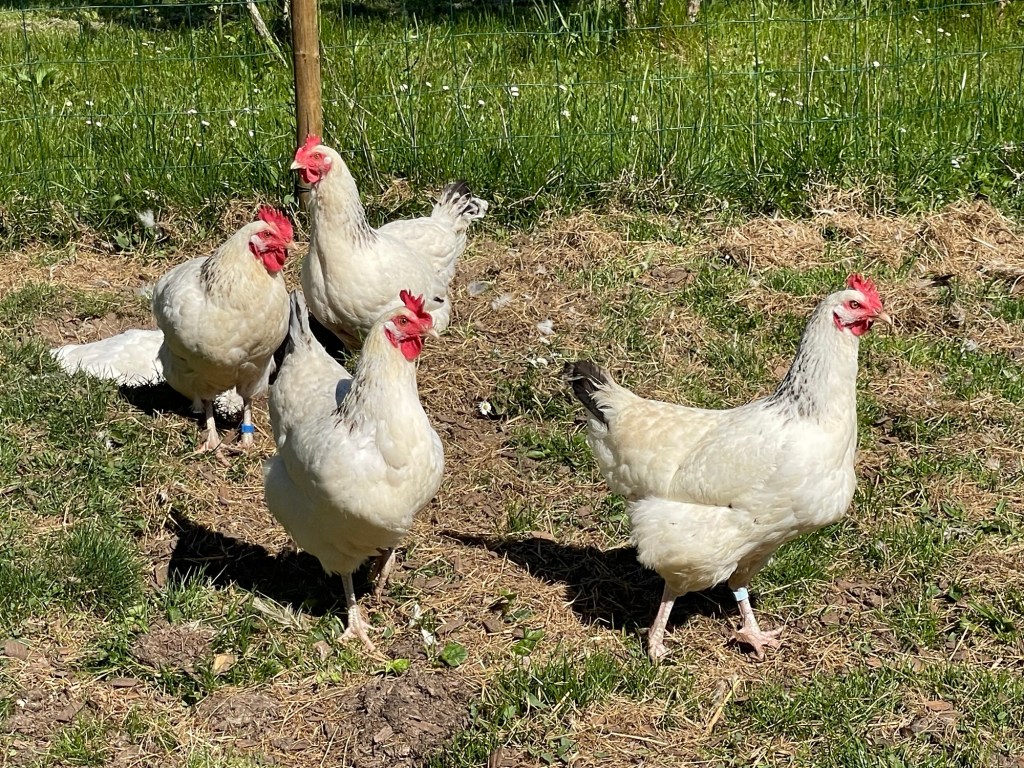
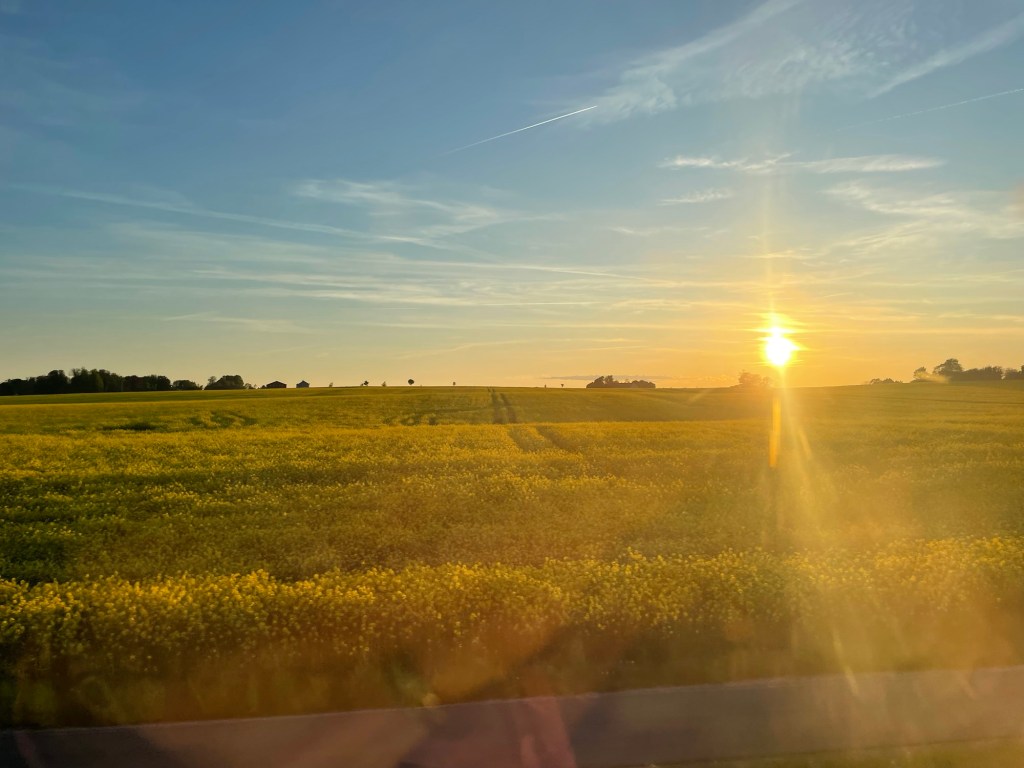
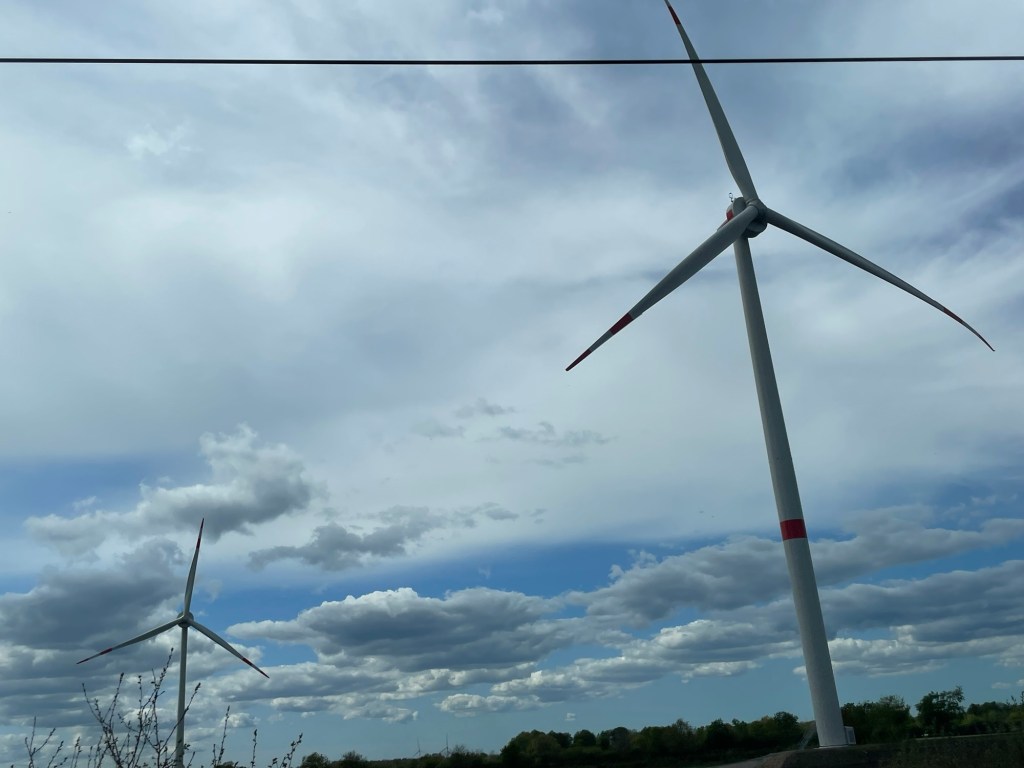
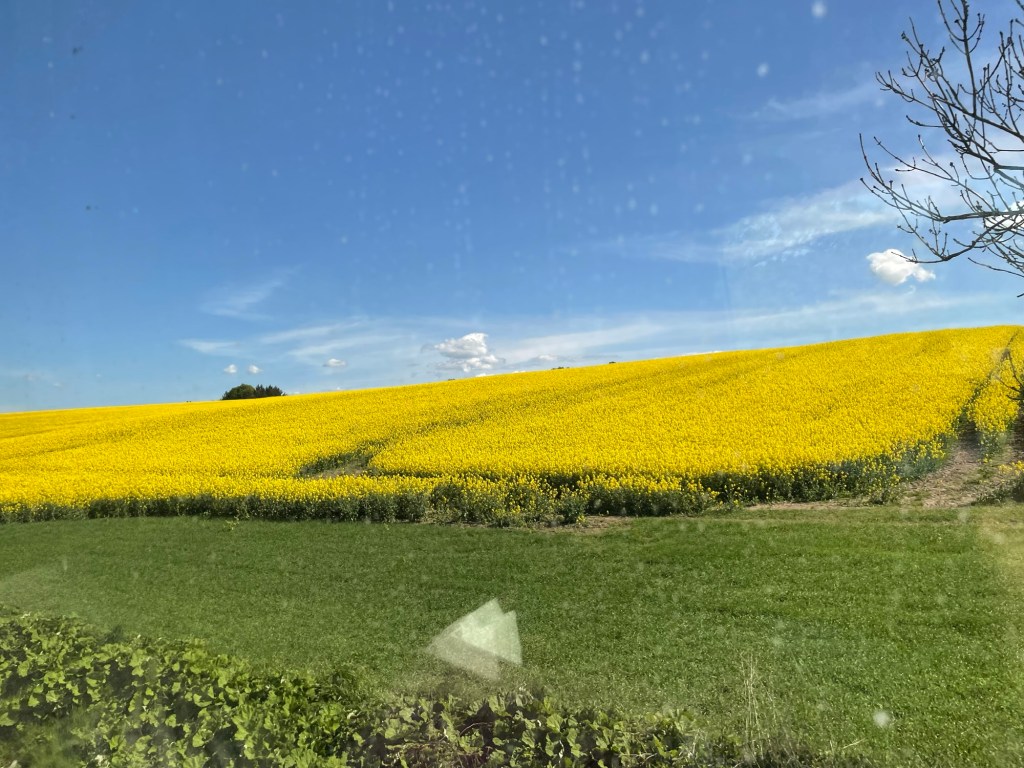
The sommerhus has a shaded patioFarewell summerhus!Common roadside view: golden fields of rapeseed in bloom and spinning wind turbinesRest stop lunch on the island of Fyn (Funen)Lighthouse on the small island of Sprogø, located in the middle of the Great Belt crossing. It has an inauspicious history, previously being used as a place of exile for women deemed problematic.Approaching the main span of the StorebæltsbroenA stereotypical Danish dwellingBirds of the day: Christina and Thomas keep chickens in their yard!
We arrived in Borup around mid-afternoon. Susannah had arranged to meet her former student Sanita for an early evening chat. We took the train in to Valby, a district of Copenhagen, where she met us at the station. We had a delightful time catching up at an outdoor cafe, then explored our surroundings a little bit on foot before catching another train home as the sun was setting.
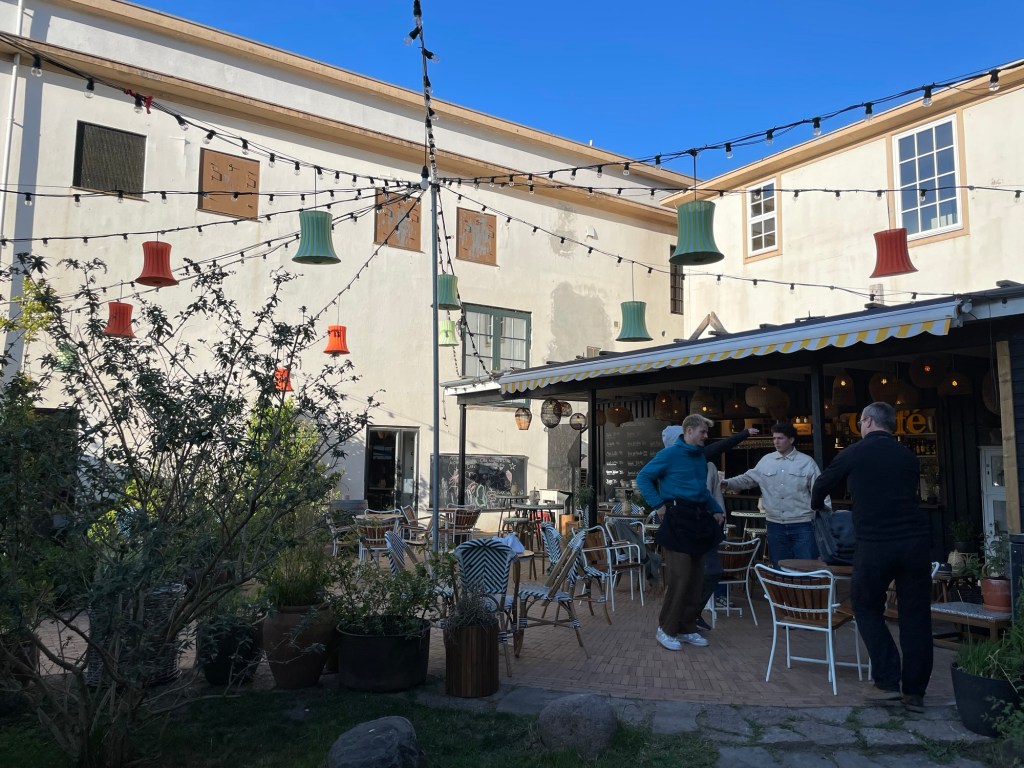
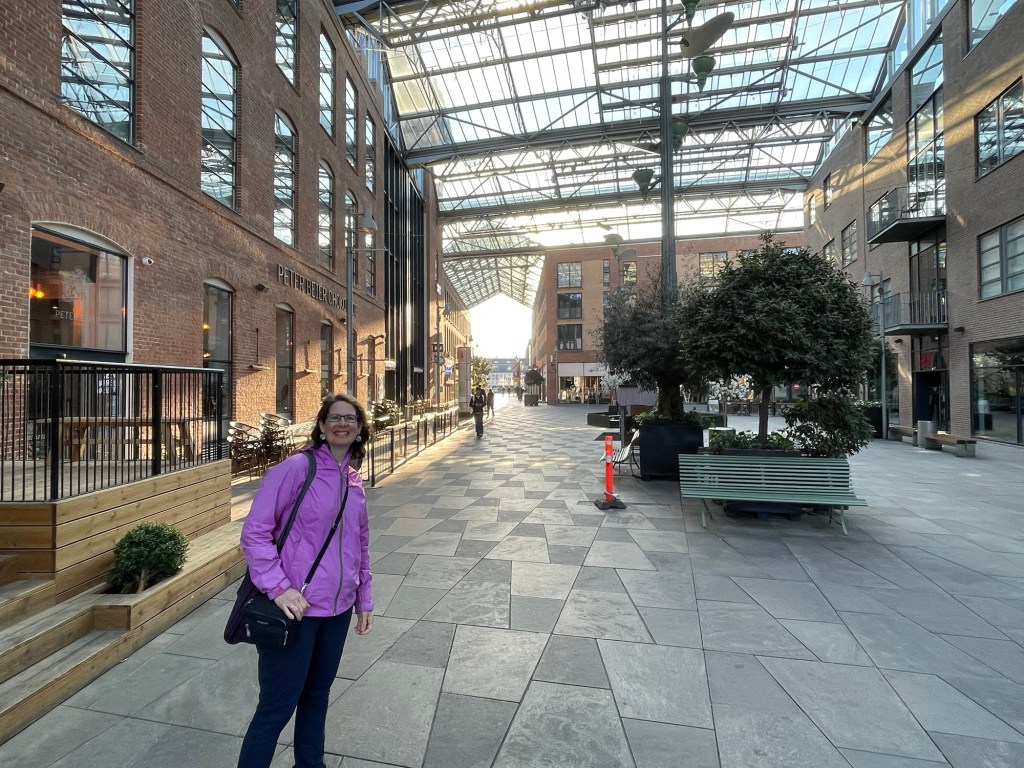
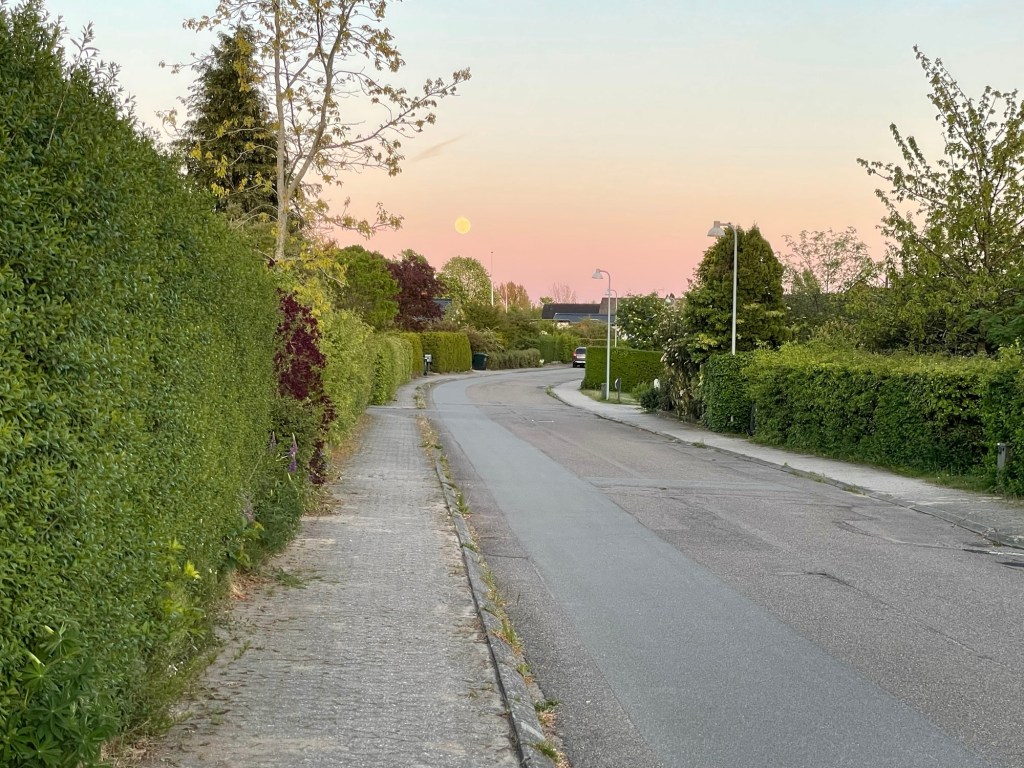
Havekaféen outdoor cafeDuring our wanderings in Valby we came across this protected outdoor mallShadows are getting longSun setting on fields of goldAs we walked home from the station, the full moon had risen over Borup
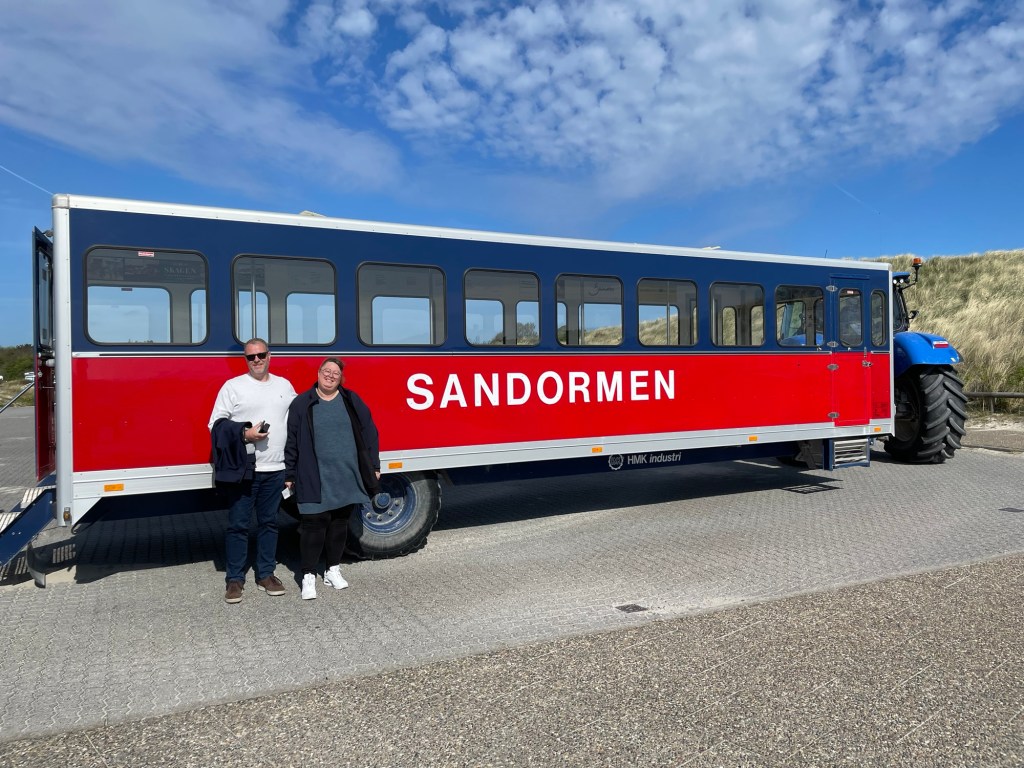
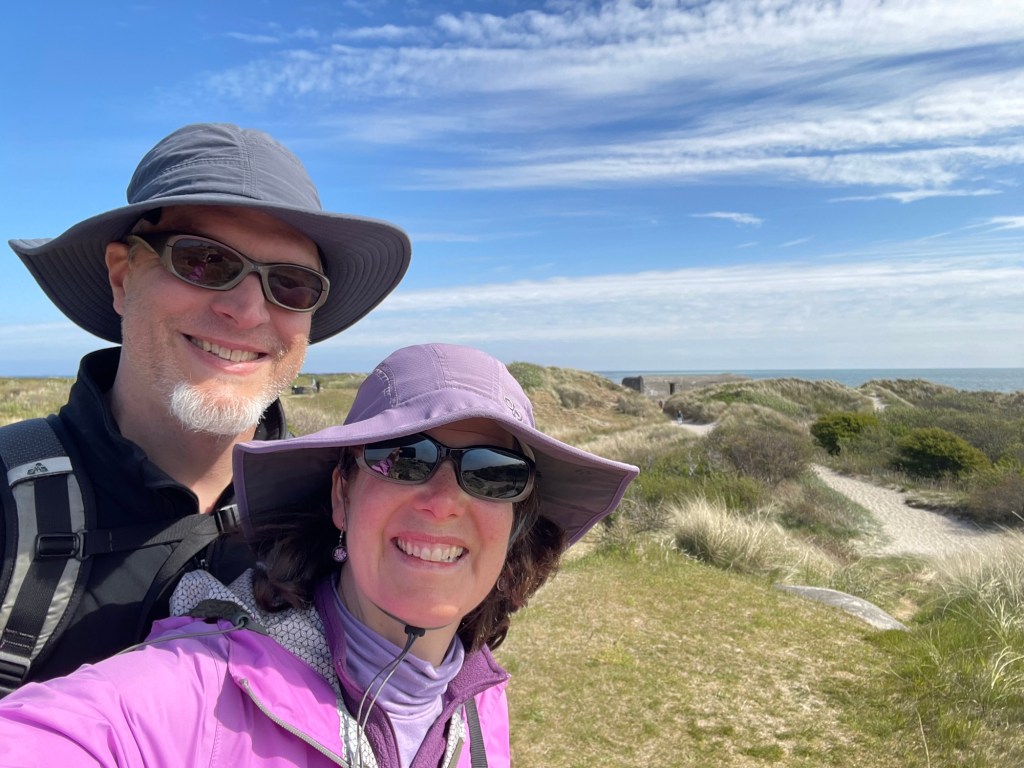
Today we journeyed north to the very tip of Jutland, where the waters of the Skagerrak on the west and those of the Kattegat to the east meet and mingle. The peninsula ends in a long sandy spit, and at the tip you can actually see the waves coming from each side and crossing each other. The tradition is to stand in the waters at the point with a foot on each side.
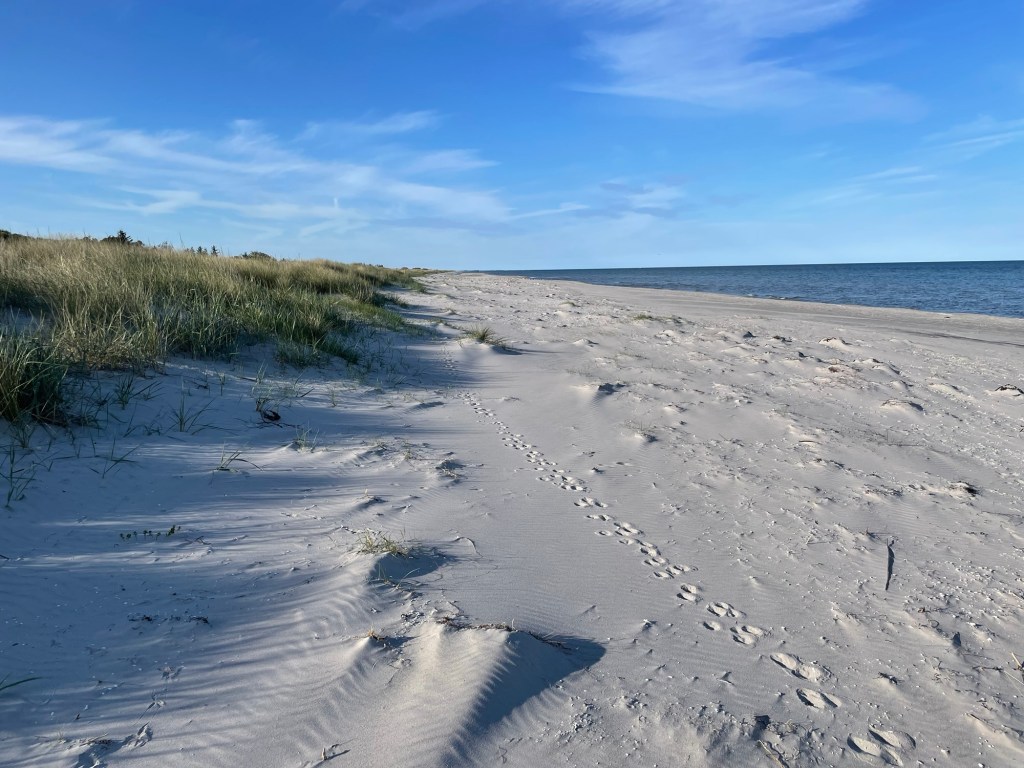
The “Sand Worm” takes visitors most of the way to the point.The water temperature is bracingFeet in the waterTourists congregating at the tipWe chose to take the long walk along the beach back to the parking lot. In the distance, notice all of the ships lined up waiting to get into the harbor.Beyond the beach there are grassy dunes, dotted with concrete bunkers left behind by the German occupationThis lighthouse warns ships away from the 4km offshore reef. In the distance you can see a cruise ship that was responsible for a lot of the tourists in the area.
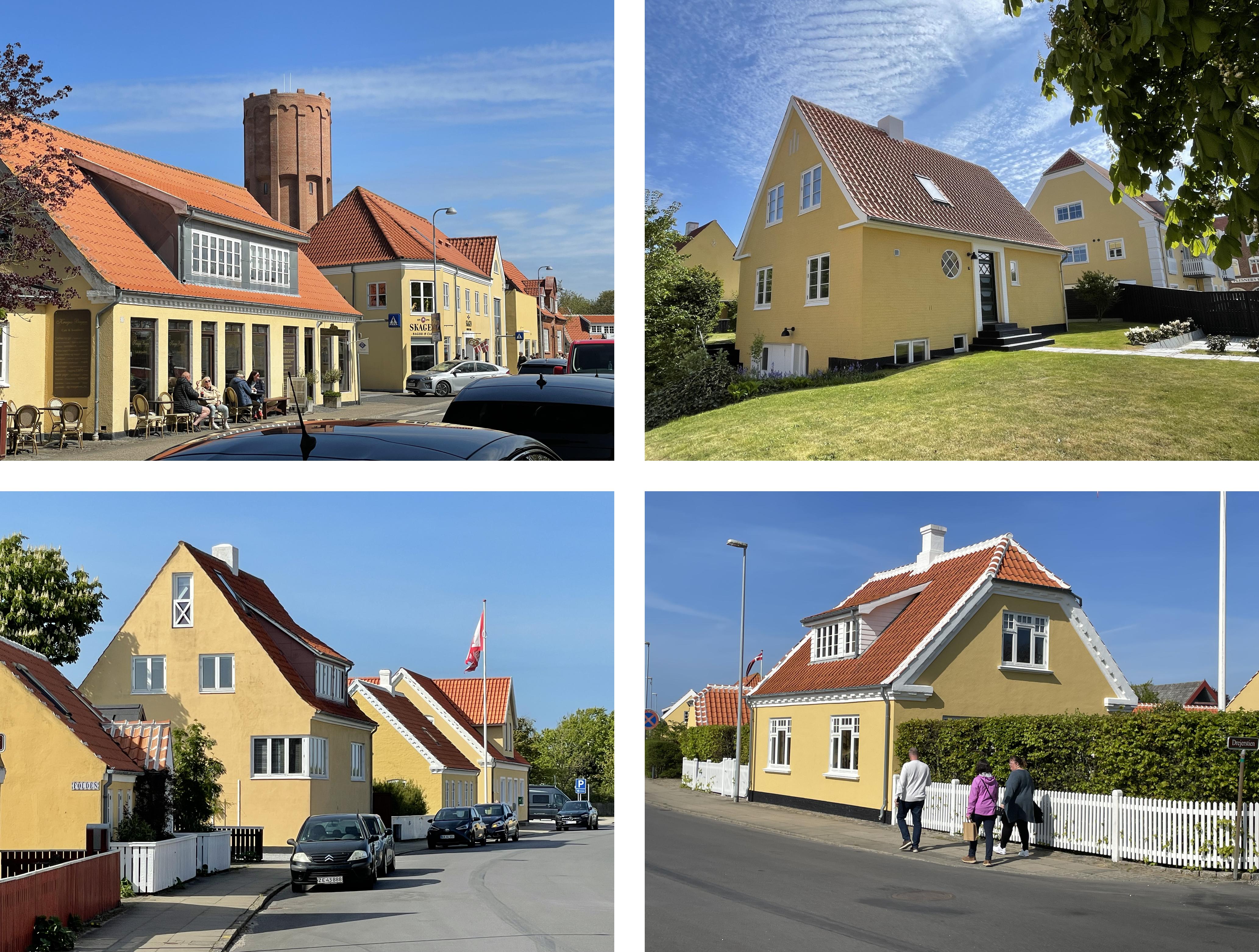
Following our walk on the beach, we headed for the nearby town of Skagen, marked by cozy yellow cottages with small gardens. A little more than a century ago the area became known as an artist colony when a small group of artists settled here. They were all friends and compatriots, included both men and women in their number, and painted many pictures of each other, the local life and scenery, plus their various pastimes. The Skagen Museum displays a large collection of their works, and the home of one artist couple has been preserved and includes many more paintings. By the end of our visit, we felt a certain familiarity with the artists and their families — seeing so many of their paintings was like viewing a family photo album, and we could pick out the distinctive features and mannerisms of many individuals.
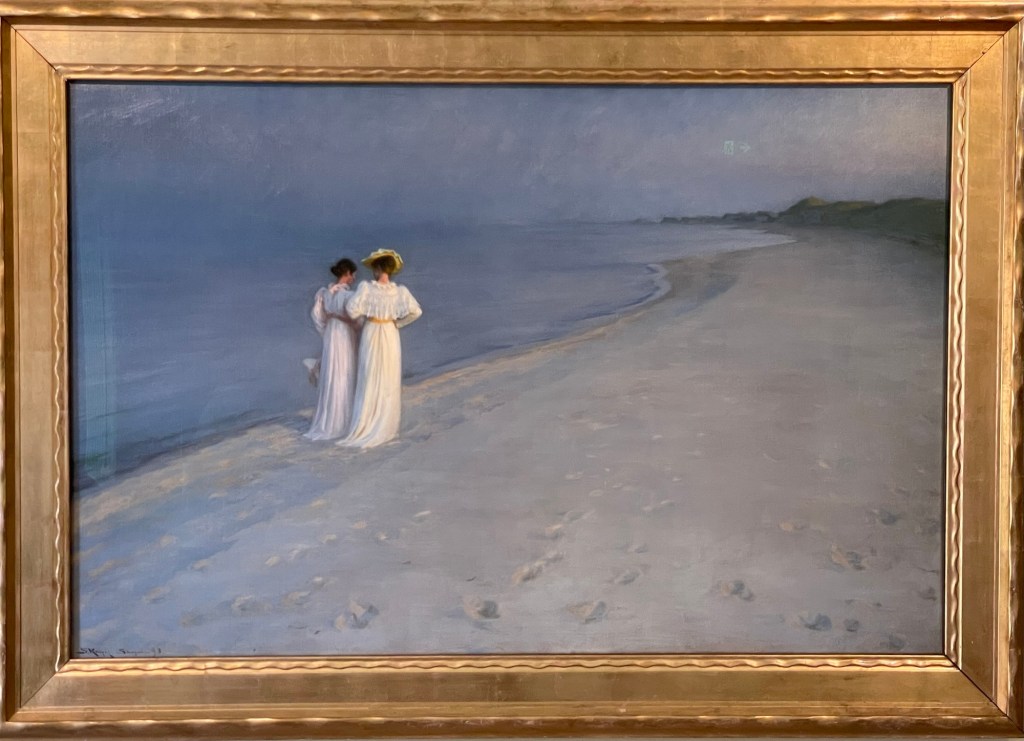
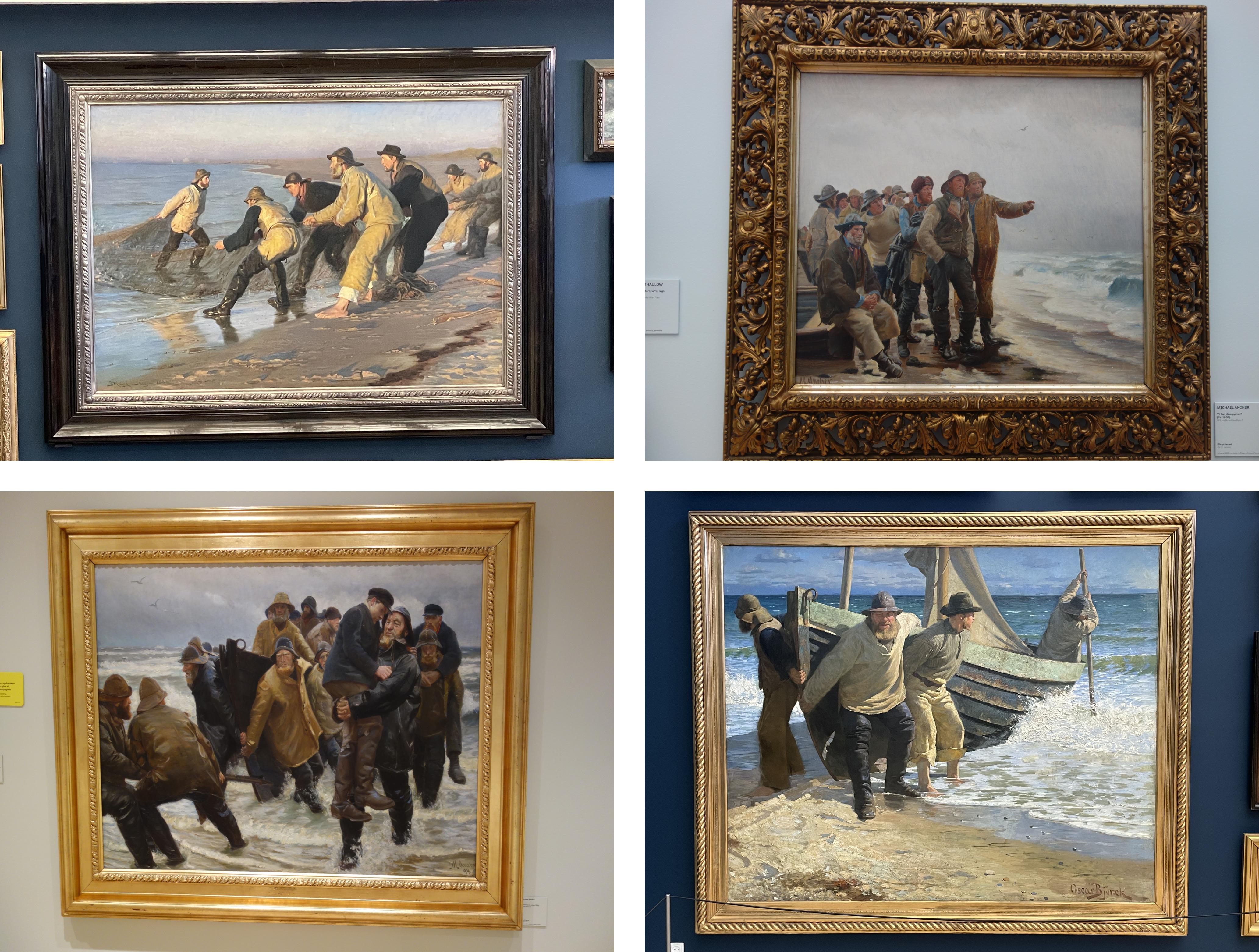
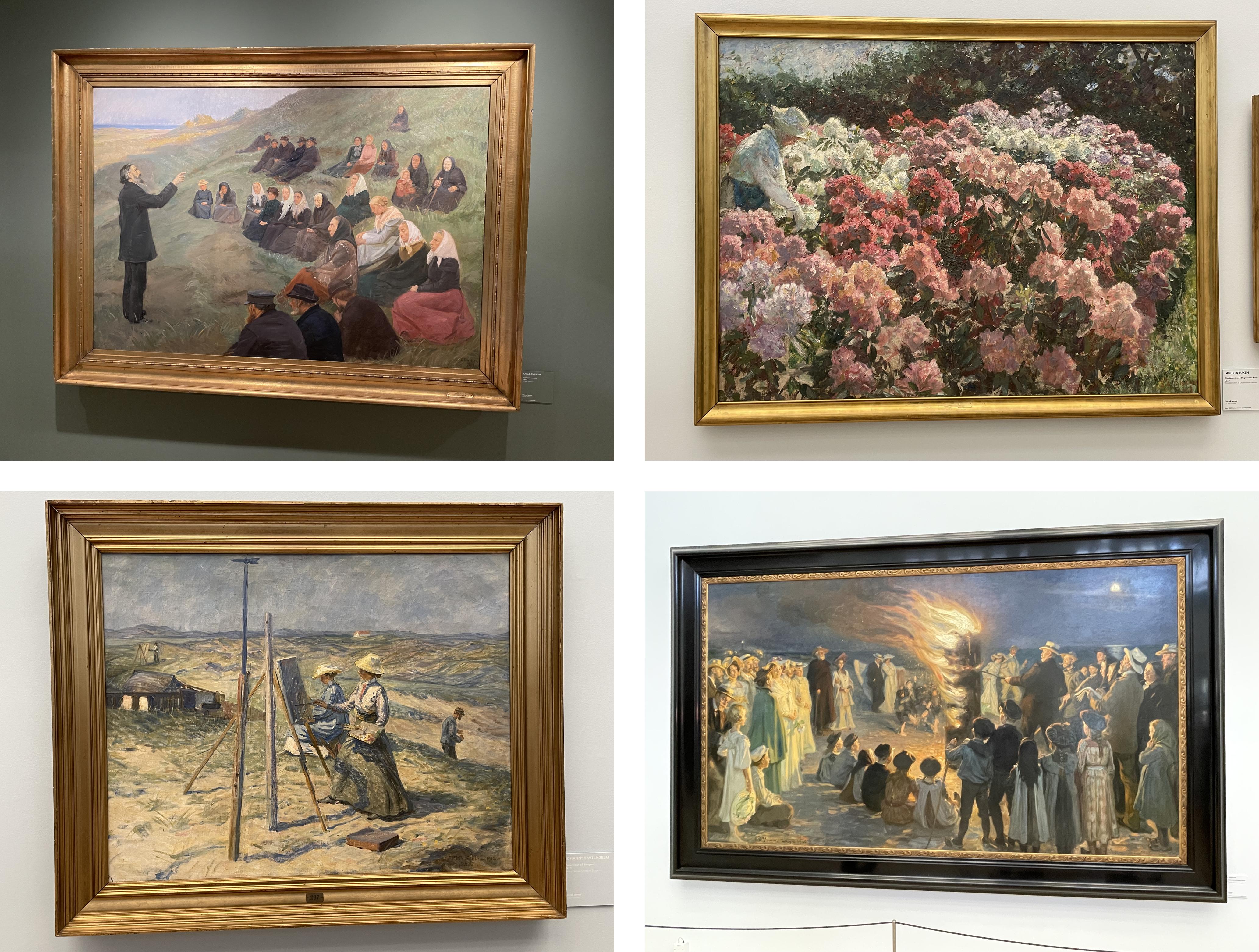
The houses are yellow due to an inexpensive ochre pigment mixed into the limewashP.S. Krøyer’s painting of Anna Ancher and Marie Krøyer walking on the beach – perhaps the most famous work from the Skagen paintersFishermen were a popular subjectOther scenes are drawn from local life and scenery
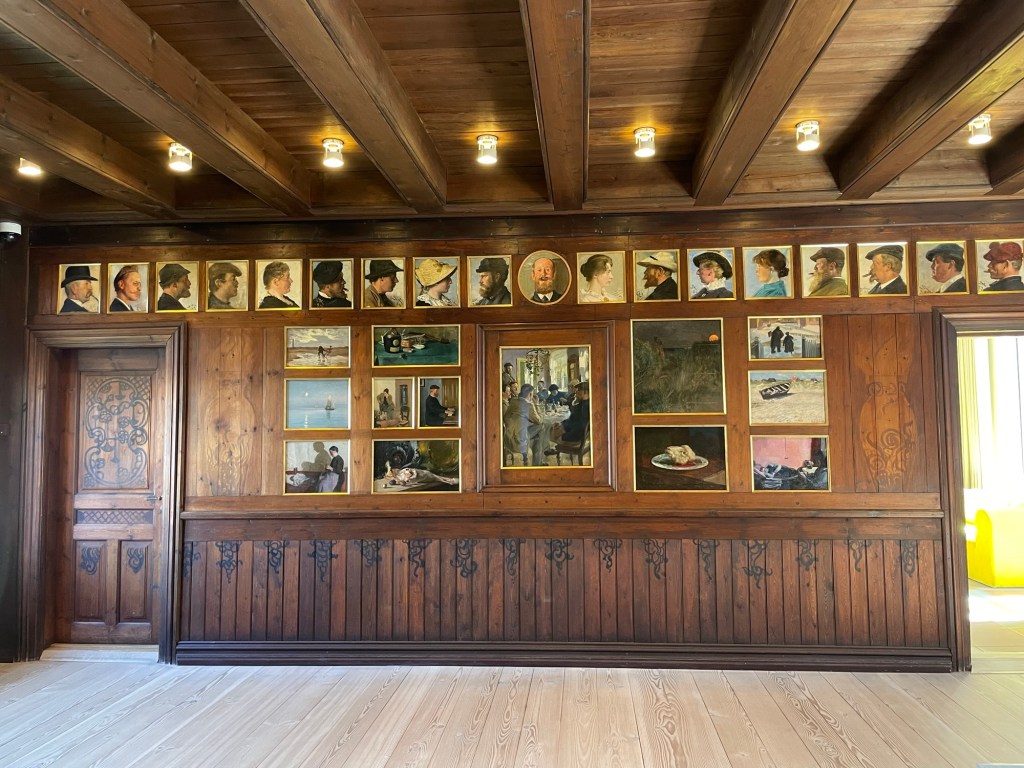
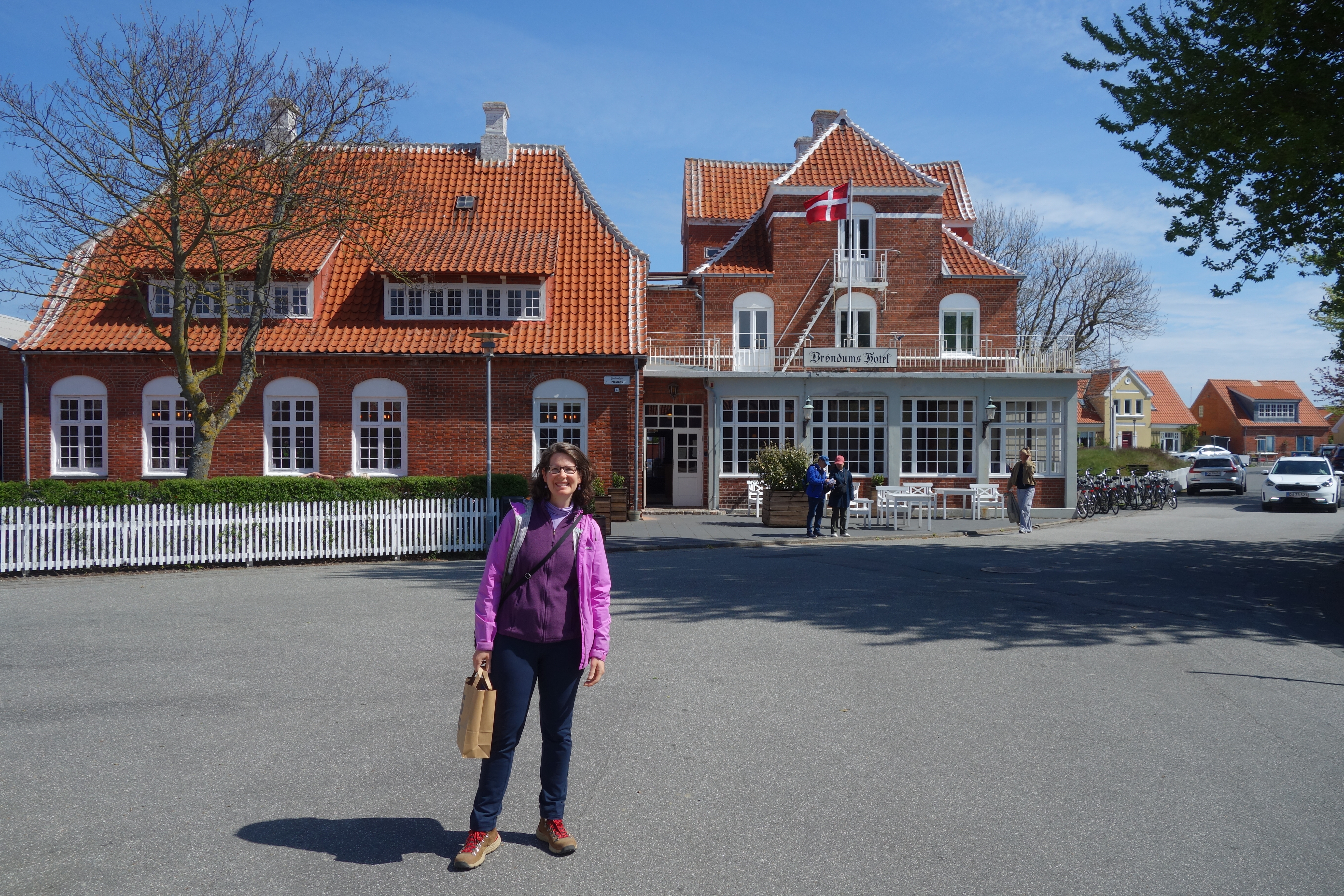
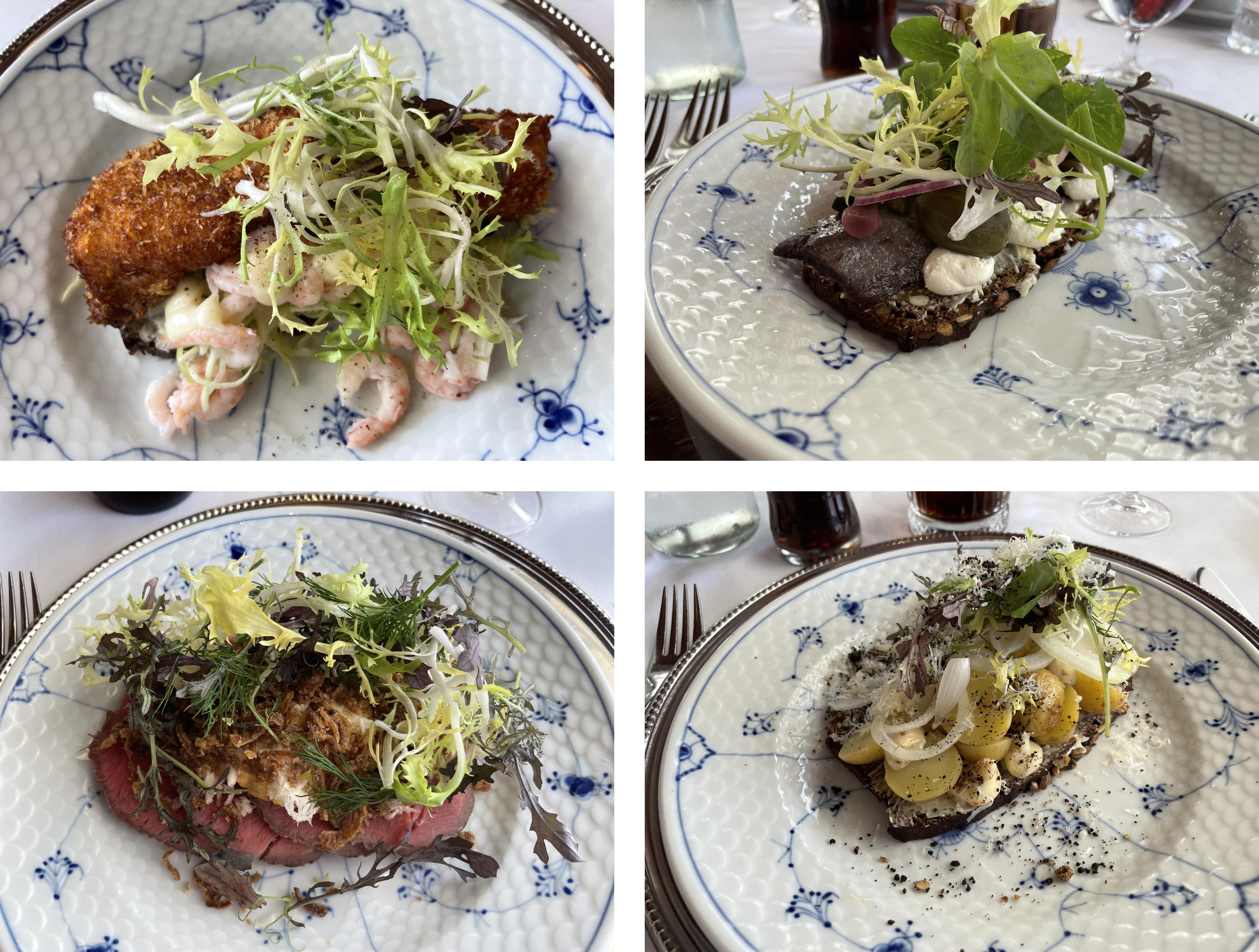
Many meetings of the Skagen painters took place in the dining room of Brøndums Hotel. To mark it as their own, the artists decorated the room with paintings and portraits inlaid within the wood paneling. In later years the original decor was preserved and transferred to the Skagen Museum so that visitors can see the room as it existed then. Meanwhile the Brøndums Hotel still stands, and it is possible to order lunch as we did in its now modernized dining room. One specialty of the house is a Danish treat: smørrebrød.
One wall of the dining room from Brøndums Hotel, as preserved at the museumBrøndums Hotel as it looks todaySmørrebrød, essentially an open-faced sandwich with fancy toppings
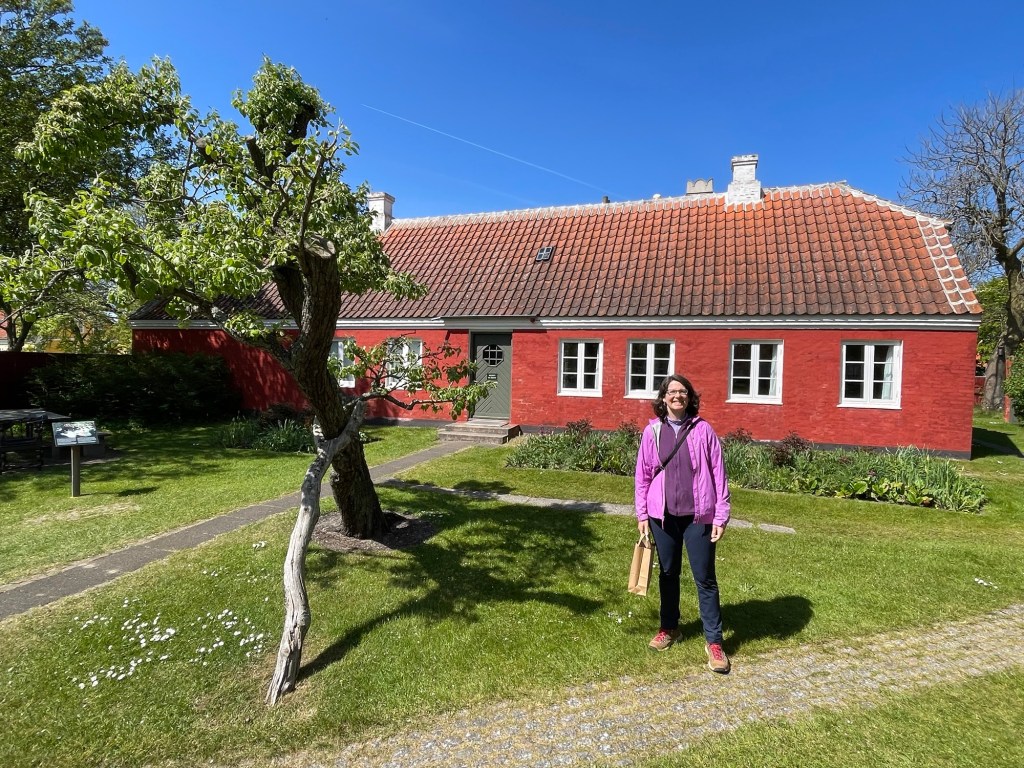
Anna and Michael Ancher and their daughter Helga all painted. When her parents died, Helga closed up their house and eventually it was donated to the museum. Visitors can see the house as they left it, including their individual studios in the rear. Everyone is asked to wear fabric overshoes in order to protect the floors from damage.
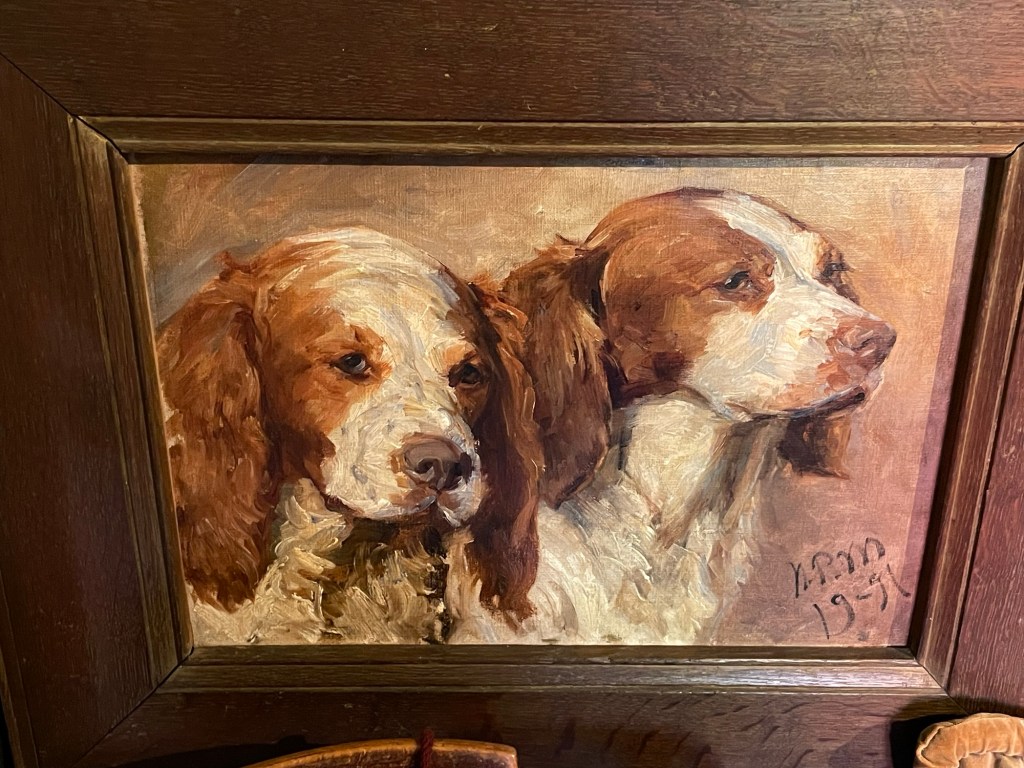
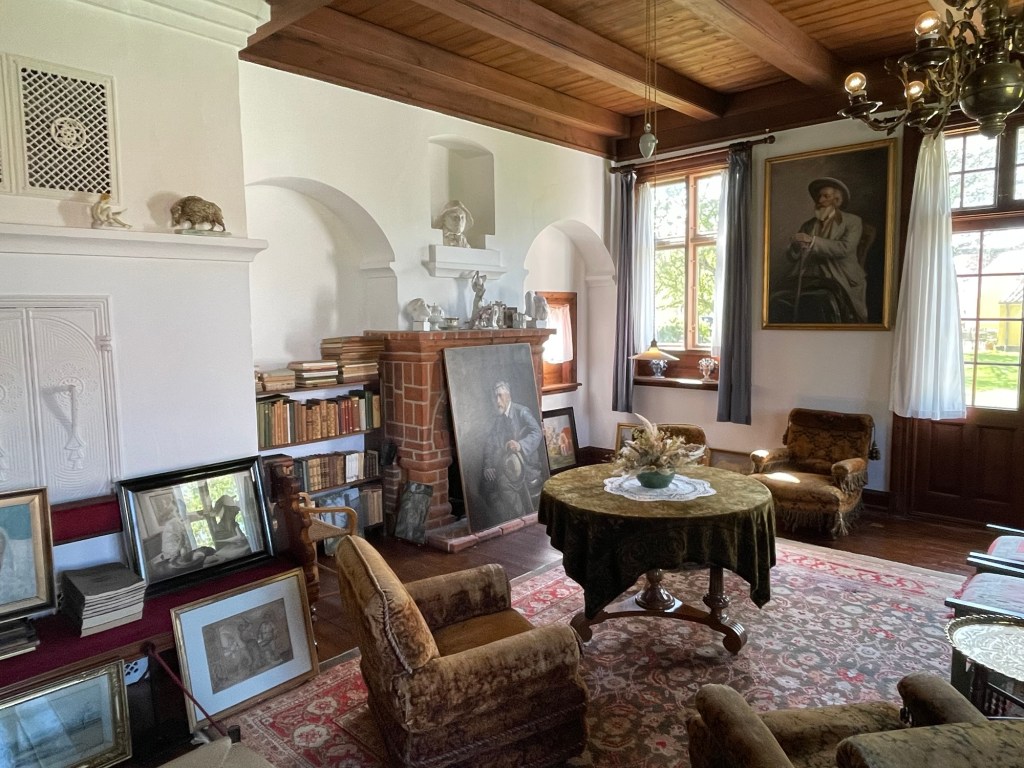
In front of the Ancher’s houseBooties!Family portraits in the parlorFamily dogsMichael’s studio is larger than Anna’s, but not as well lit
After getting to know the artists of Skagen, we turned our attention to features in the surrounding countryside. One curious structure that caught our eye had appeared to be a sort of trebuchet. On closer inspection it turned out to be a primitive form of lighthouse. On the end of the long arm is a metal basket, in which a fire can be built. The arm with its burning basket is then raised into the air so that it is visible to ships at sea.
The early lighthouseToday’s ships rely on more advanced means of navigation
The sea and sand are always part of the conversation here. Yesterday we saw a village that had been abandoned due to sand infiltration. Today, we saw a whole church that was swallowed by sand. All that remains visible today is the upper part of the tower, since the rest of the structure was pulled down when it was abandoned. The tower was left standing and painted white to serve as a navigational aid for sailors.
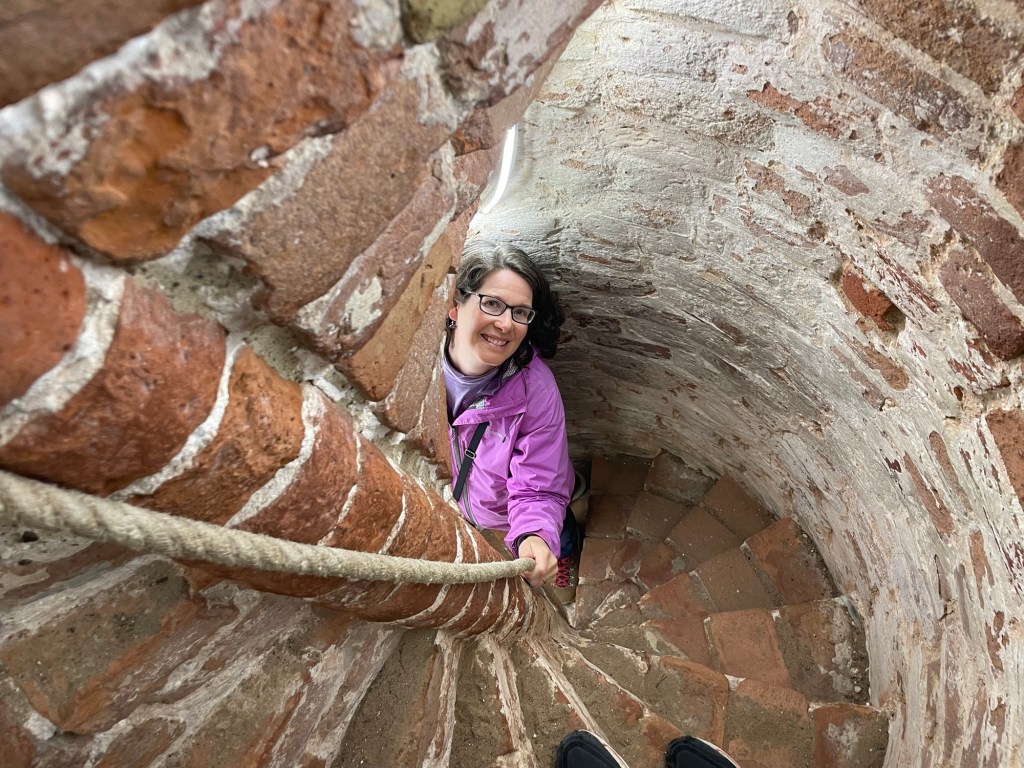
The sand-buried churchAccess to the tower was via a very steep and narrow spiral staircaseThe roof truss was a work of art in itself
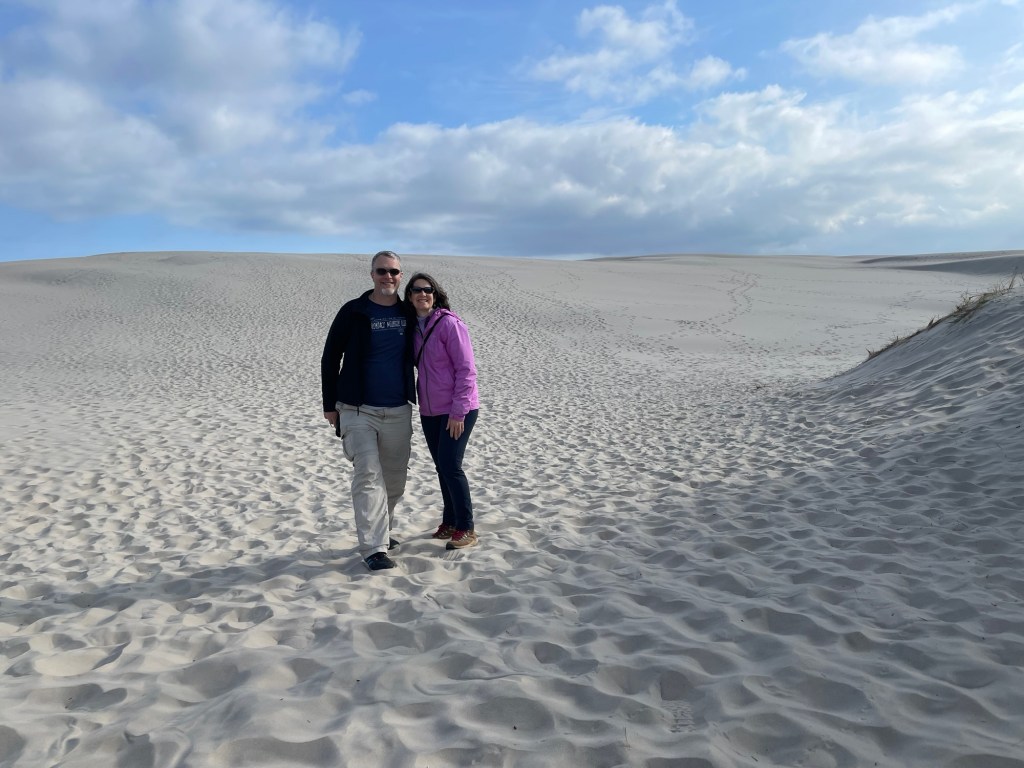
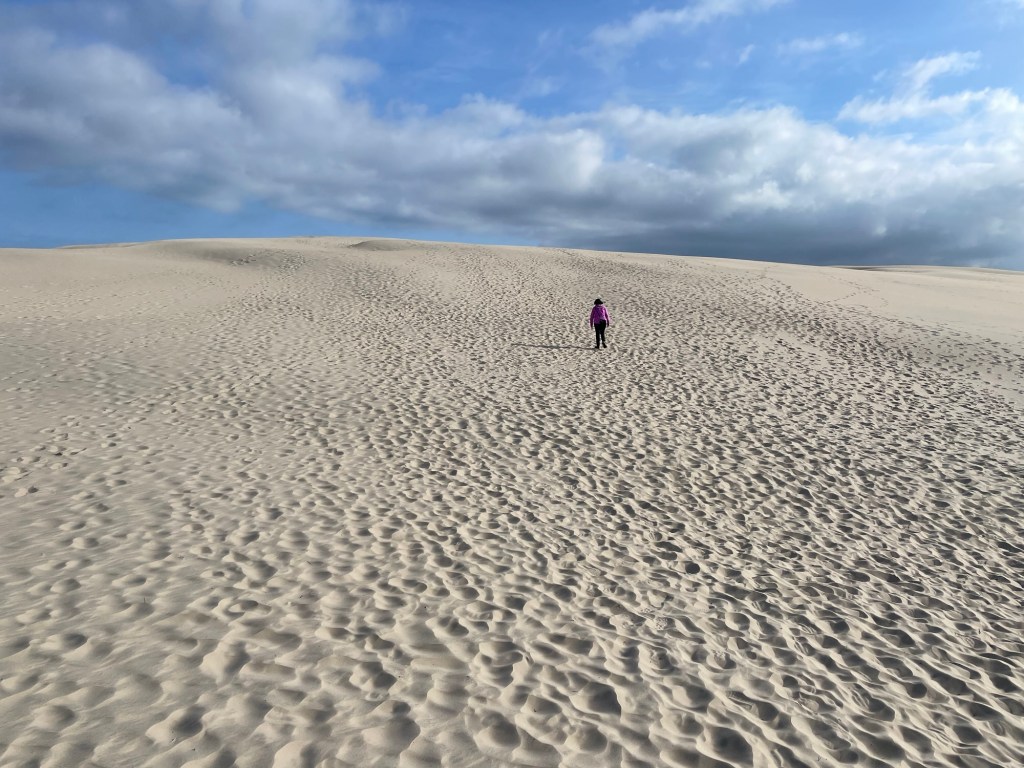
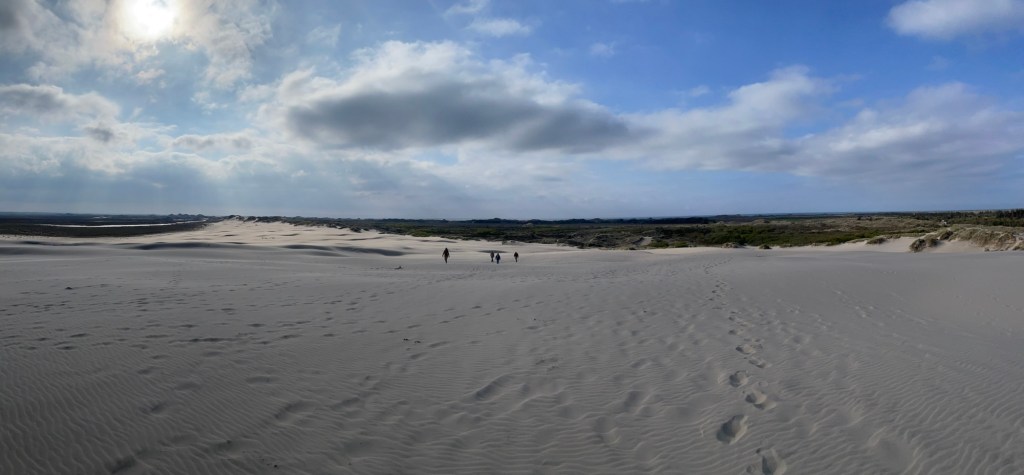
Following the church, we paid a visit to a moving sand dune that is swallowing up new ground even today. Called Råbjerg Mile, the two-square-kilometer dune moves eastward by about 15 meters per year. Though surrounded by green forests and waterways, the dune itself feels like a sort of pocket desert wasteland. Although we could see the footsteps of other visitors who had come before us, the wind was already erasing their traces.
At the base of the duneThe highest point of the dune is 40m above the surrounding terrainLooking back from the top of the riseWind-sculpted ripplesWe stopped for groceries in Hals harbor, on the north side of the Limfjord, on the way back to the summer cottage
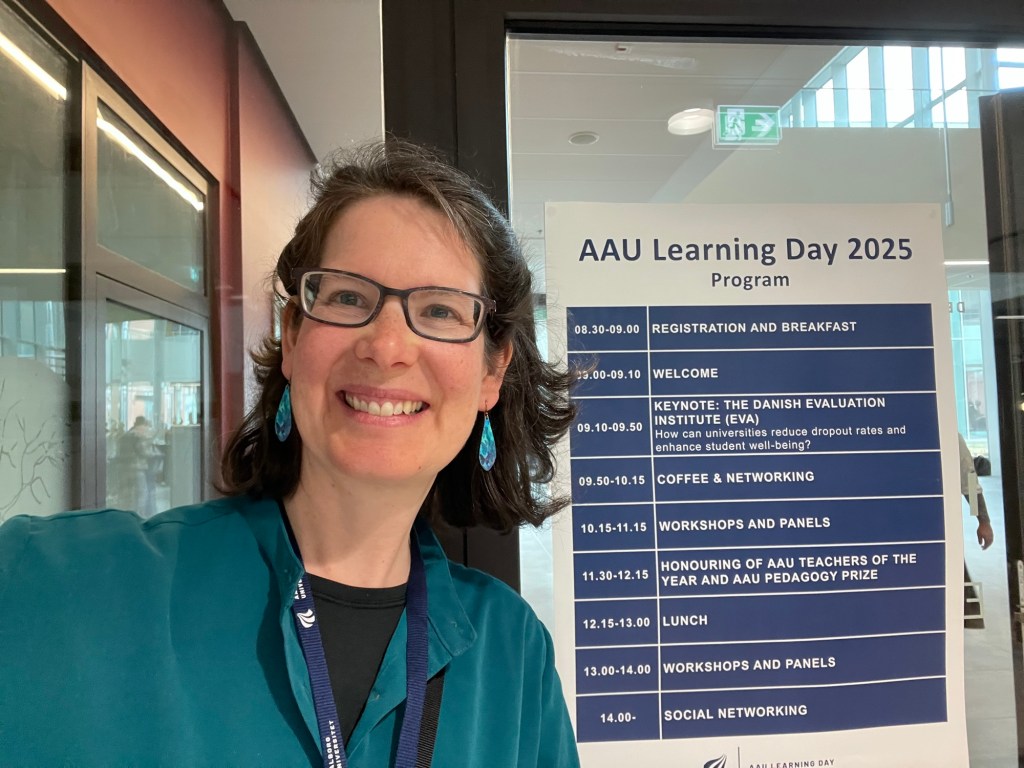
This morning most of us relaxed at the sommerhus while Susannah attended a workshop on problem-based learning held at nearby Aalborg University. In the afternoon, we all joined up to visit the city of Aalborg, where we saw the Limfjord. This body of water actually separates the northern part of Jutland from the rest of the peninsula, and has connections to both the North Sea to the west and the Kattegat to the east. Historically, the western outlet has come and gone with storm activity and shifting sands, and has only been kept open in modern times through dredging.
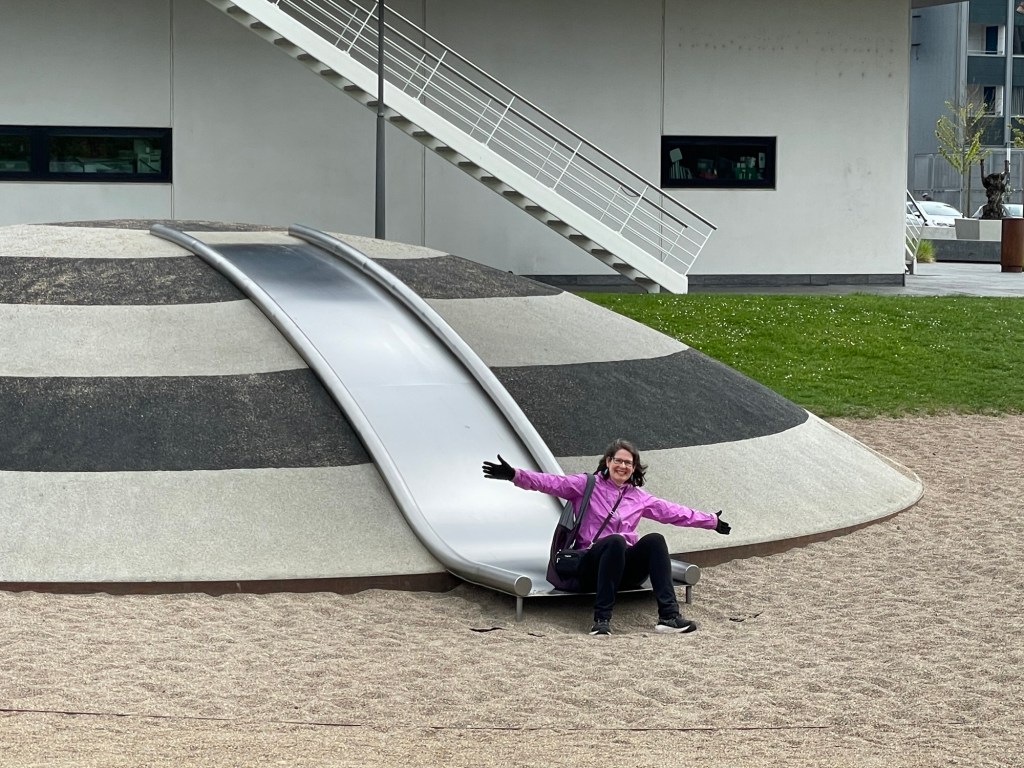
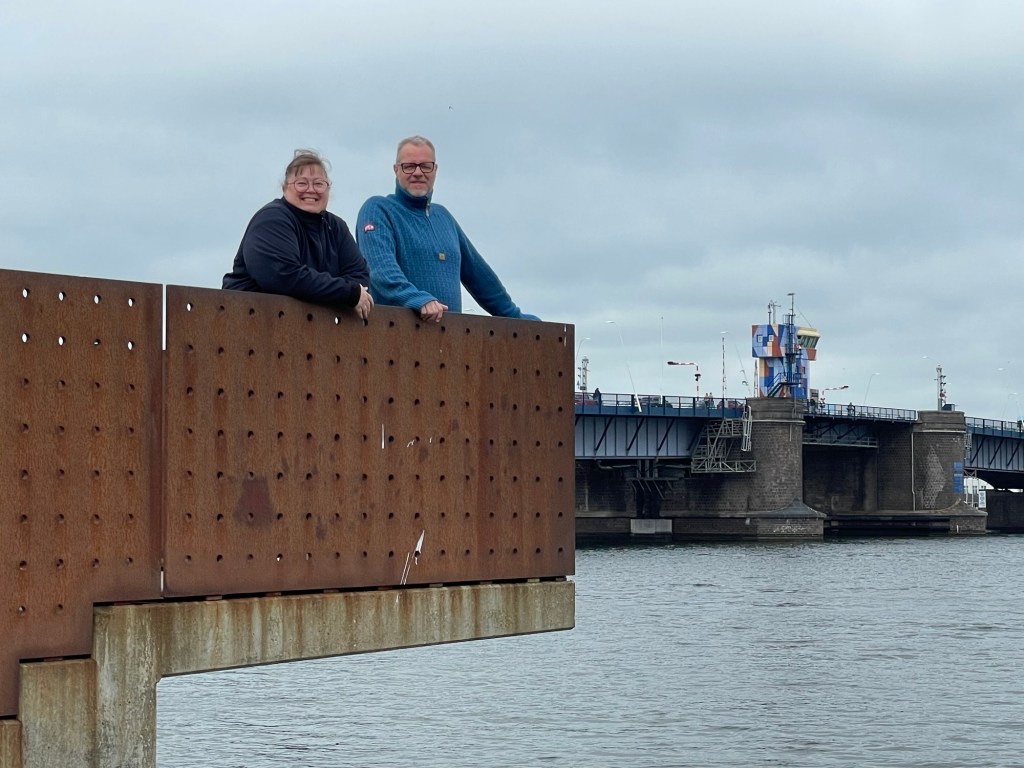
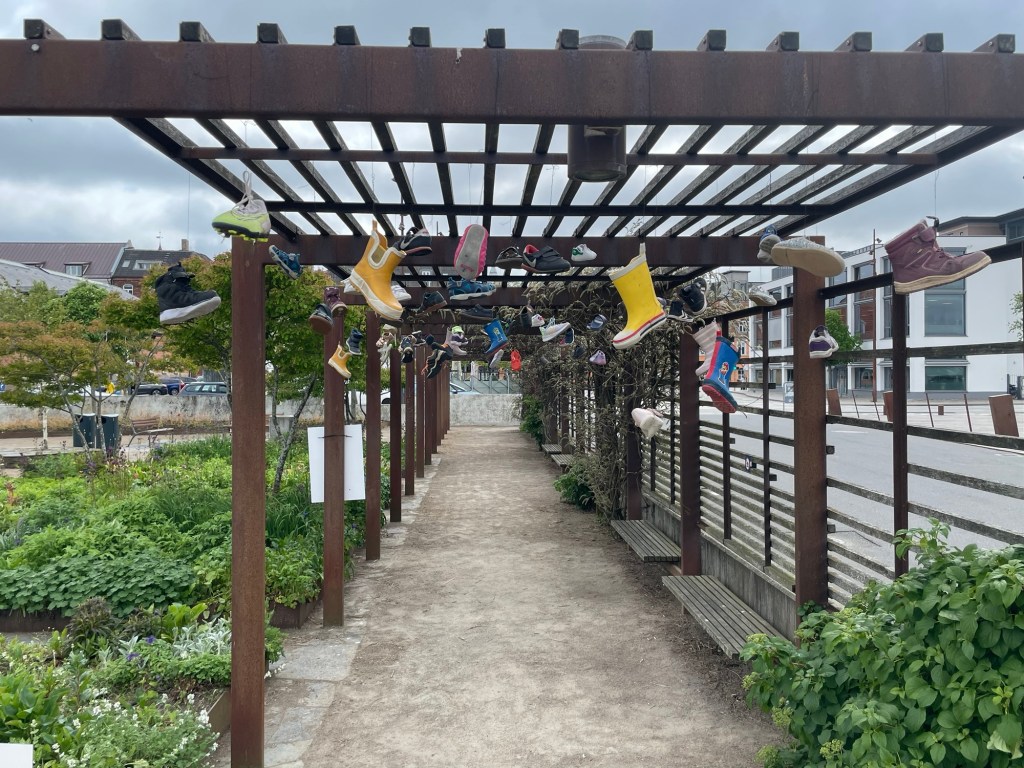
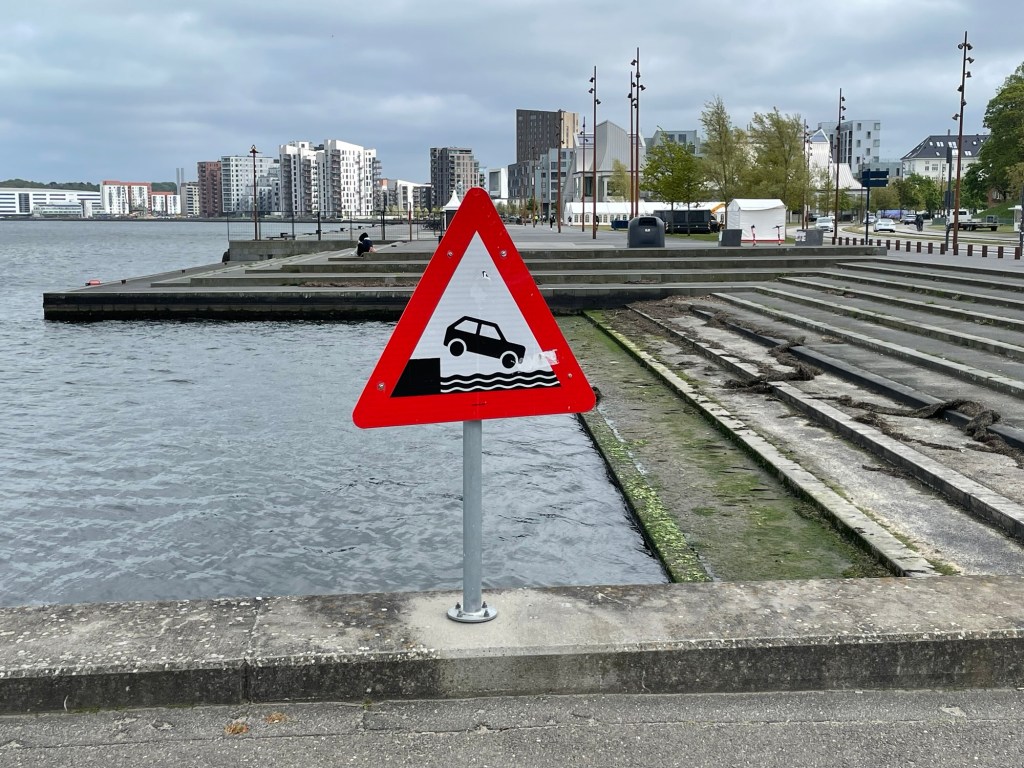
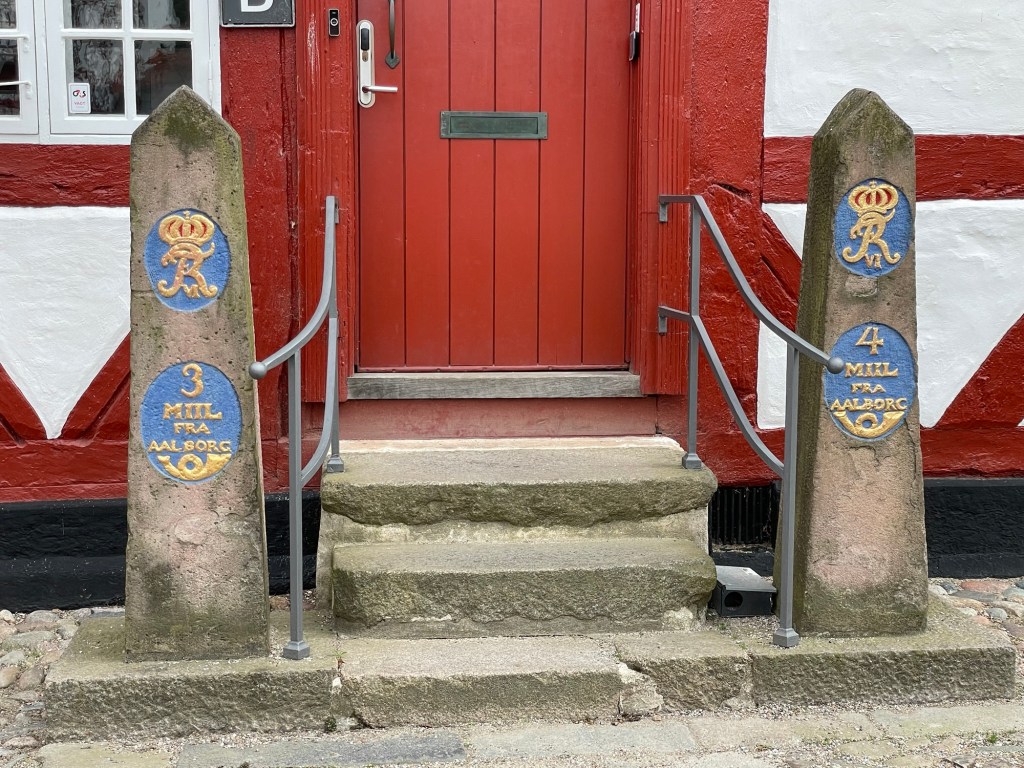
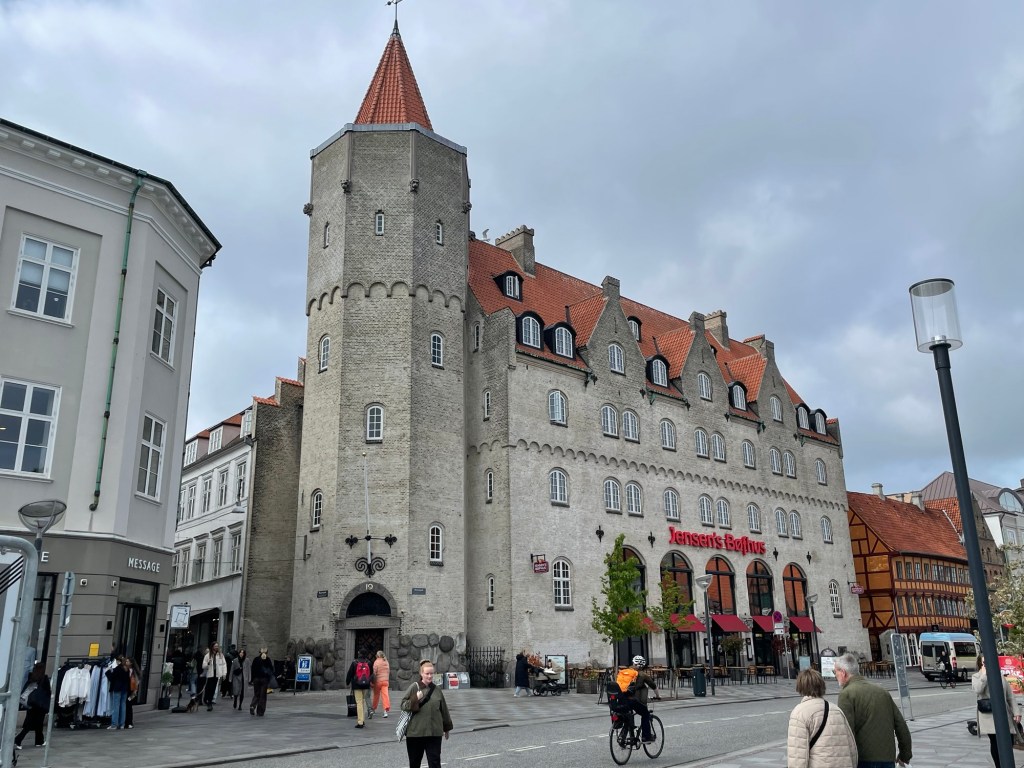
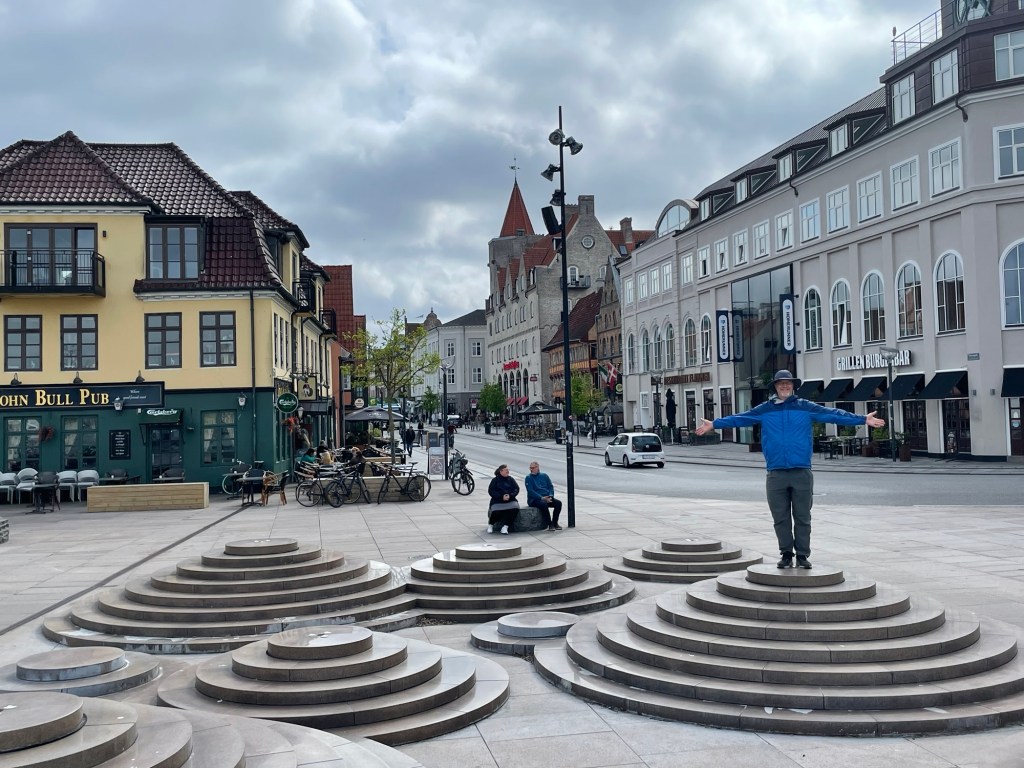
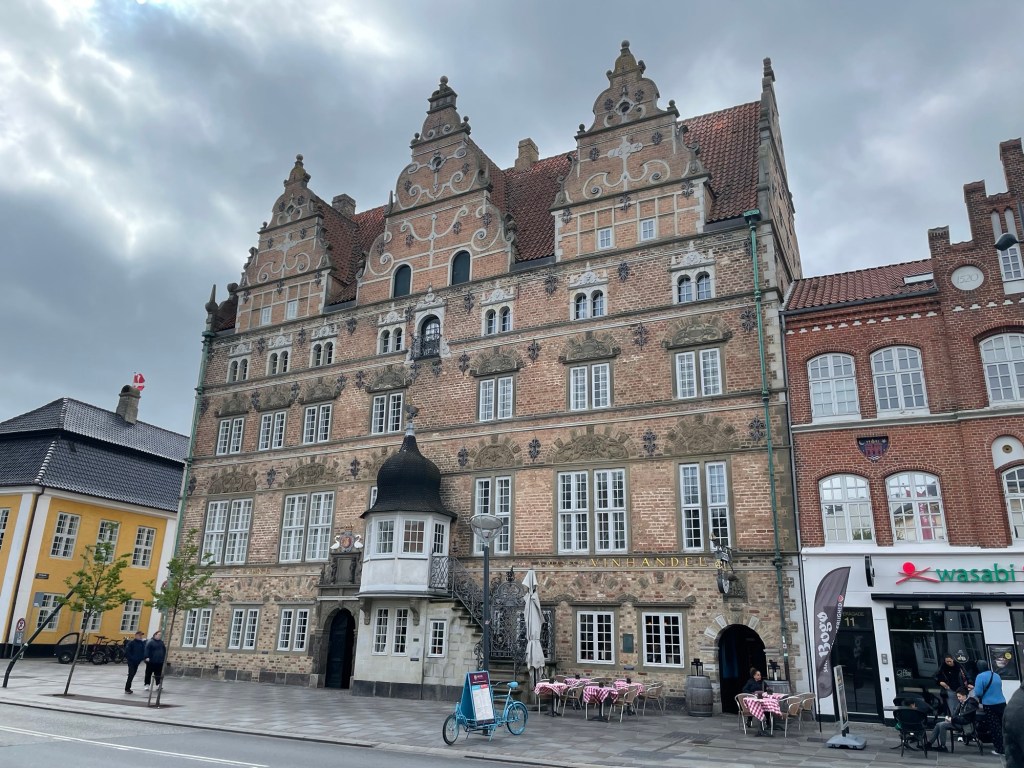
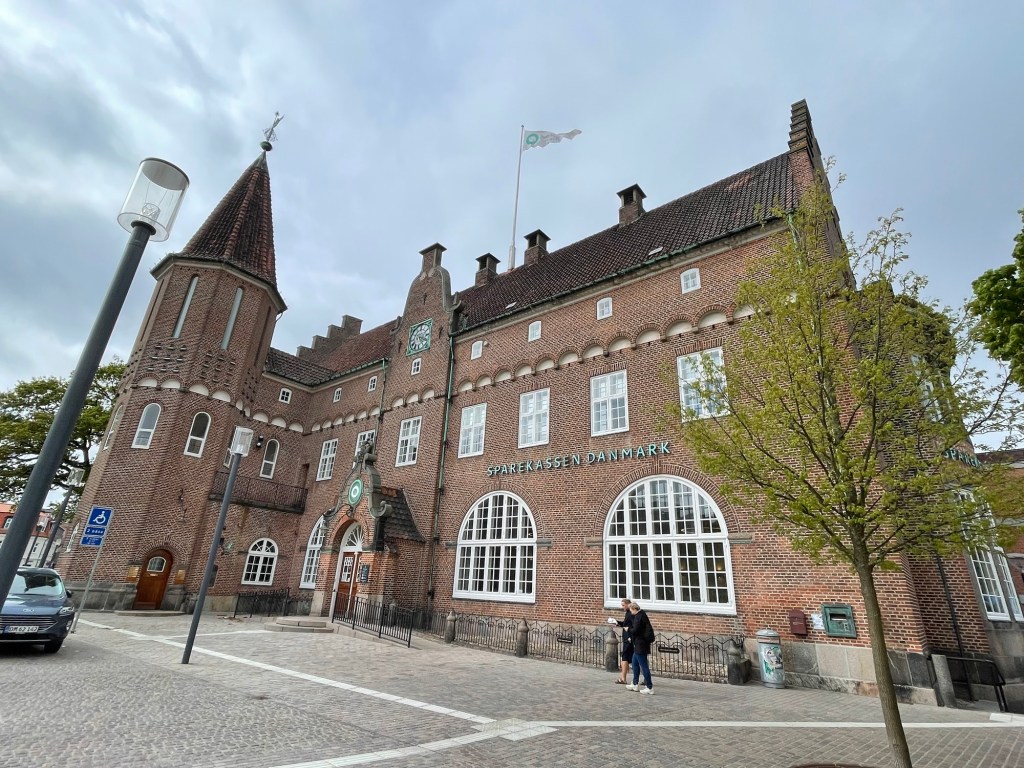
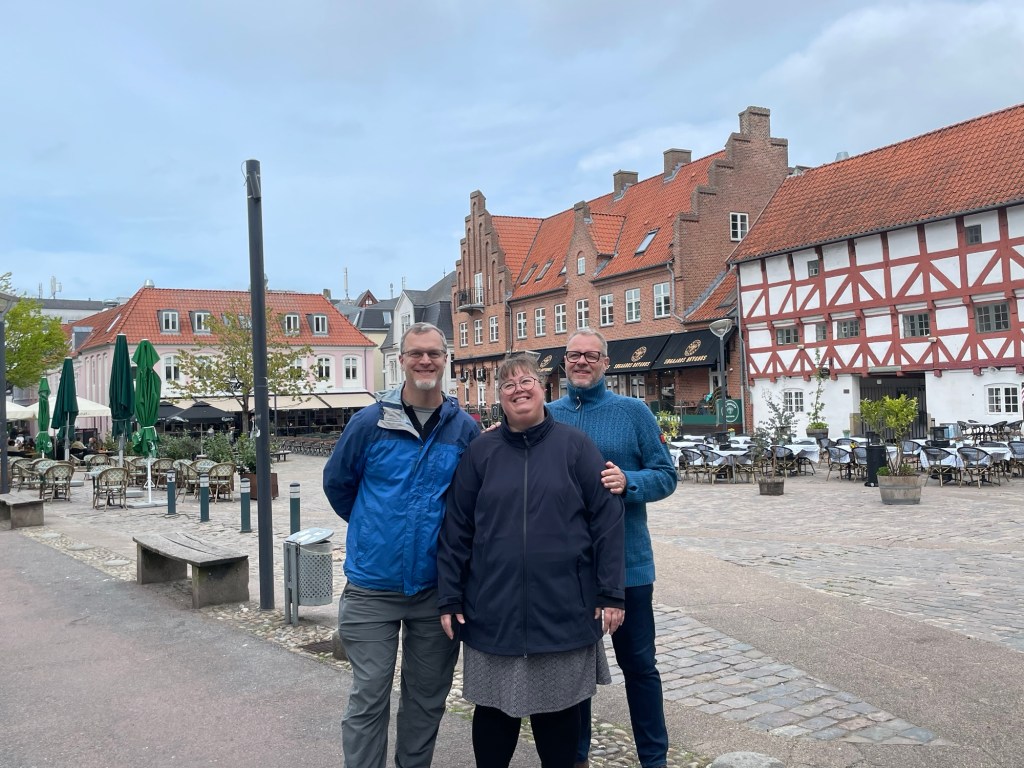
At Aalborg UniversityPlayground in AalborgViewing platform on the LimfjordArt installation in support of children in Ukraine, Gaza, and SudanHelpful Danish sign: don’t drive your car into the water!This museum was designed by Jørn Utzon, the architect of the Sydney Opera House, who was from AalborgAalborg Castle. Never successful as a military installation because it lacks a source of fresh water, the castle had gone through multiple cycles of neglect and decay followed by eventual refurbishment. The buildings were used as granaries for shipment to Norway and Britain.Door flanked by two official milestones. One miil was about 10 km / 6 miles.Jensens Bøfhus (Steakhouse) was a popular restaurant, until it sued newcomer Jensens Fiskehus (Fishhouse) for trademark infringement. The steakhouse won the court case but lost their reputation with the public, eventually going bankrupt before the chain was sold to new owners.This area is a fountain in the summertimeA mercantile house in AalborgShopping street in Aalborg. Most of the old buildings are helpfully labeled on the outside with the date that they were built.Bank buildingThis church was part of a conventThe old market square of AalborgApparently, this is the number one party street in all of Denmark!
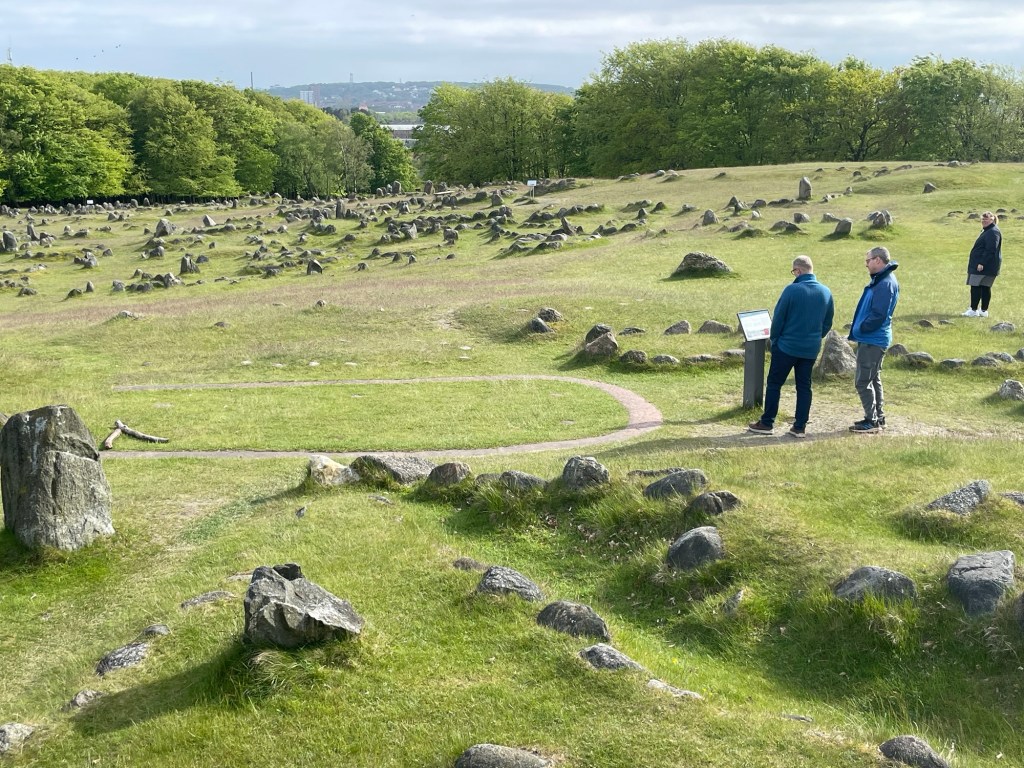
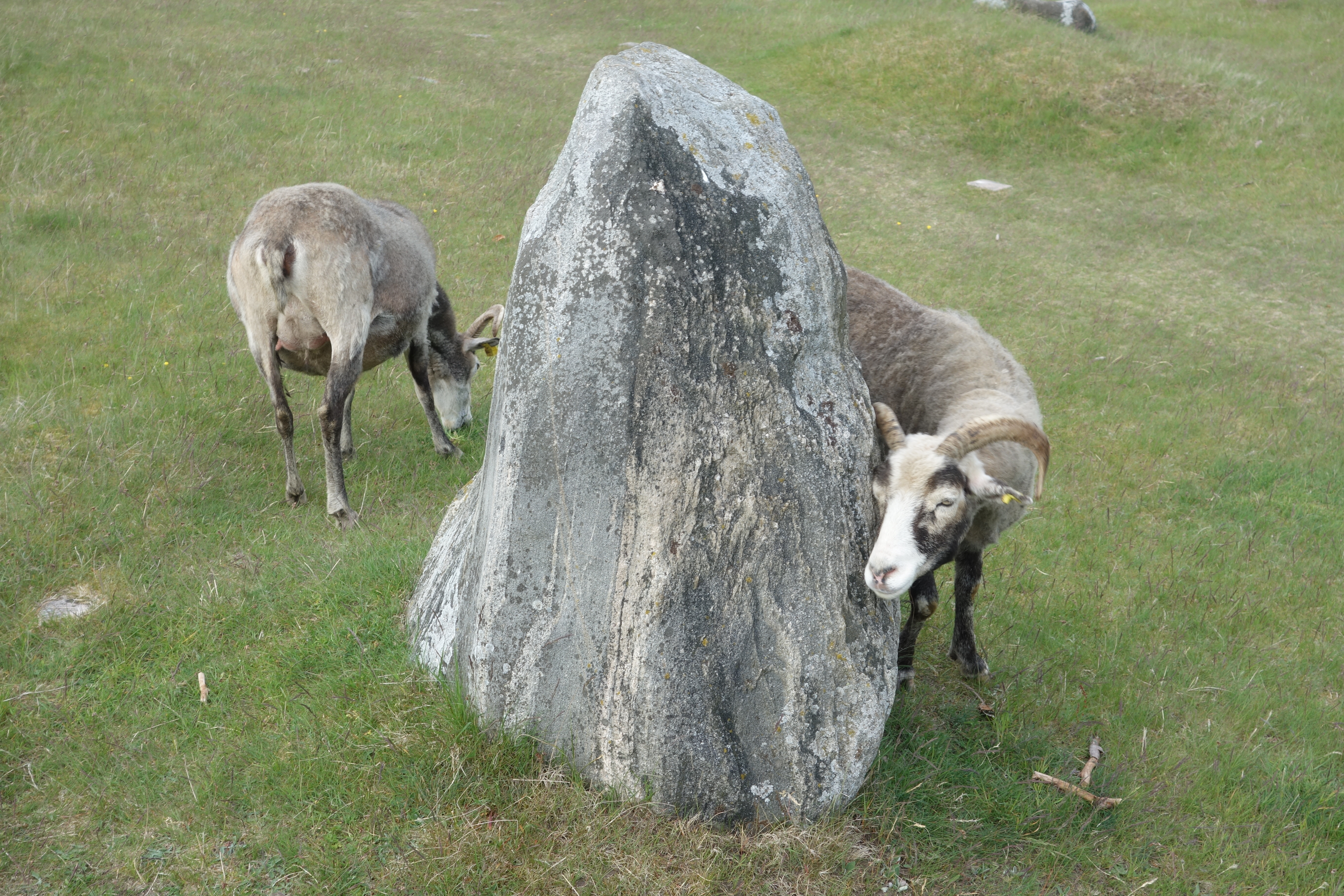
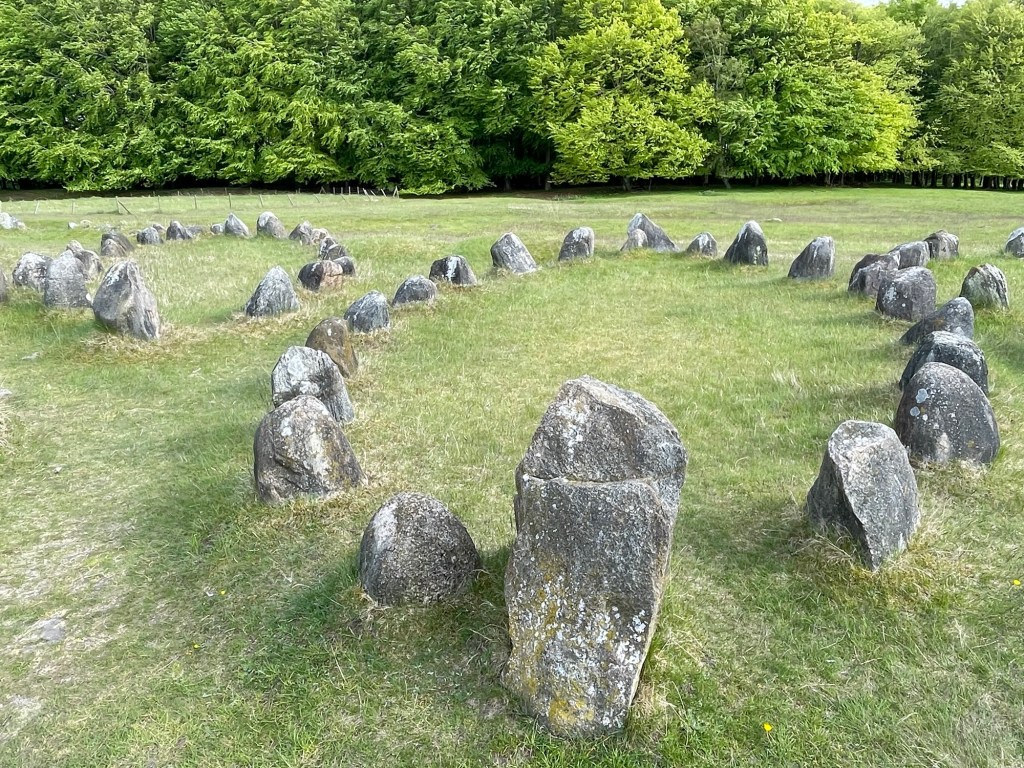
At the end of our visit to Aalborg, it was after 5 pm and all the museums were closed. Fortunately, just outside the city center is an area that can be visited at any time: Lindholm Høje, a Viking-era settlement site and graveyard. The area was in active use from around 400 to 1100 CE, but was eventually abandoned after storms covered the farm fields with sand. Archeological excavations have uncovered evidence of Viking longhouses and multiple graves, some unmarked but many ringed with stone markers. The site was quite picturesque in the setting sunlight. A rookery fills the woods surrounding the field: many ravens had nests in the treetops, and we could hear them squabbling and occasionally see groups of birds flying about.
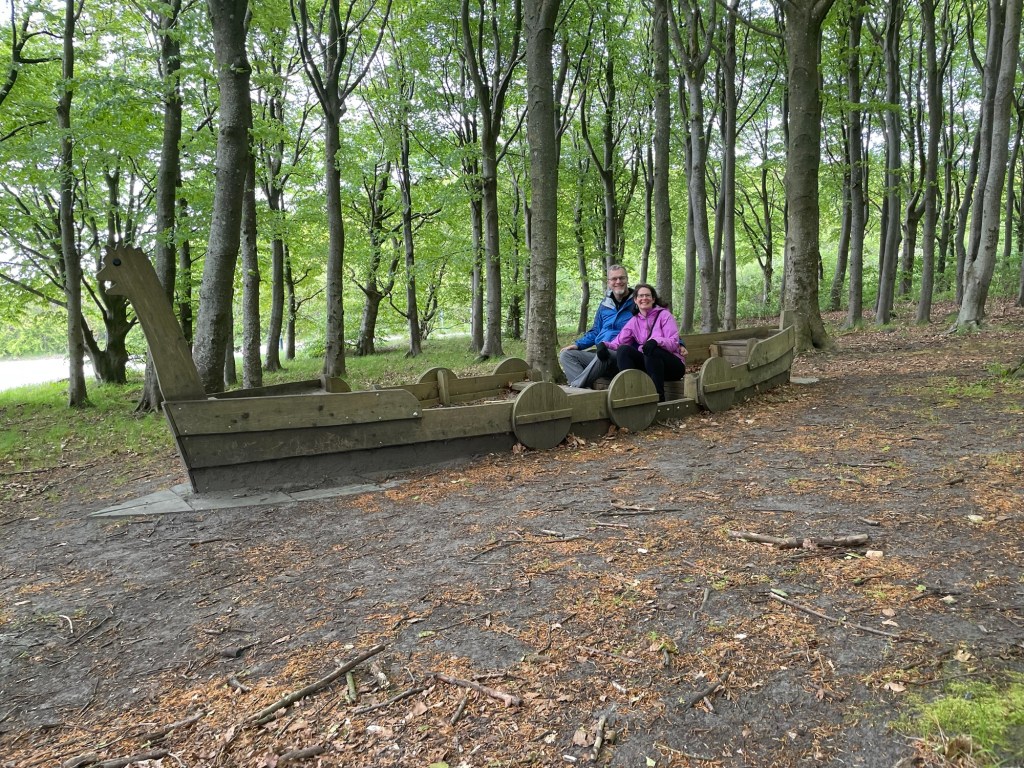
Lindholm Høje, with views of Aalborg in the backgroundCurly-horned sheep graze among the stonesRings mark grave sitesA playground in the woods near Lindholm Høje
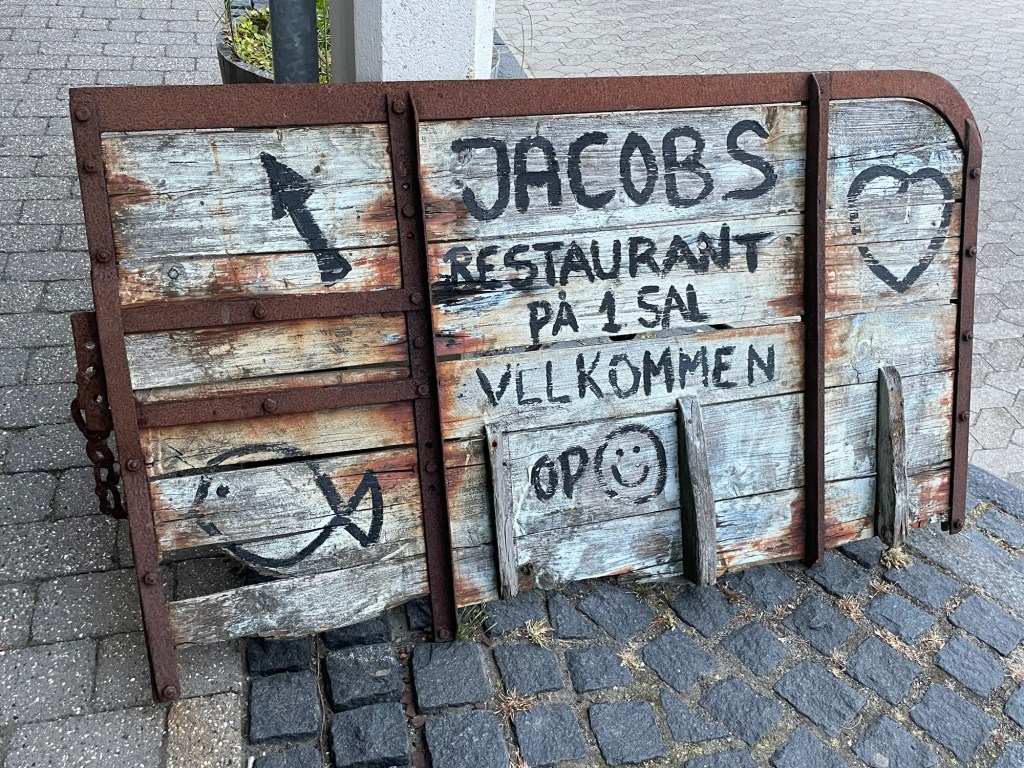
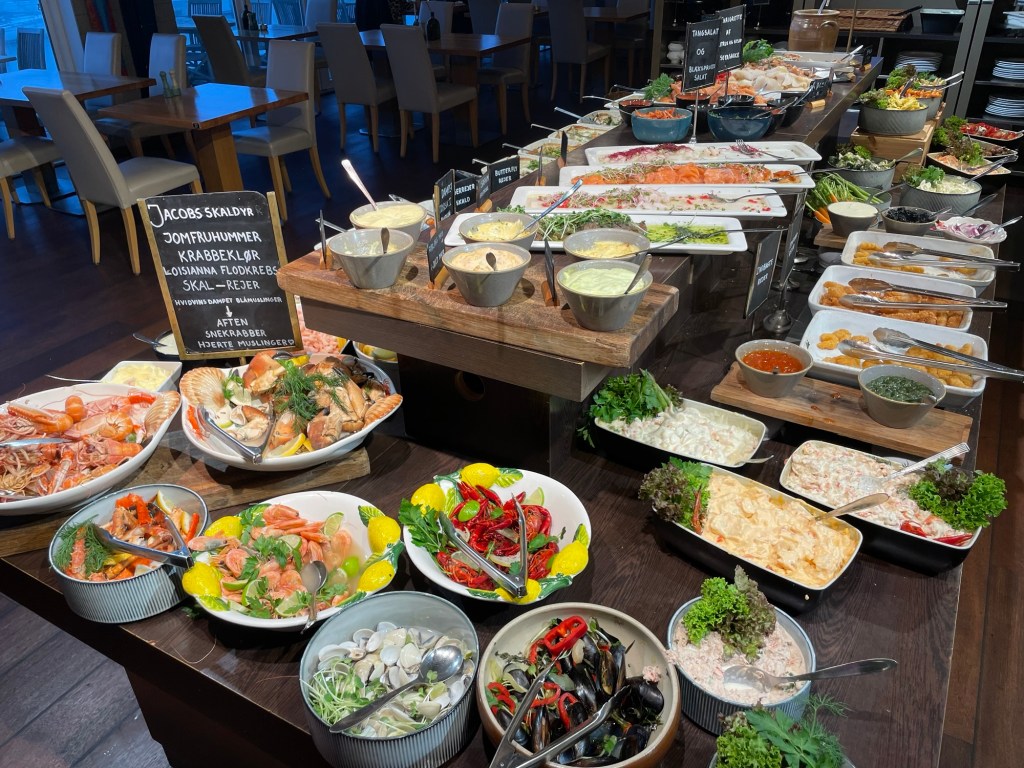
If you visit Scandinavia it is almost imperative that you try the seafood. For our last stop of the day we had to pay a call to the aforementioned Jensens Fiskehus, now called Jacob’s. Located in the port town of Sæby, it offers an all-you-can eat buffet replete with lobster, crab, shrimp, mussels, and fish prepared just about every way you can imagine. Lobster and fish soups to start, a dessert table to end the meal — we all came out completely stuffed and happy.
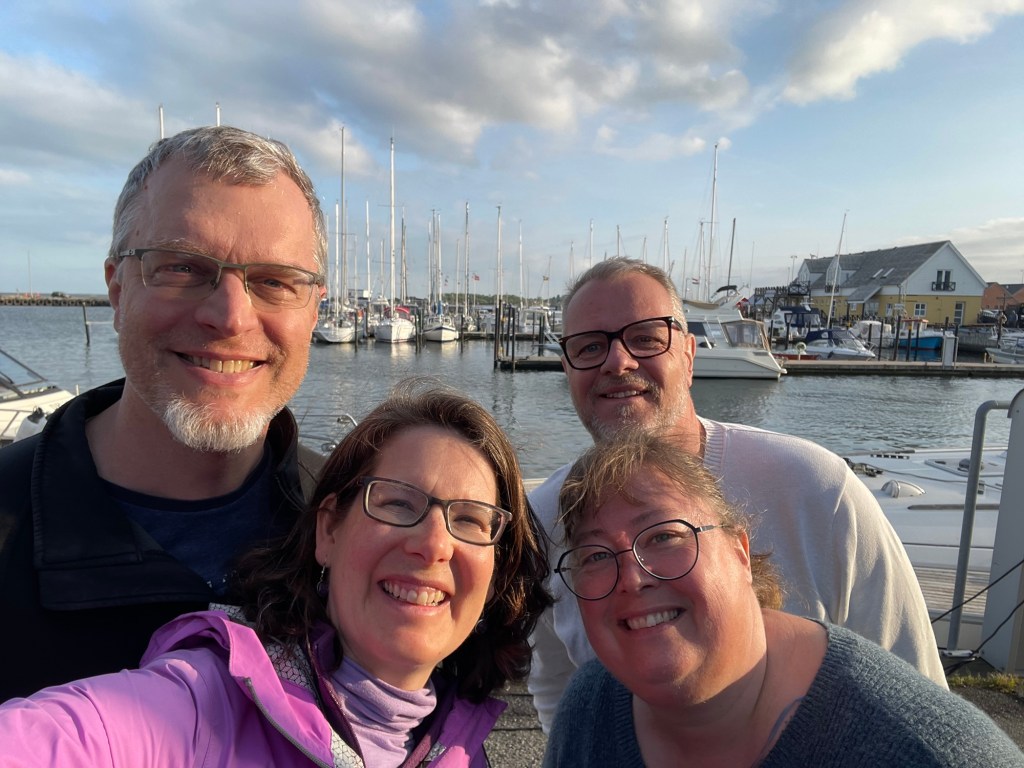
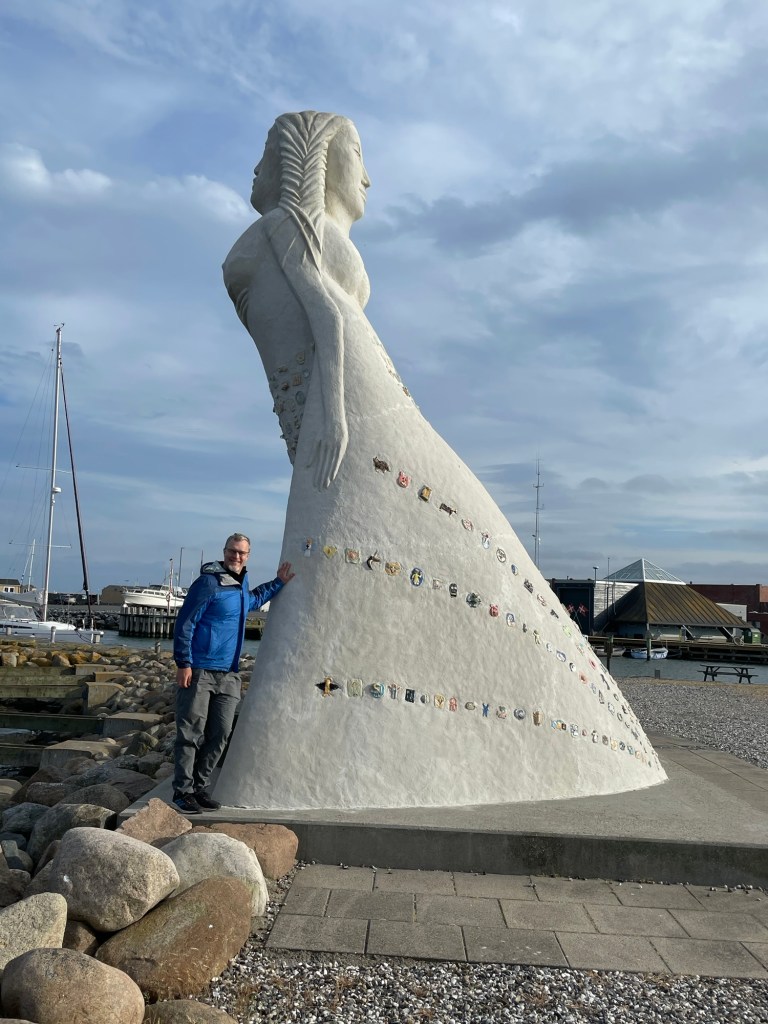
Port of Sæby – we took a stroll around the harbor before heading inside to dinnerThis statue is inspired by Ibsen’s play The Lady From The SeaSæby harbor at sunsetThe buffet at Jacob’s
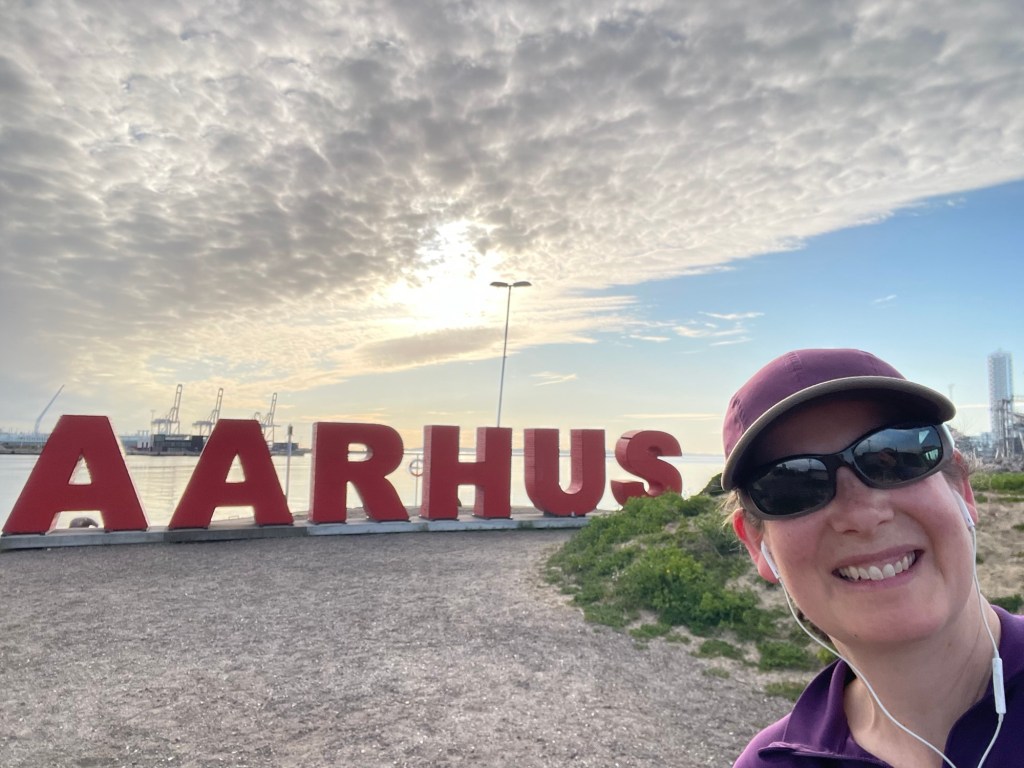
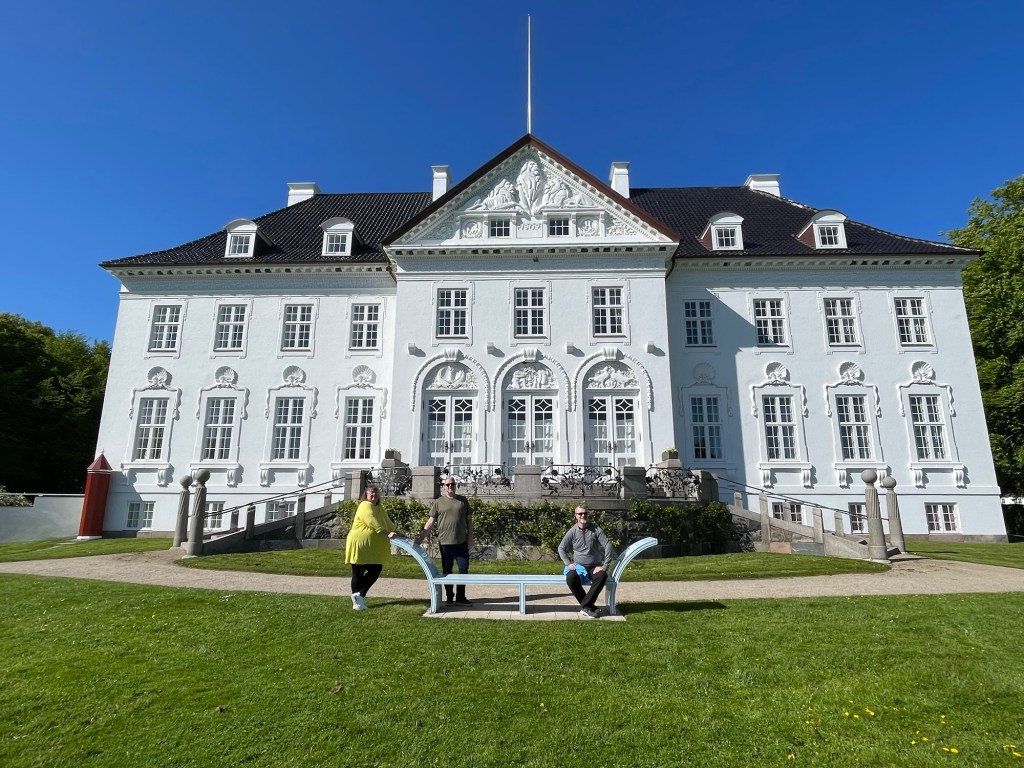
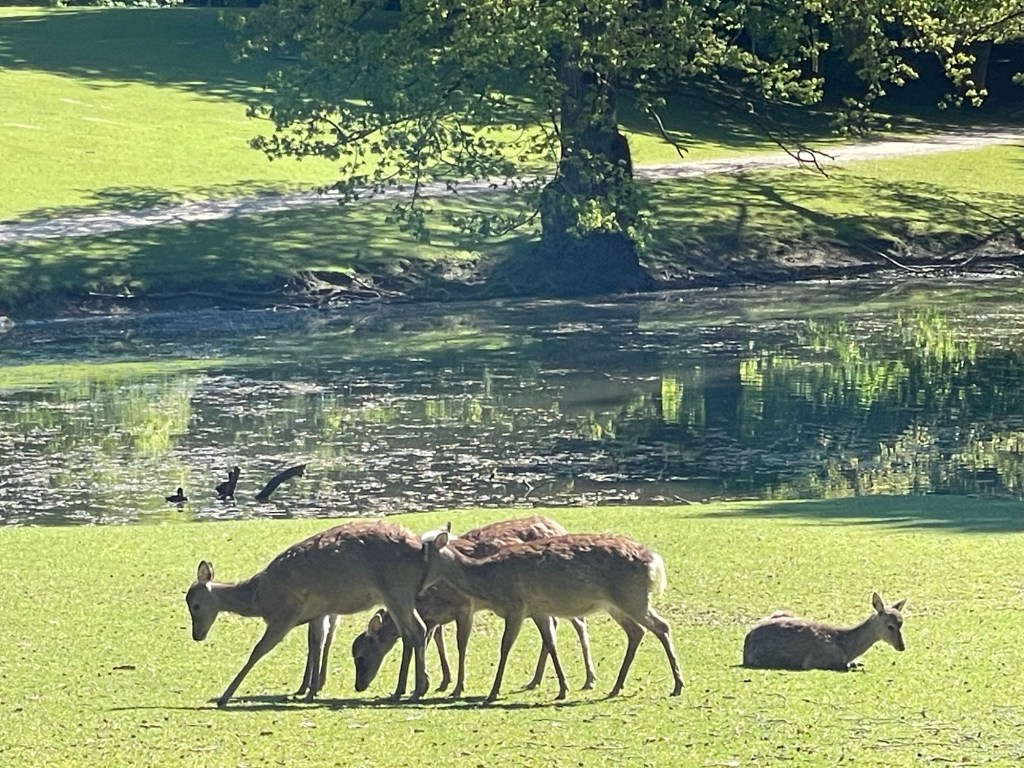
Susannah was invited to give a talk today to a research group at Aalborg University during the middle of the day, so our activities were arranged around this fixed point. She went for an early morning run along the waterfront in Aarhus, before meeting everyone else for breakfast with a view on the 10th floor of the hotel. Following this we visited several sights in the area: first, we took a walk in the park surrounding one of the houses owned by the royal family (since they are not currently in residence, the public is allowed to enjoy the grounds). Not far away is an interesting circular boardwalk that projects out from the beach — one can stroll around it as far as desired. Finally, we visited a park where semi-wild deer live within a large enclosure. Since they are very accustomed to human visitors, they don’t mind having people get close to them.
Convenient harbor-side signageBack side of the royal residence. (Not shown: the robotic electric lawnmower traversing a random path across the lawn)Front side of the royal residenceThe infinity boardwalk – one can walk on it foreverThe sprawling grounds of the deer reserveInnovation building at Aalborg University. Susannah’s talk went well!
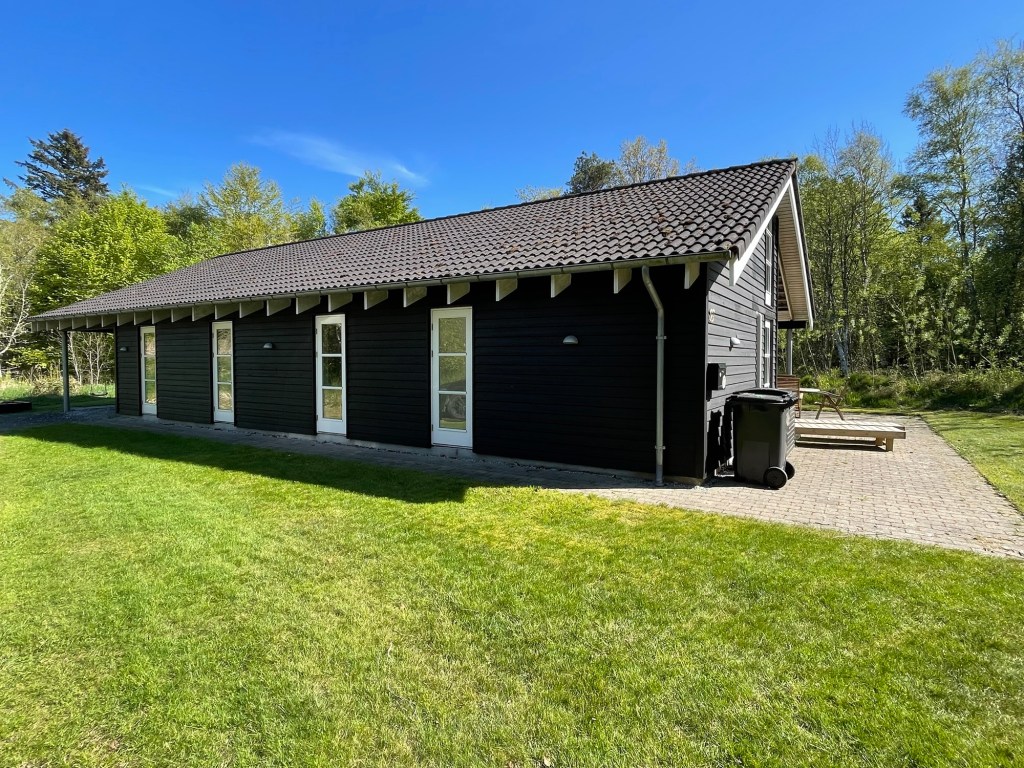
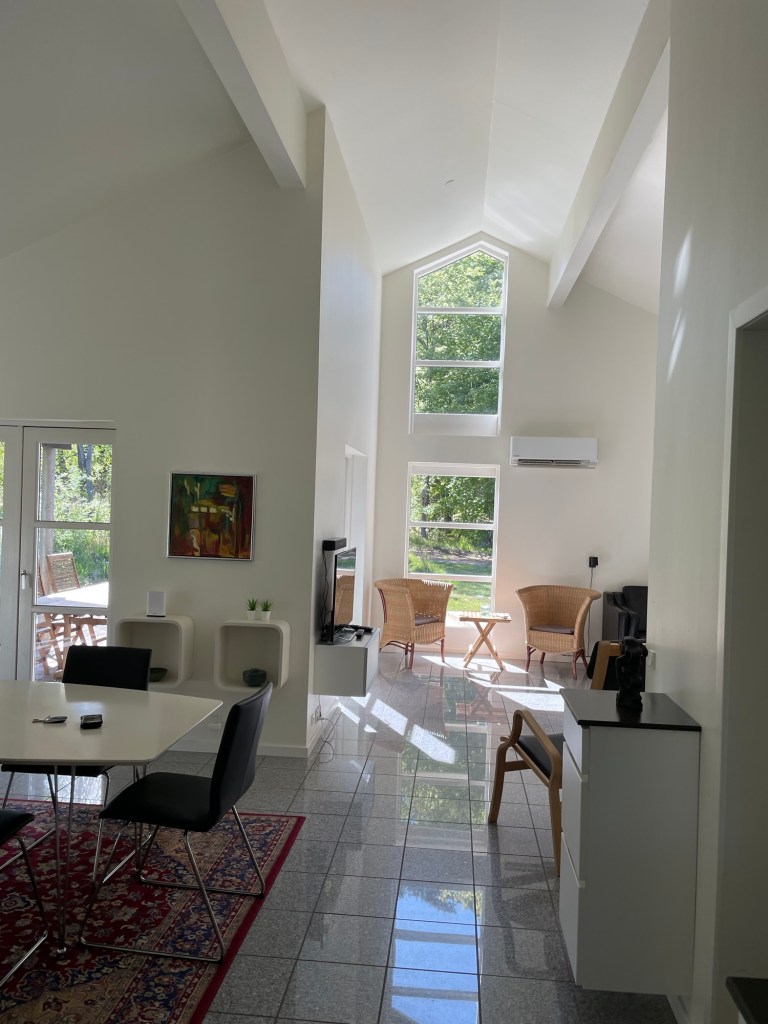
Picking Susannah up after her talk, we all proceeded to the sommerhus (summer house) that we’ve rented for the next few days in Hals along the Kattegat. It is located in a birch forest mixed with scrub pine, and has a comfortable, airy design. A short walk takes you to a beach with grassy dunes and fine white sand. We can feel the relaxation setting in!
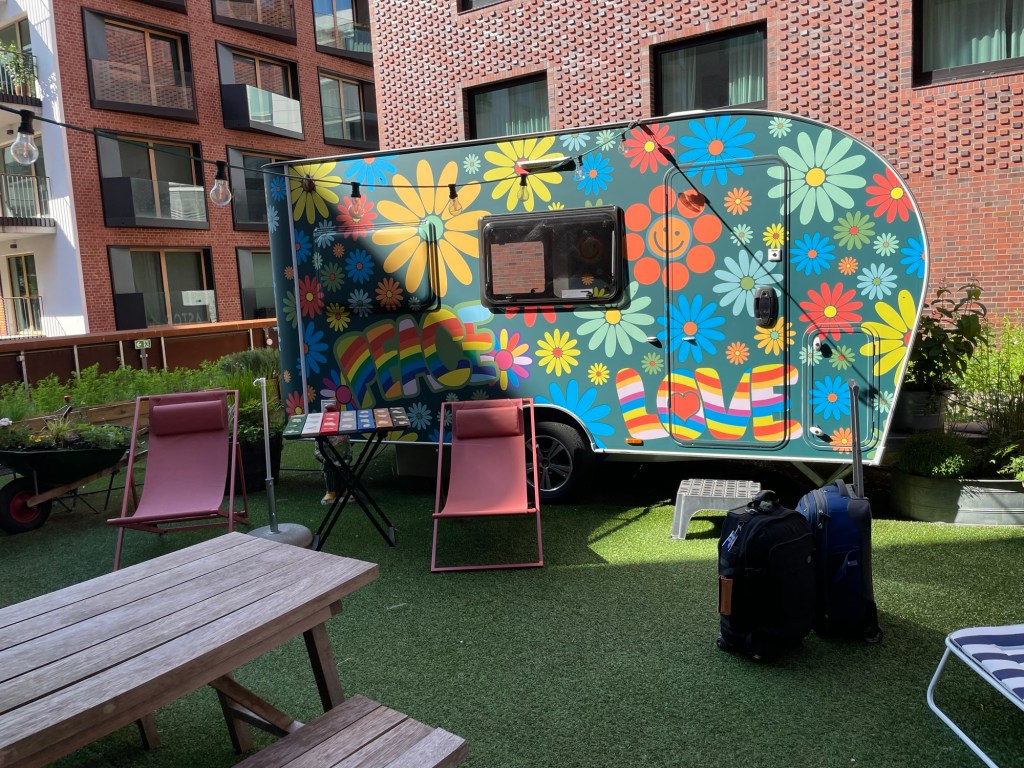
We had a relaxed morning in our little “Peace and Love” urban camper van. It came equipped with a phonograph in a little case and some vinyl records from the 60’s, so we had breakfast while listening to the beautiful voice of Miriam Makeba. We still had plenty of time to pack up and make our way to the station for our train to Denmark.
Alas, friends, travel does not always go smoothly as planned. Do you notice the slight curve in the tracks in the photo above? It didn’t seem important to us at the time. We were waiting near where our previous train had dropped us off, and there were others waiting also on the benches around us. The train seemed to be a little bit late, but we’re told that’s not unusual for Germany these days… Yet why was it no longer showing up on the information boards? Nothing ever passed by us on the track, so as best we can tell our train slipped into the station from the north, left again in the same direction, and was too short for us to see around the bend of the track. Another lesson in travel for us! Fortunately the trains in Europe run frequently, and we were able to take another one that left an hour later. With mostly blue skies, we had lovely views of the German and Danish countryside along the way.
Arrived in Aarhus, Denmark!View from our hotel balcony Susannah matches the artwork!
We are here to visit Susannah’s good friend Christina and her husband Thomas. They live on Zealand outside of Copenhagen, but came to meet us in Aarhus. We’ll join them for a few days in a vacation summer cottage in the northern part of Jutland. We had a little time to wander the streets of Aarhus before heading to dinner.
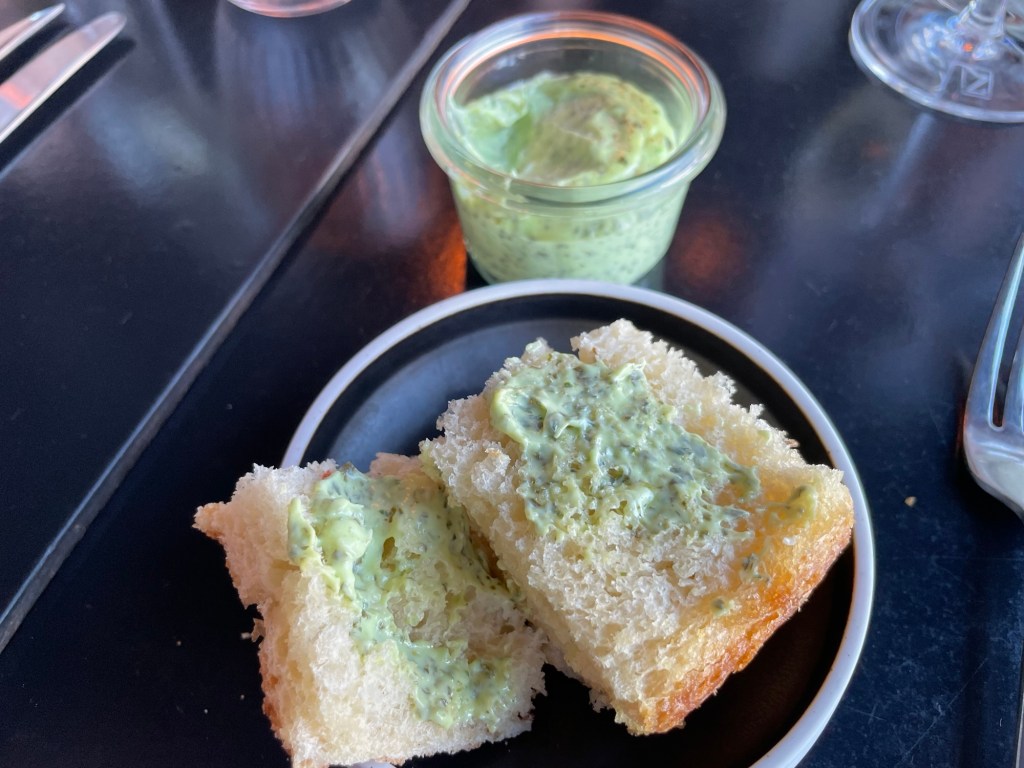
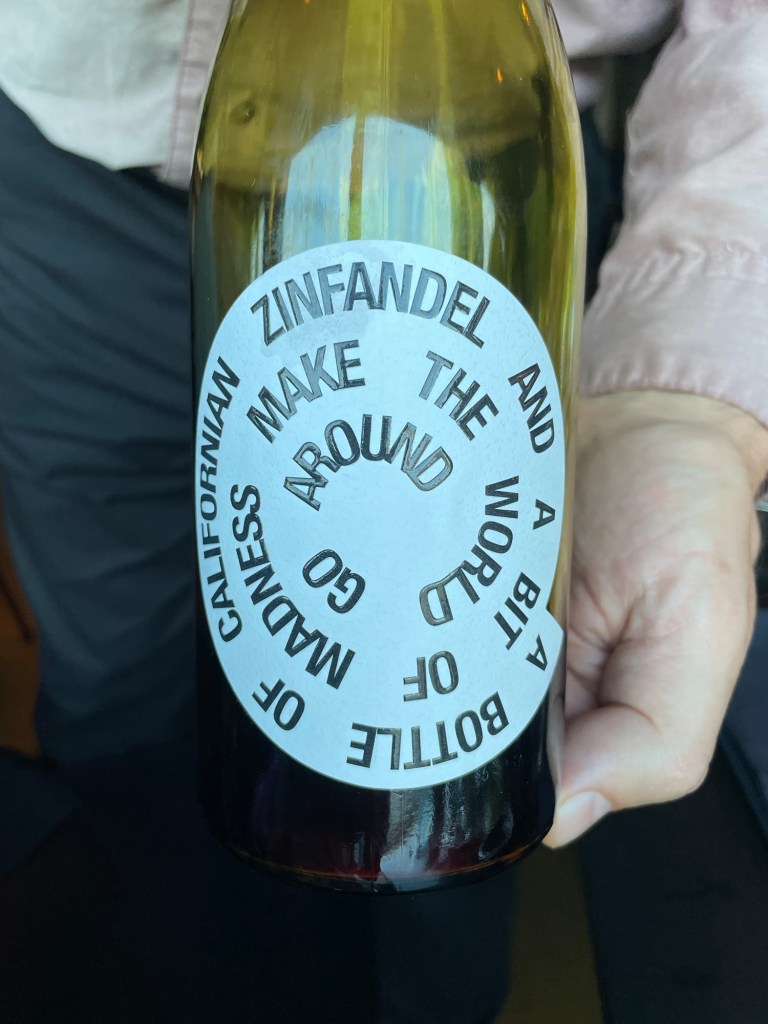
For this evening, Christina had planned a special dinner at a restaurant called Det Glade Vanvid (The Happy Madness). It’s the sort of place you need to make reservations months in advance, so she booked it for us as soon as our travel plans were firmed up. They serve fancy “New Nordic” cuisine, exquisite creations of foam and culinary magic. Yet they keep prices affordable by serving all guests the same menu in a single sitting. The meal was incredible, and our table was right by the window with a clear view of the water.
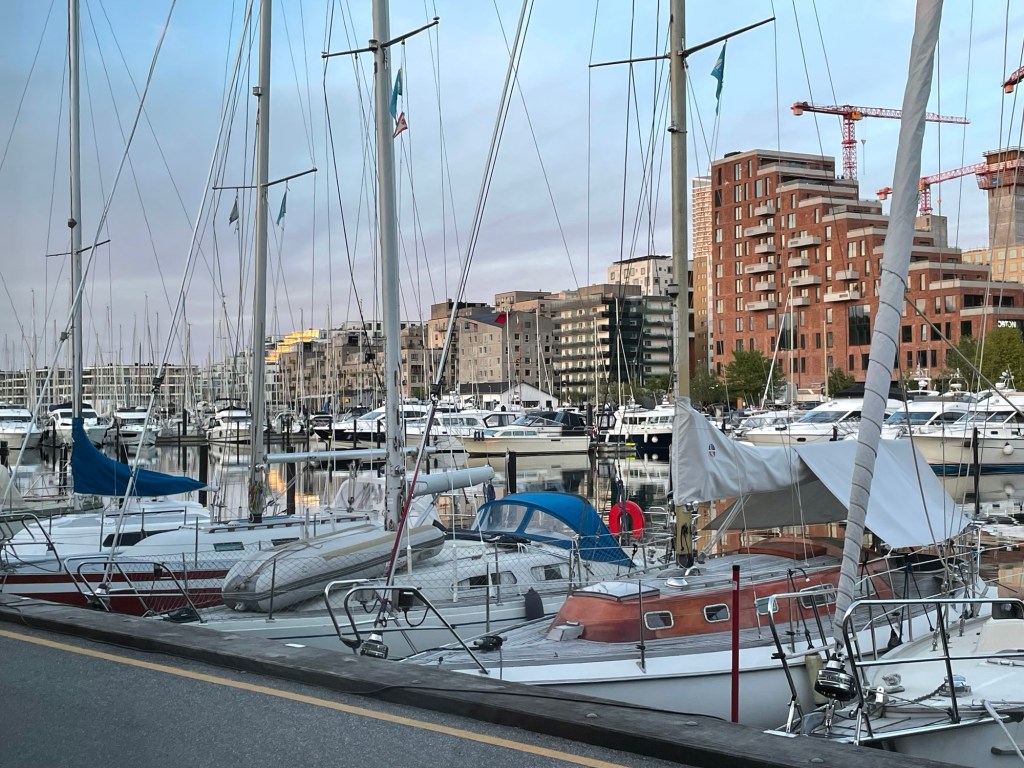
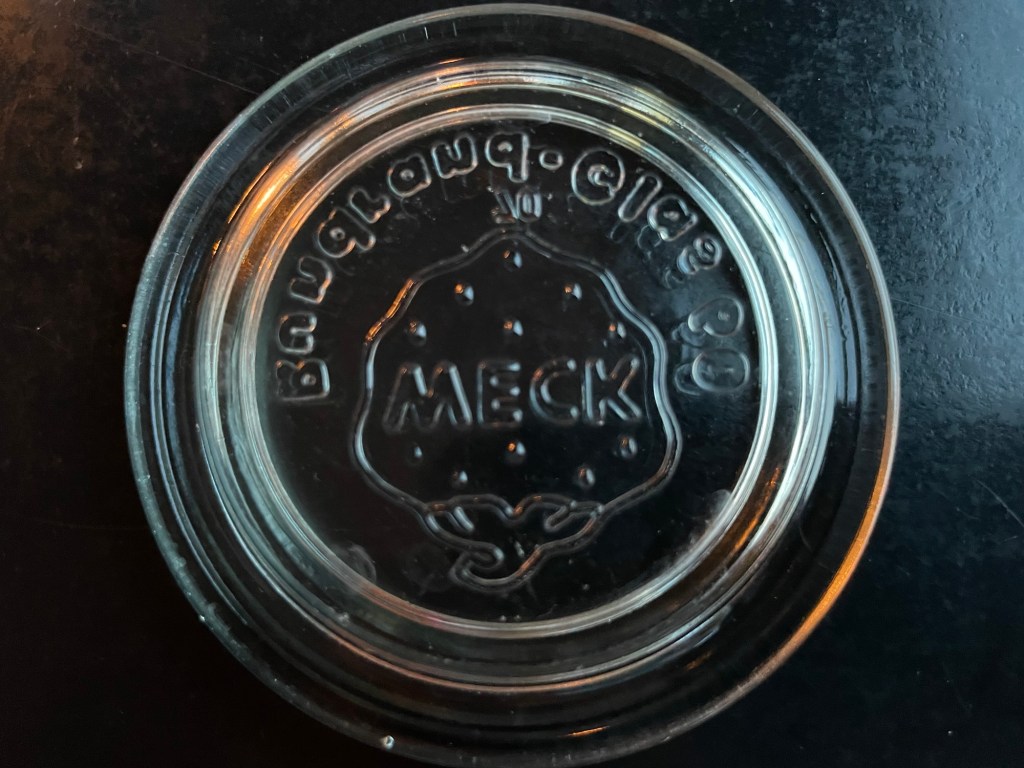
Rosemary bread with parsley aioliShrimp and tomato foam on a wheatberry bedCod with rhubarb sauce, mussel foam, celeriac pouch, and a tuile on topRoast pork in truffle sauce, potato souffle in pea sauce, and pickled daikon with blueberry aspicA different wine came recommended with each courseDessert was peach mousse with mango-lemon ice creamOur view of the harborWith coffee they also served tiny cakes in little glass jars
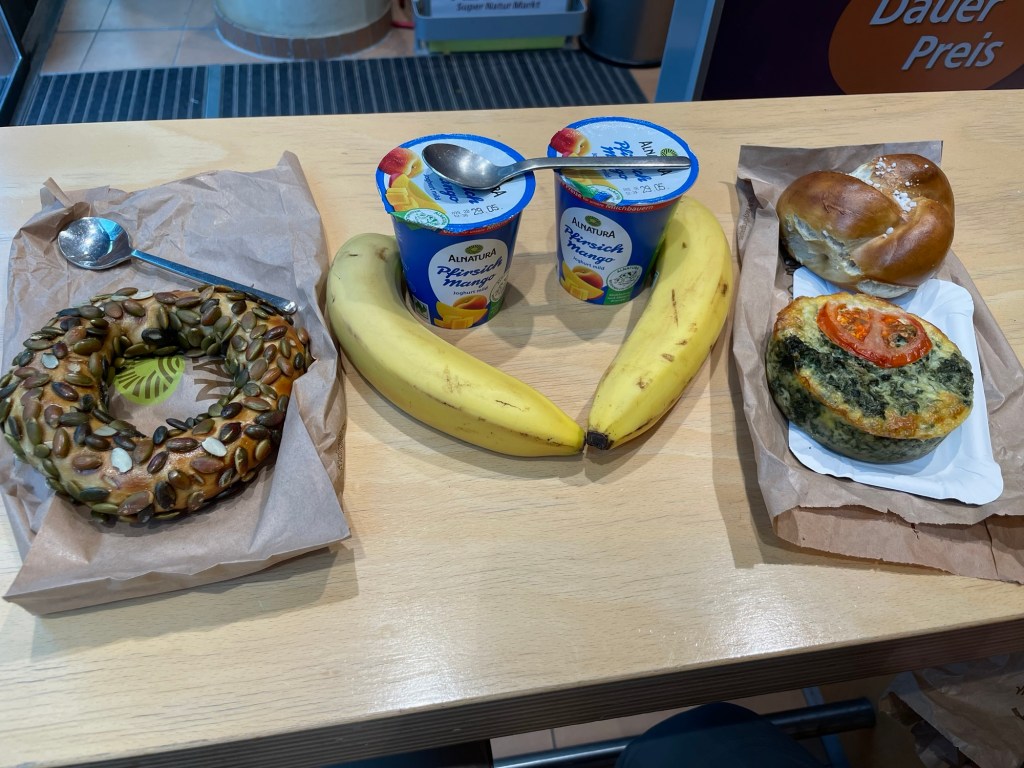
Today after a quick breakfast at the local natural food store (80% discount off the hotel breakfast!), we took an early taxi across the Elbe River to Finkenwerder, where Airbus has a large assembly facility. The tour lasted for two and a half hours, during which we visited three different hangars where different steps of the process occur — first the sections of fuselage are mated together, then the inside wiring and ductwork is added, before they are painted and given engines. The various pieces come from different countries: tails from Spain, nose and forward section from France, and the back and middle are made here in Hamburg. (As a pan-European project, Airbus has to distribute its production to maintain political support in the major nations of the E.U.) Unfortunately we cannot show you any pictures because cameras are strictly forbidden during the tour. Since the tail and wing sections come pre-painted, they create a strange contrast with fuselages in only green or brown primer coat.
Love that natural grocery store breakfast!Our only photo, taken outside the gates
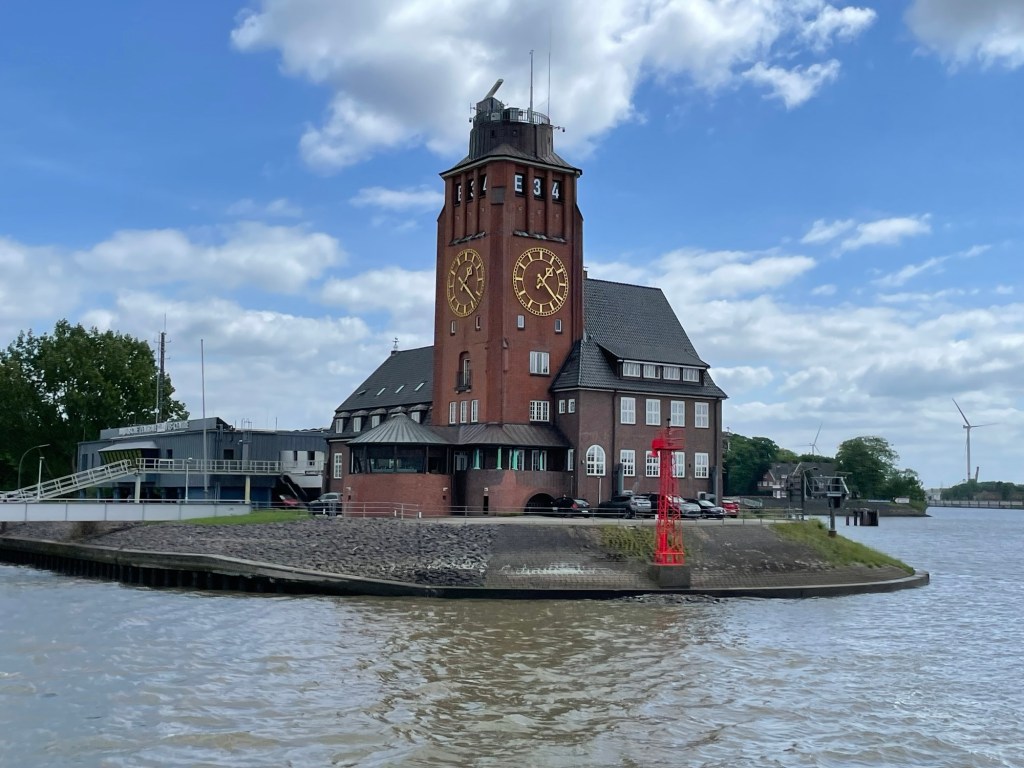
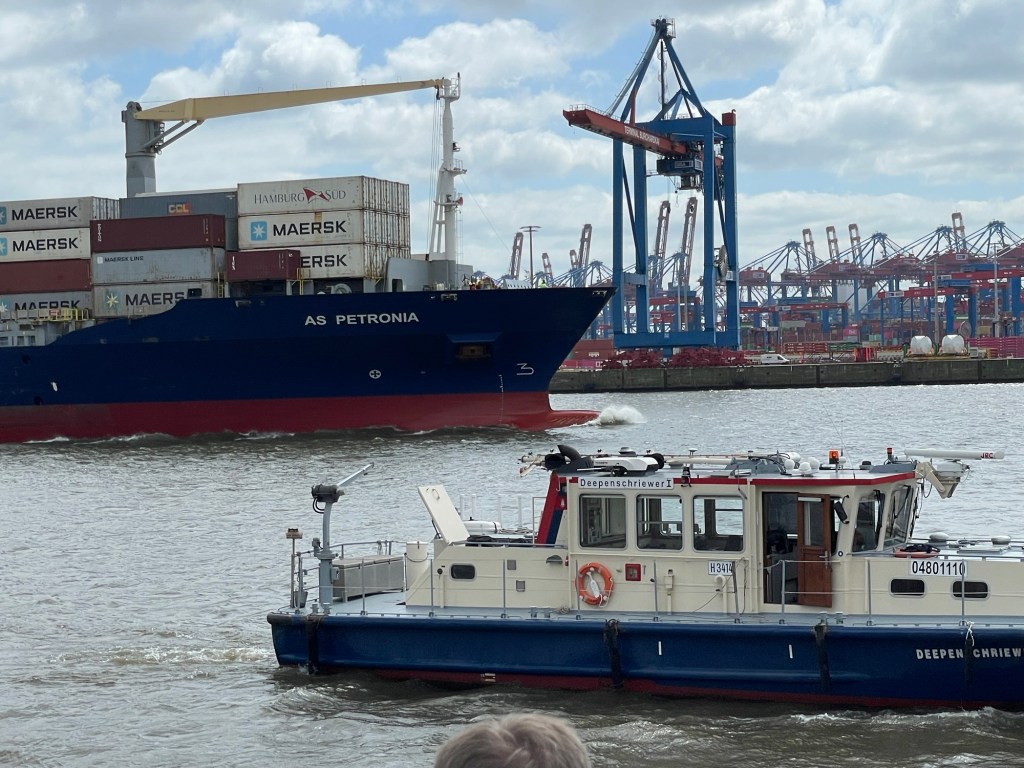
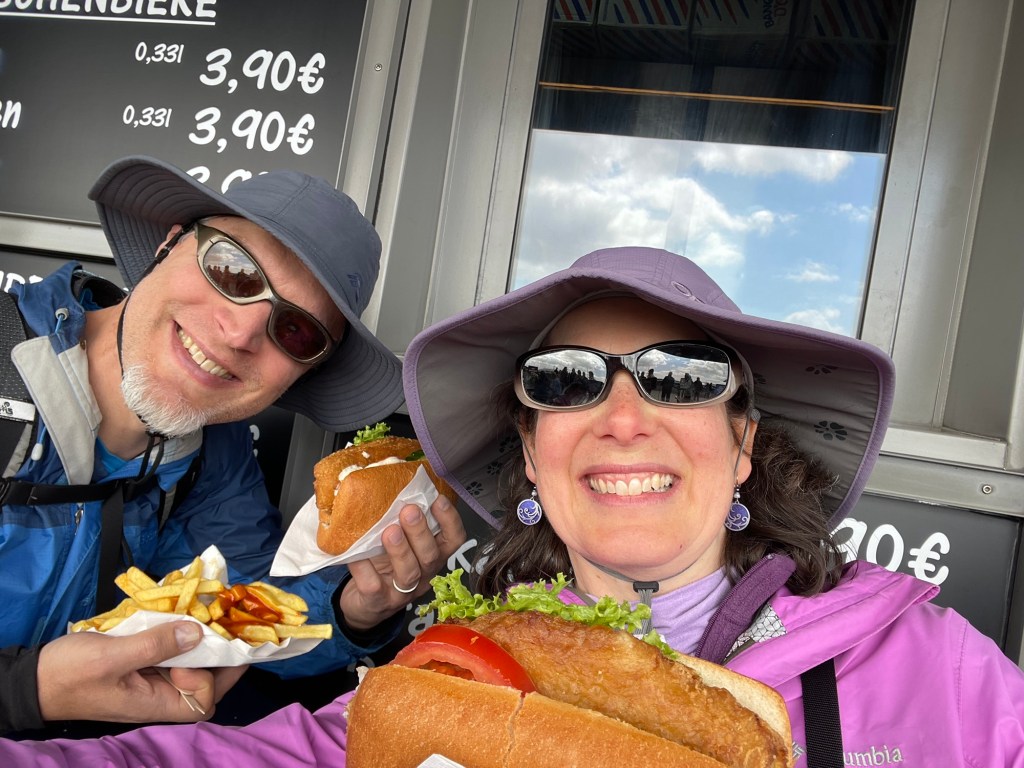
Heading back to the main part of the city, we were in a little bit less of a hurry so we opted to take the ferry and sit on the top deck, since the weather had turned for the better. Hamburg is a very busy industrial port, so we saw many cargo barges, tugboats, and even a large container ship or two going by. Upon landing we picked up lunch from a waterfront establishment that sold fish and seafood sandwiches.
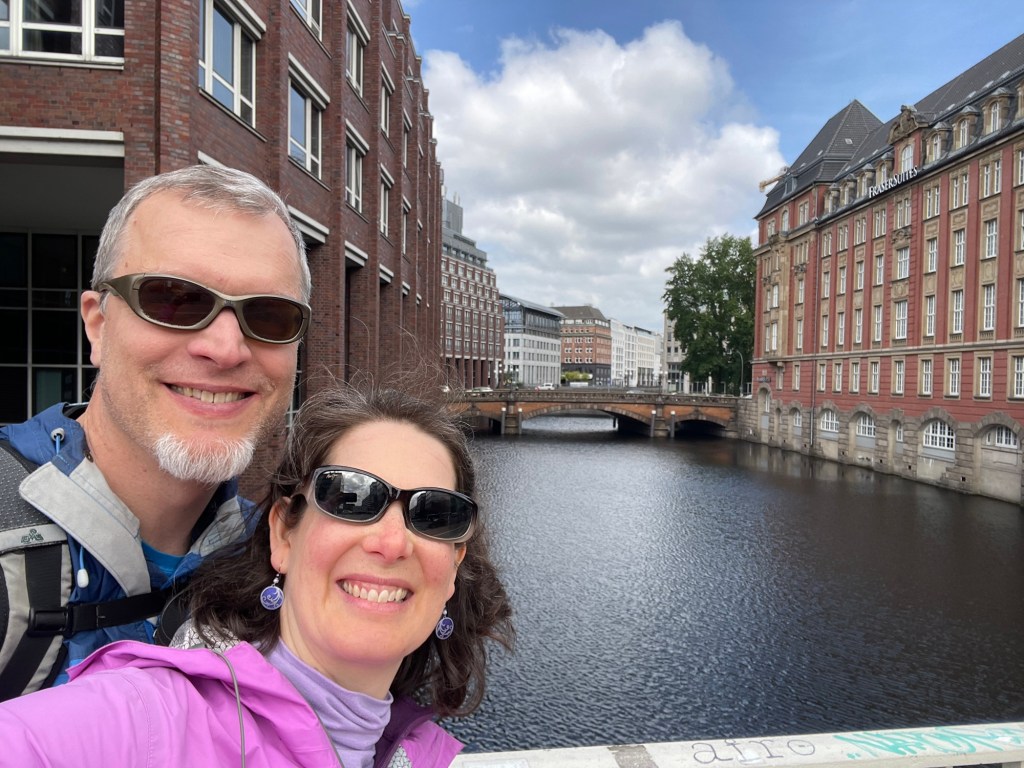
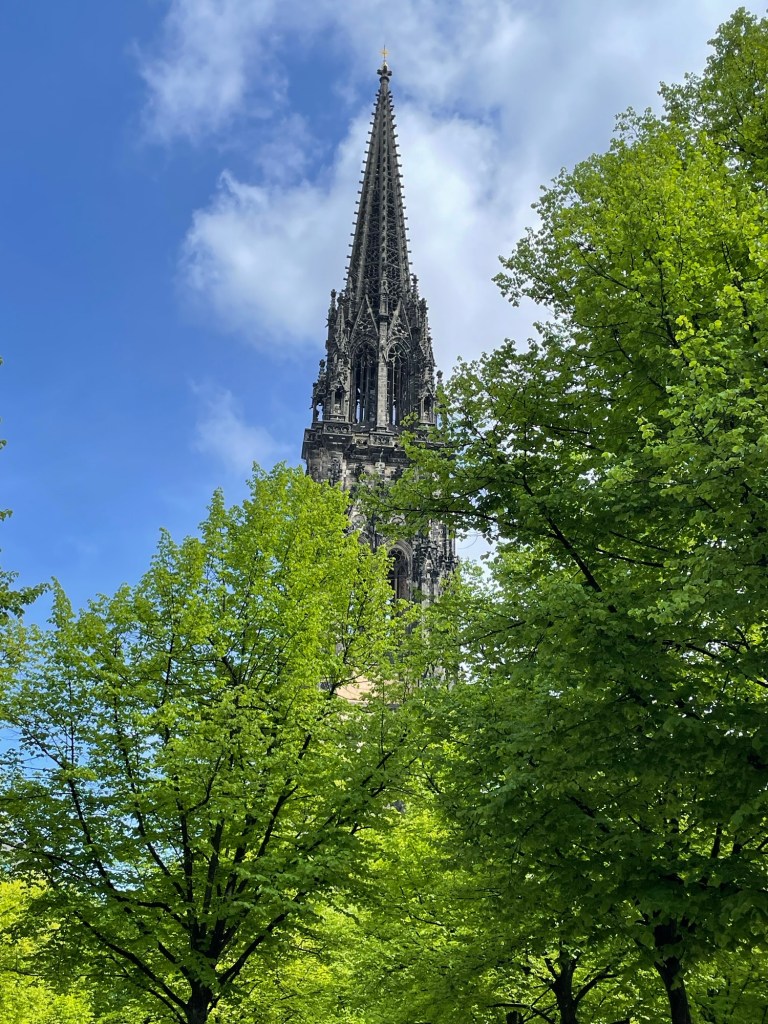
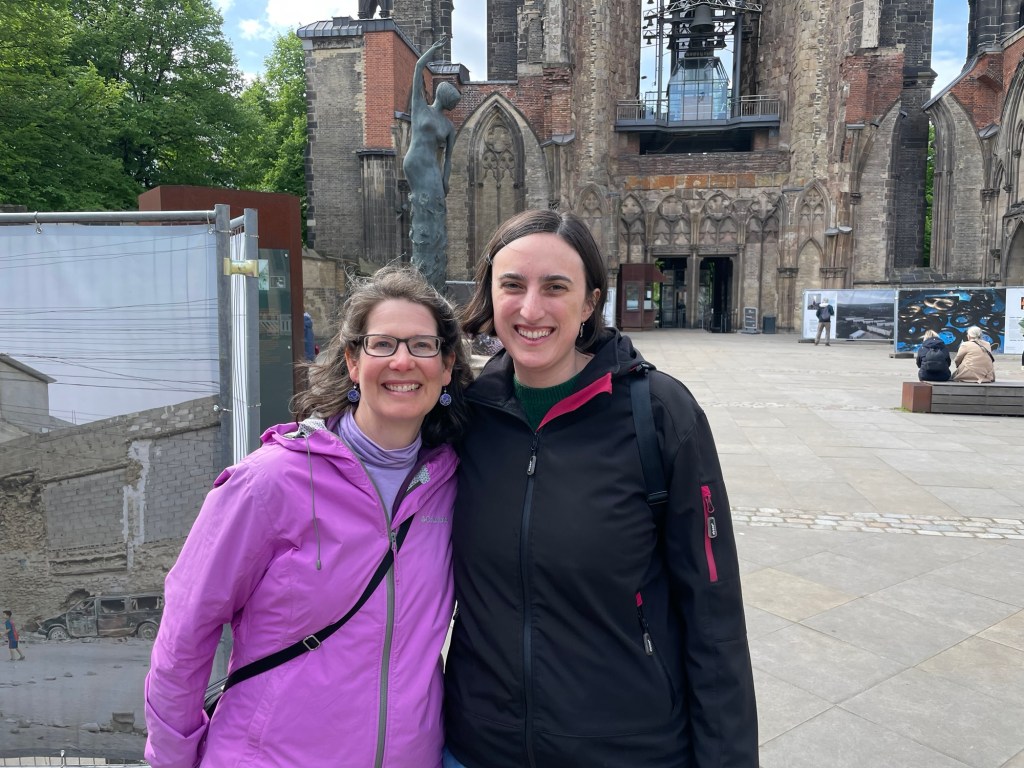
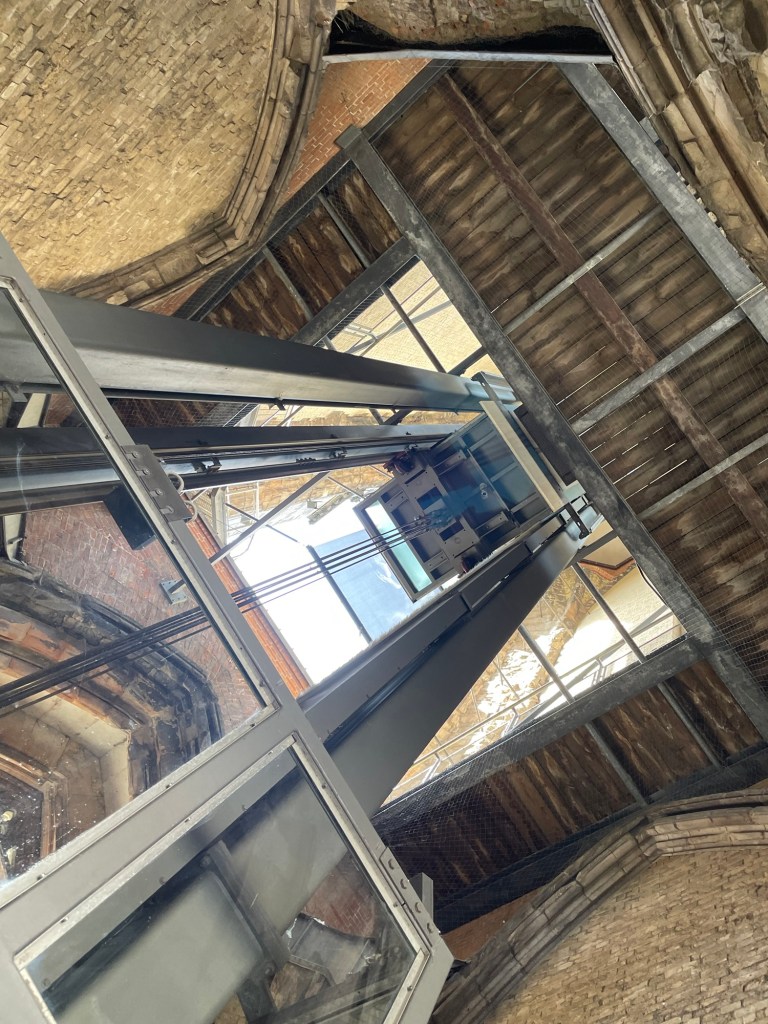
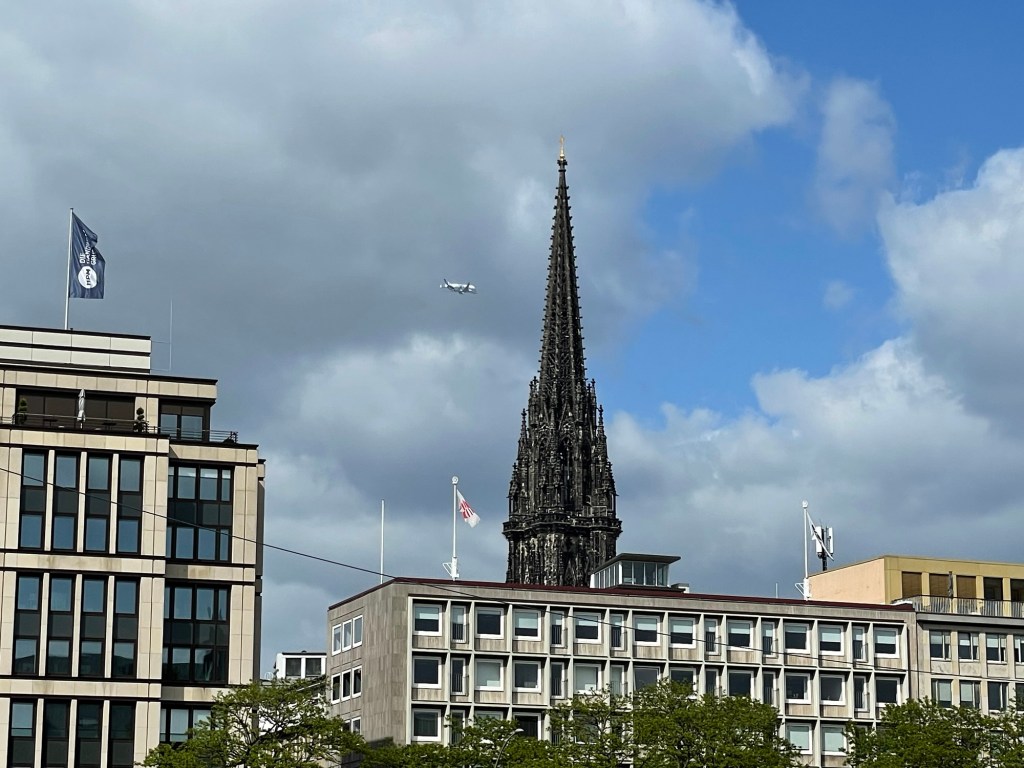
From the waterfront it was a short walk through the city’s canal zone to St. Nikolai’s church, where we were meeting Susannah’s former student Taylor Beall. The church was burned out during the Allied incendiary bombing raids in 1943, and has been left in ruins as a memorial to the many people killed. Its tall spire was left intact because the bomber crews used it for navigational purposes. It stands to this day still covered in soot, and a recently installed elevator takes you up to a level with views of the city. In the crypt below the former church, a small museum holds an exhibit about the bombing and its aftermath, which killed tens of thousands (and was seen as a response to earlier German bombing campaigns during the Blitz).
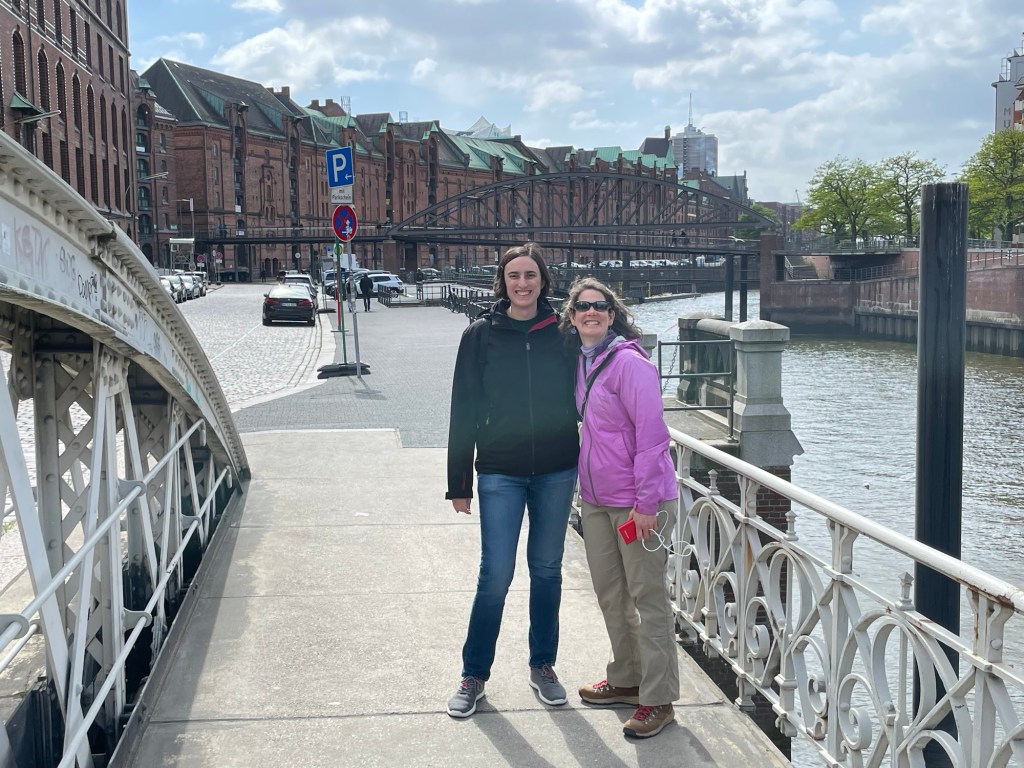
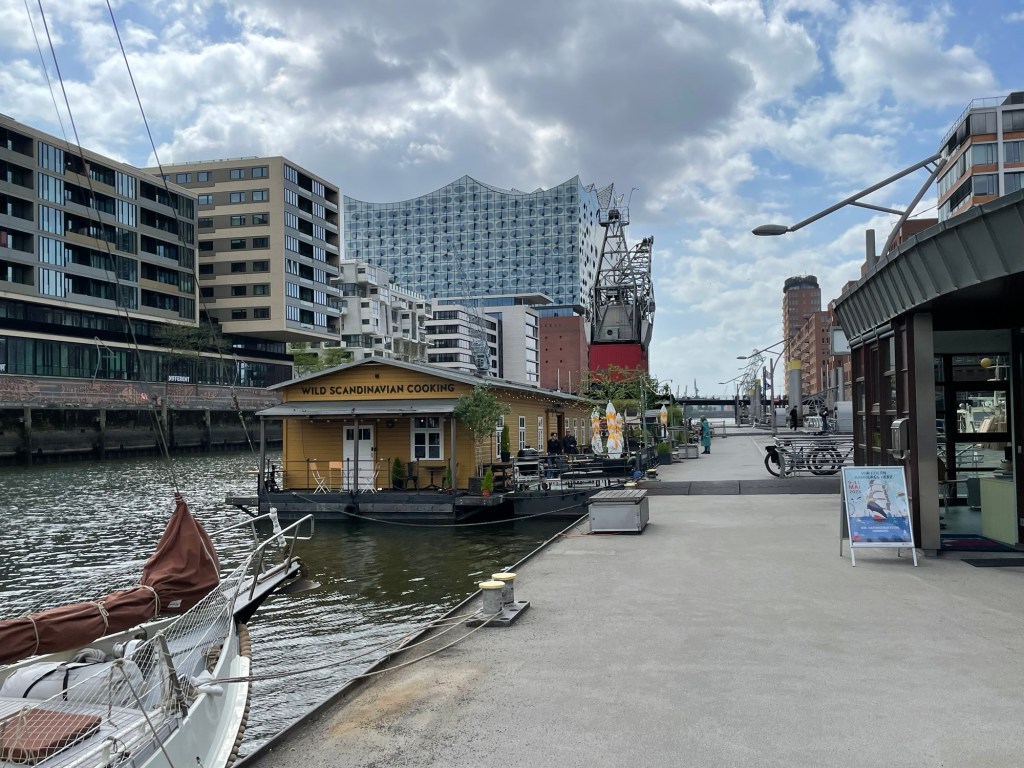
The canal district is prone to flooding, whenever a storm surge from the North Sea combines with high flow in the Elbe river. Knowing this, the lowest levels are used for car parks and other functions that can be temporarily suspended. The walkways that connect across the canals have multiple levels so that the buildings will still be connected even when the water is high. Some of the buildings overlooking the water have interesting architectural styles, cantilevering out for the best views.
Upper walkway for high-water useThe building with the scalloped roof is the Elbphilharmonie, completed at great expense but apparently offering excellent sound quality.During the Airbus tour they told us about the Beluga aircraft, used to ferry normal airplane parts inside its giant bulbous enclosure. We happened to see one over the city later in the day.
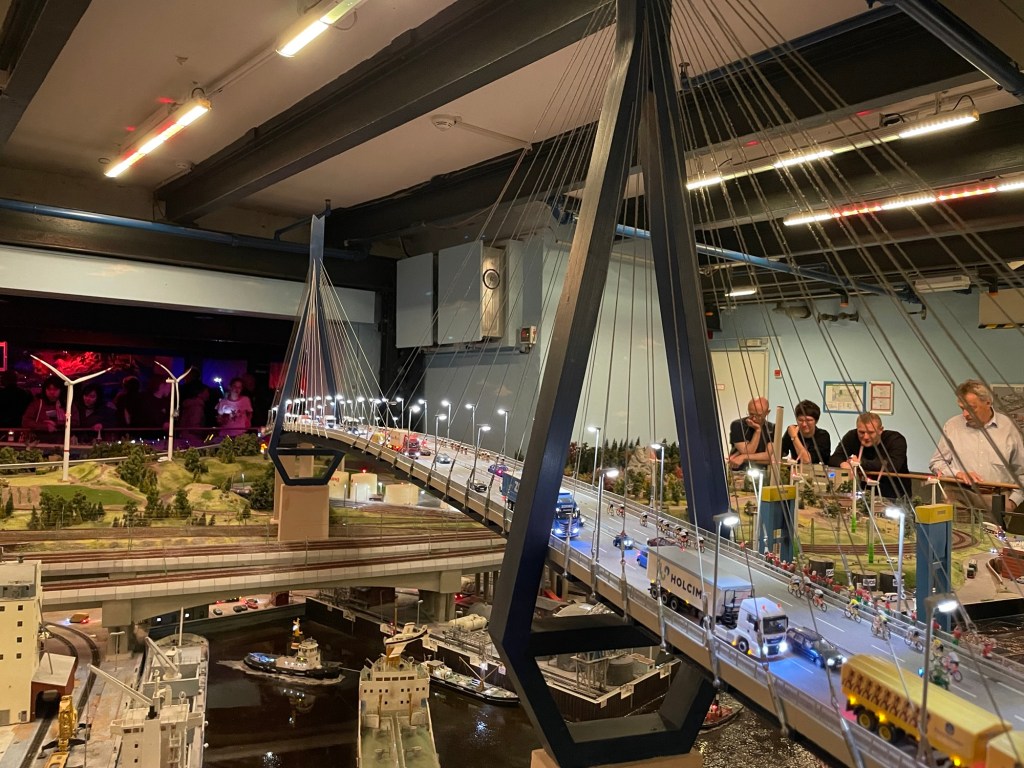
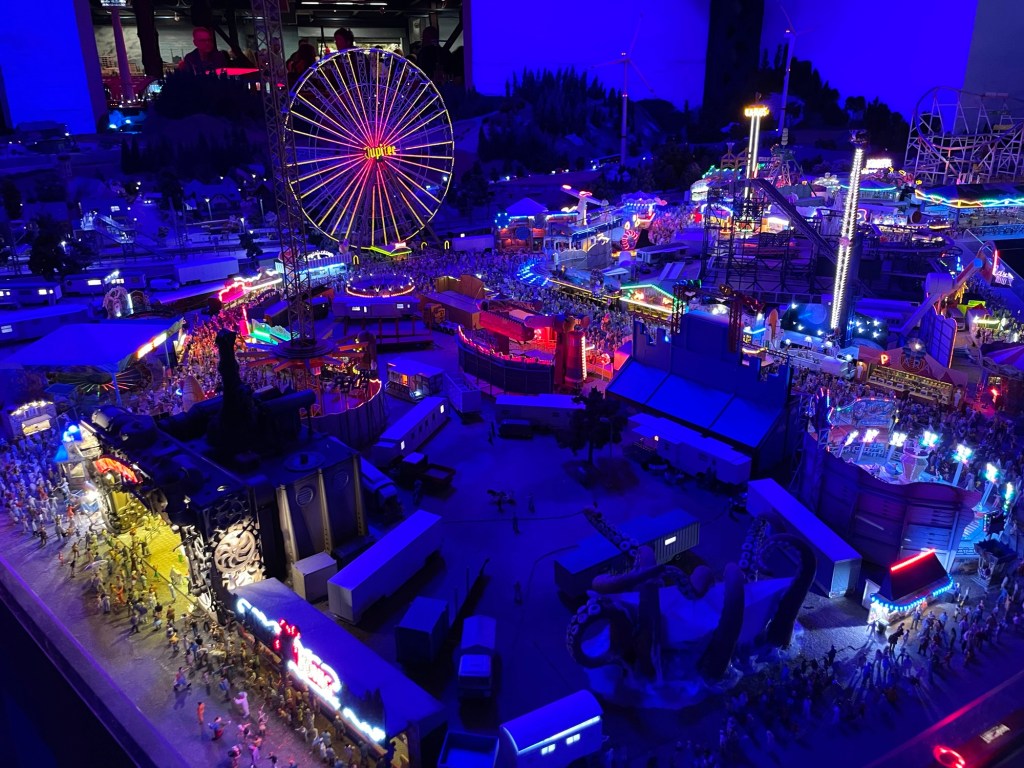
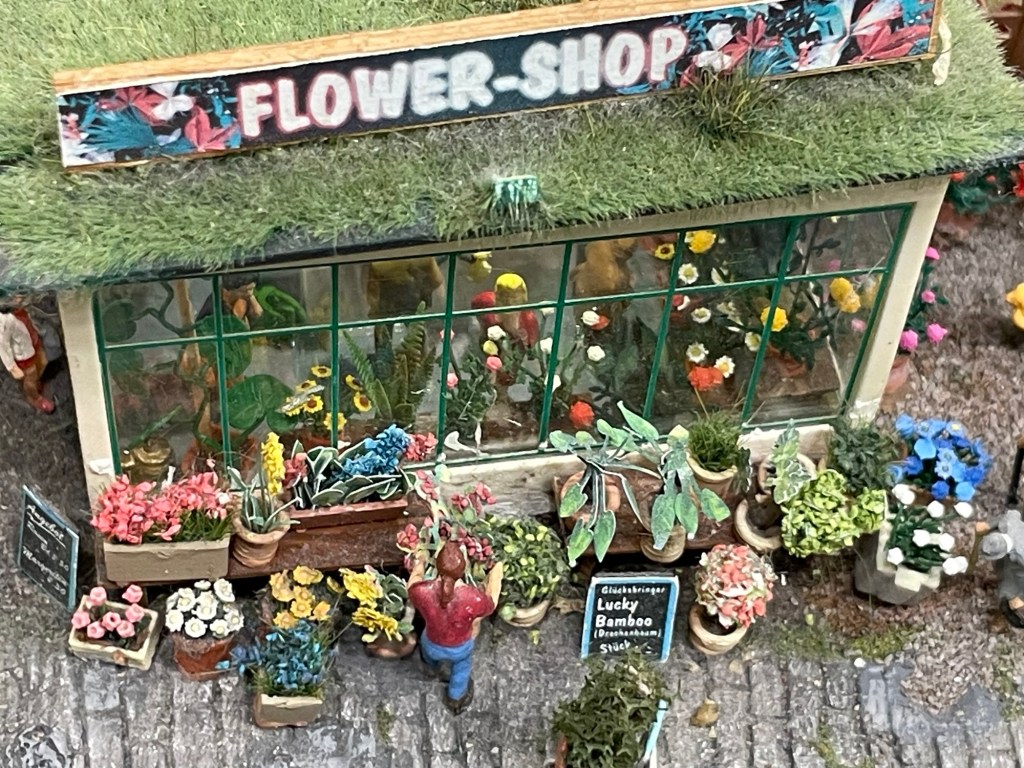
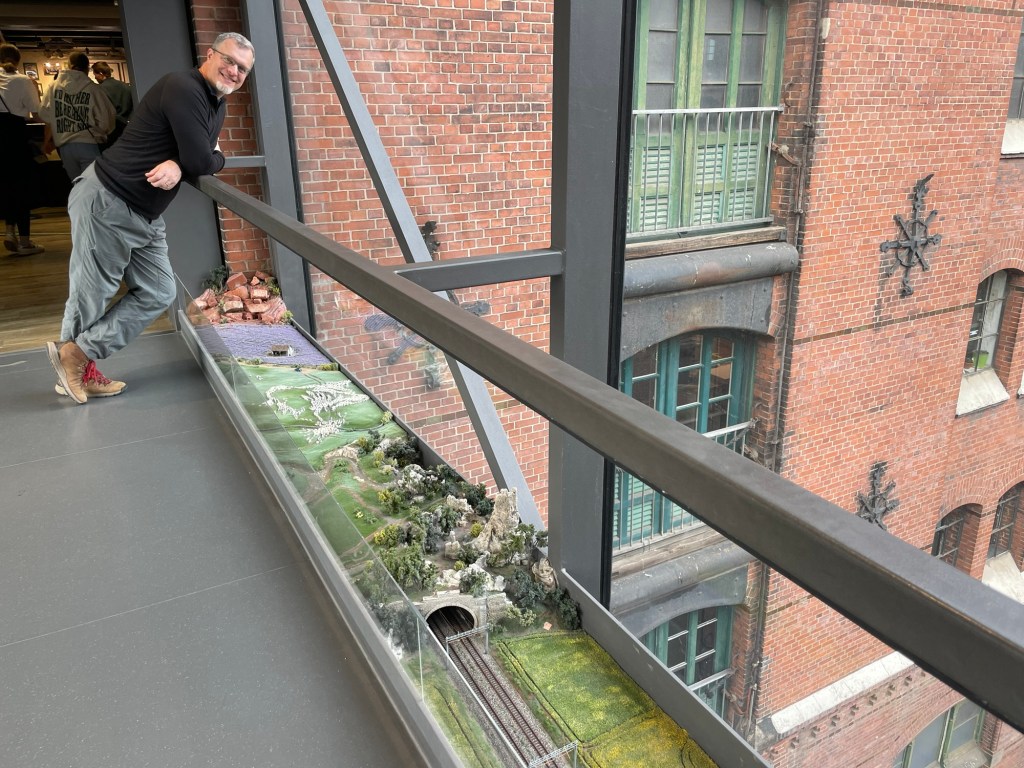
Our last sight of the day was the Miniatur Wunderland, housed in one of the old warehouses in the canal district. This museum began as a project to create the largest model railroad layout in the world. Twenty years later, it now covers multiple floors of the building and represents more than a million hours of construction work. In places, visitors could press buttons that activated certain parts of the display: operating cranes, chairlifts, drawbridges, etc. Other parts were run automatically or operated by staff from a control room.
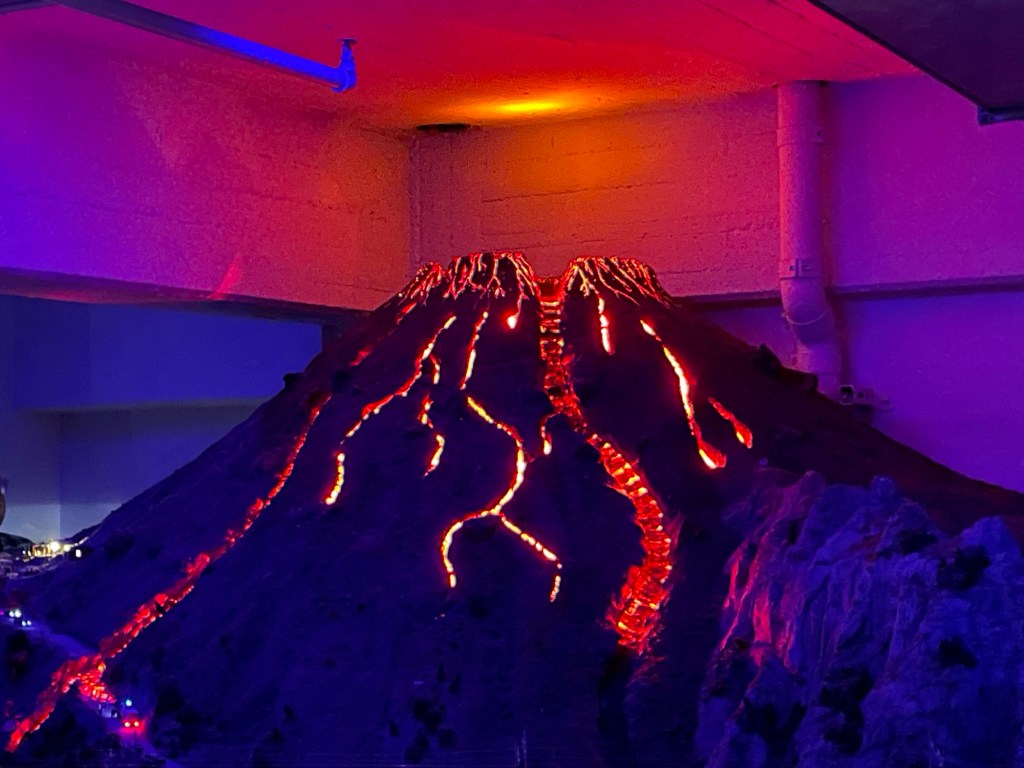
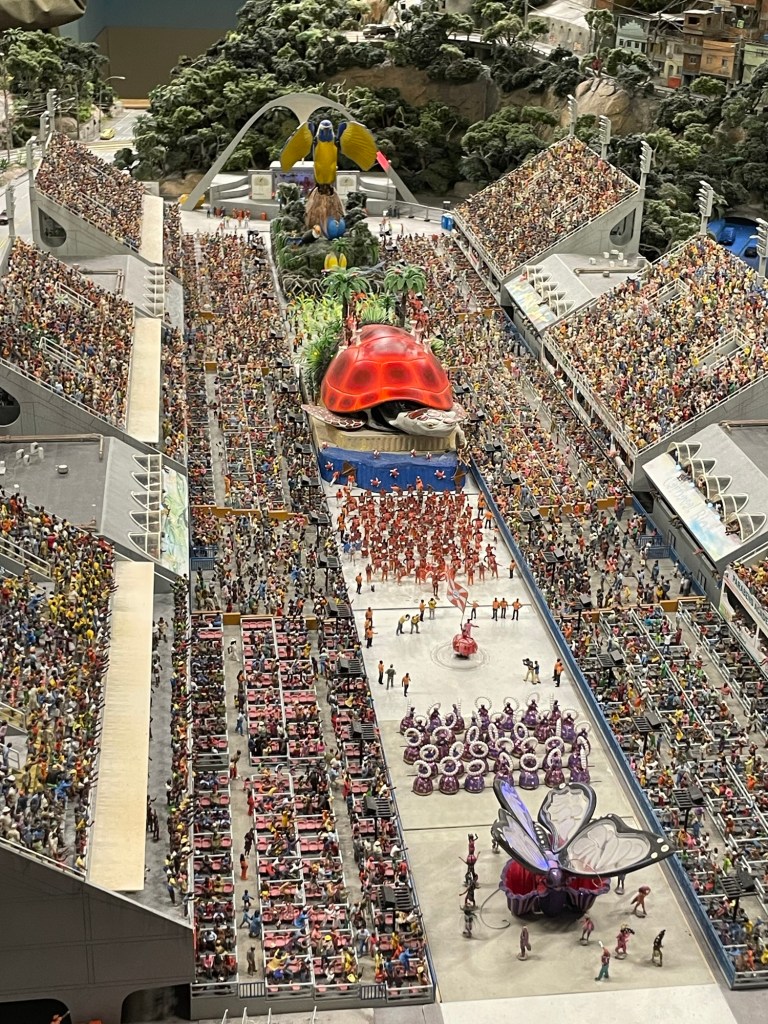
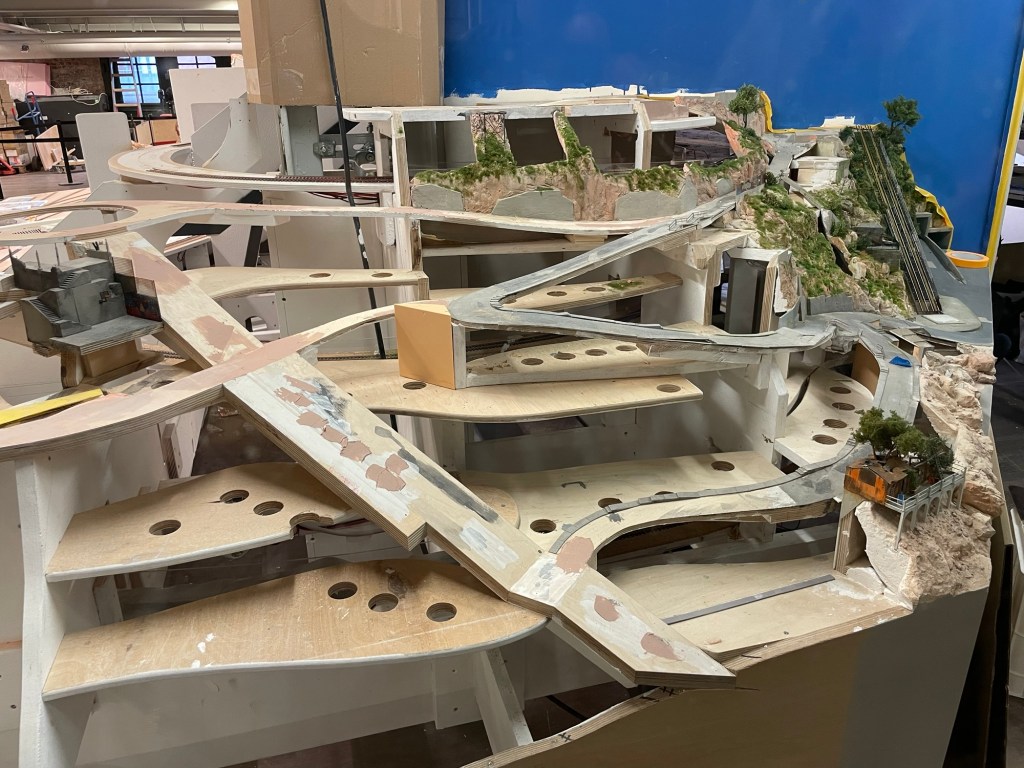
Here is the miniature version of the Elbphilharmonie. Note heads in the background for scale.The Miniatur Wunderland world cycles from day to night every fifteen minutes. During the night, hundreds of thousands of LED lights come on.The layout was filled with tiny scenes constructed with great care.A medieval tournament is taking place below this castle.The volcano eruption is impressive, with glowing lava spreading slowly down the mountain while accompanied by a deep rumbling sound.This marble quarrying operation was incredibly detailed.The chocolate factory……produces real samples – yum!The airport layout obeys all the operational guidelines of a real airport. Planes take off and land at regular intervals. Here, one plane is coming in for a landing, while others wait in the taxi lane for their turn to take off. Just for fun, a model Millenium Falcon was one of the craft using the runway today.VeniceThe exhibition crosses a skybridge into another neighboring building. The train layout also continues…The displays include a number of sites previously featured in this blog: the Arctic Cathedral in Tromso, Cadillac Ranch in Texas, Mt. Rushmore in South Dakota, and Riomaggiore in Italy.This animated scene from Carnival in Rio was truly amazing.At the end, they showed a glimpse of the workshop where they are building future additions to the exhibit. We’ll have to return again some time to see what has been added!
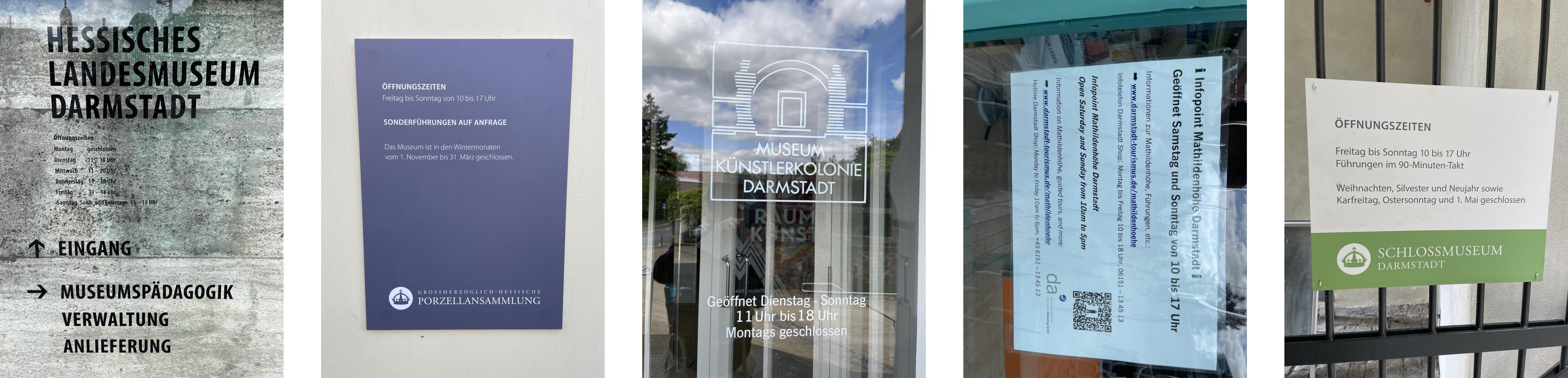
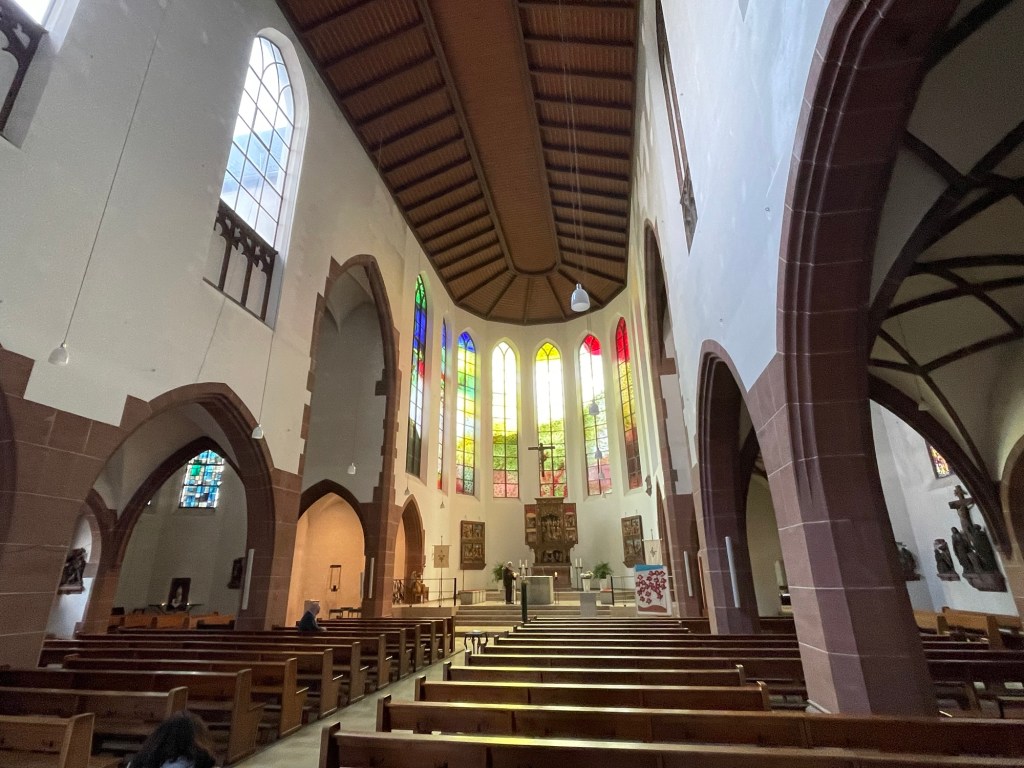
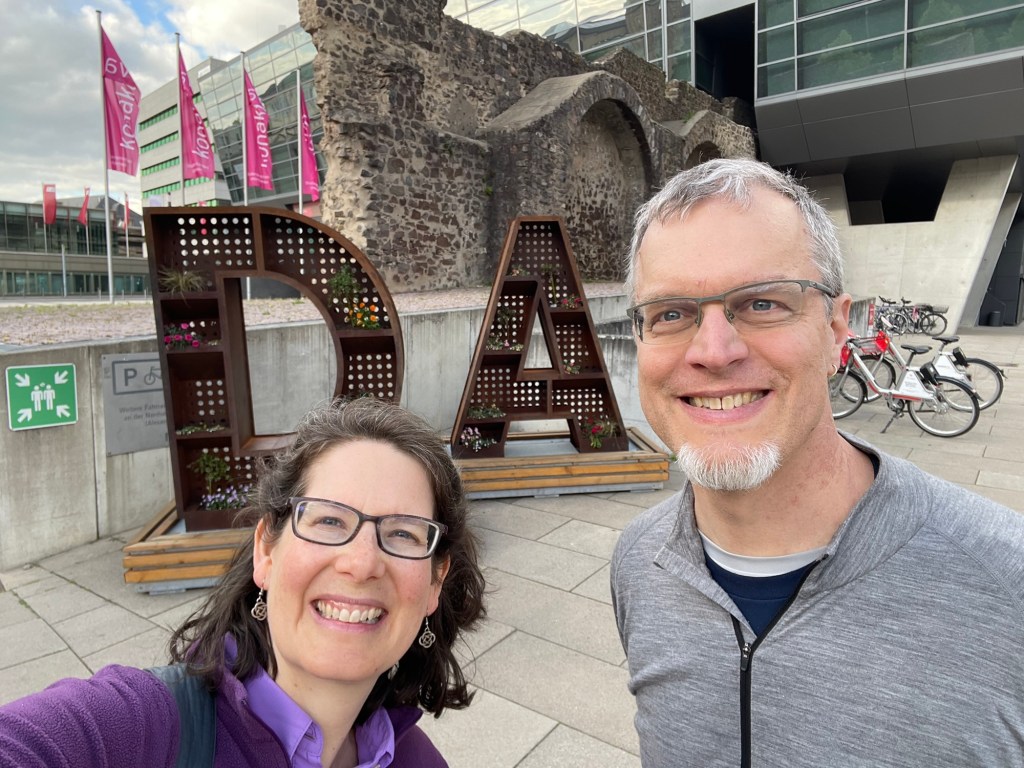
For our day in Darmstadt we split up once again, with Susannah planning a visit with former student Tiffany Liu at Energy Robotics. Meanwhile Nick planned to go sightseeing — until the woman in the tourist information office told him that no museums in Darmstadt were open on Mondays. Surely that couldn’t be the case? Unfortunately, she was completely correct. In lieu of museums, Nick spent the day exploring the city on foot. Armed with a tourist map of all the sights, he visited any that seemed remotely interesting. Some of the highlights appear in the captions below.
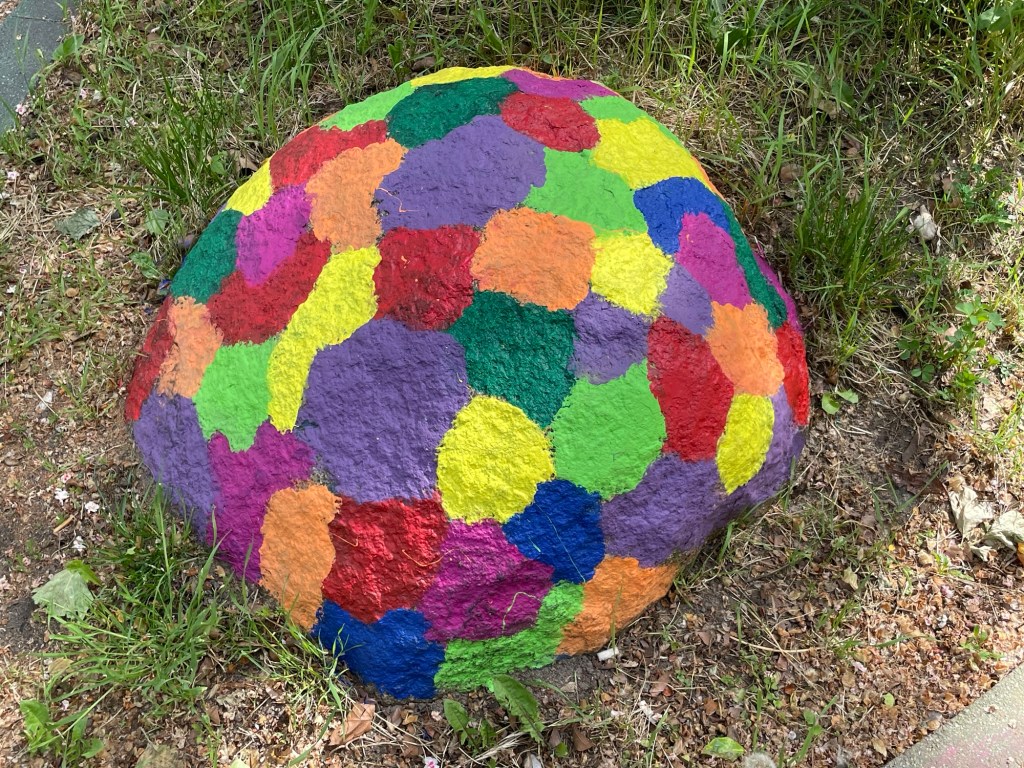
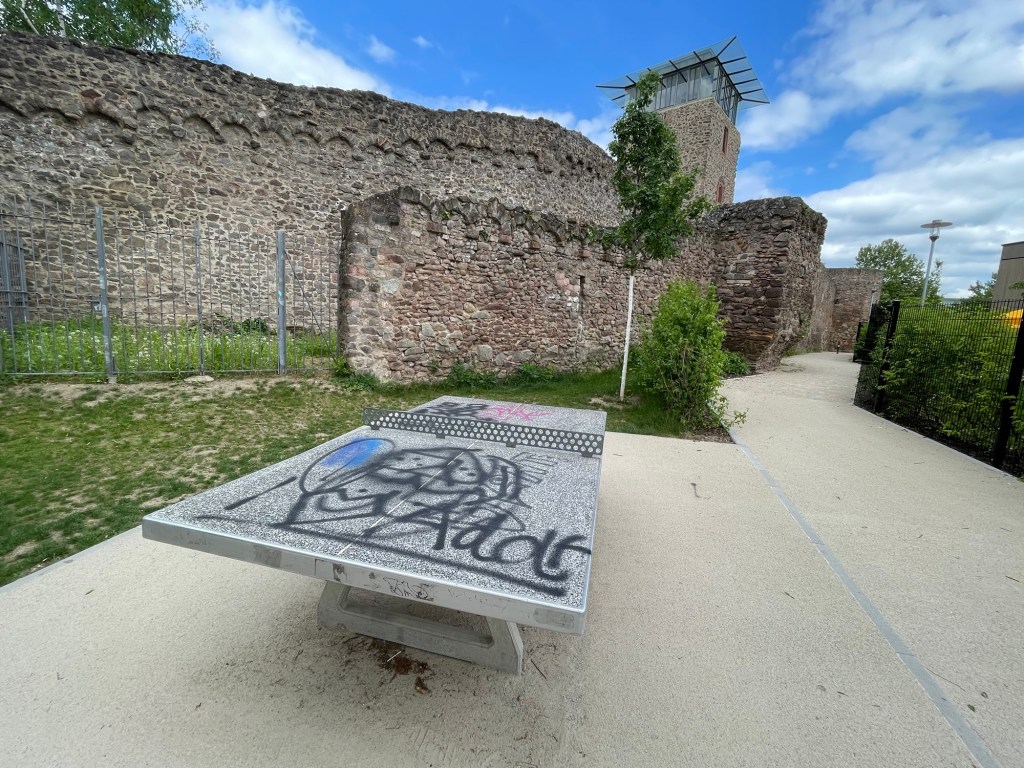
Everything is closed on MondaysThe German post delivers mail in the city using specially built bicyclesBird of the day: A number of Egyptian geese could be found on the park lawns. Although native to Africa, they have been introduced to Europe as an ornamental bird.This pillar in a geometric garden had sundials on all four sides. (Each was different from the others, due to its differing orientation.)Although the porcelain museum nearby was closed, this church had its doors openSomeone painted this colorful rock by the side of the roadWhen we visited Mathildenhöhe the day before, we didn’t notice the sculpture behind the chapelIn the shadow of the city wall is this pingpong table with a metal netThe moat of the palace serves as a sculpture garden. This piece is entitled “Out Of Service”.This sculpture is constructed out of stacks of gasoline cansThe city’s oldest church dates from the 14th century and has interesting roof detailsNick liked the expression on this stone creature
Meeting up at the end of the day, we picked up a portable dinner before heading to the train station for the 3.5 hour ride to Hamburg. Our lodging for the next two days is somewhat unusual: we’re in a small RV camper that is parked on a hotel’s rooftop terrace. Seemed like an experience worth trying…
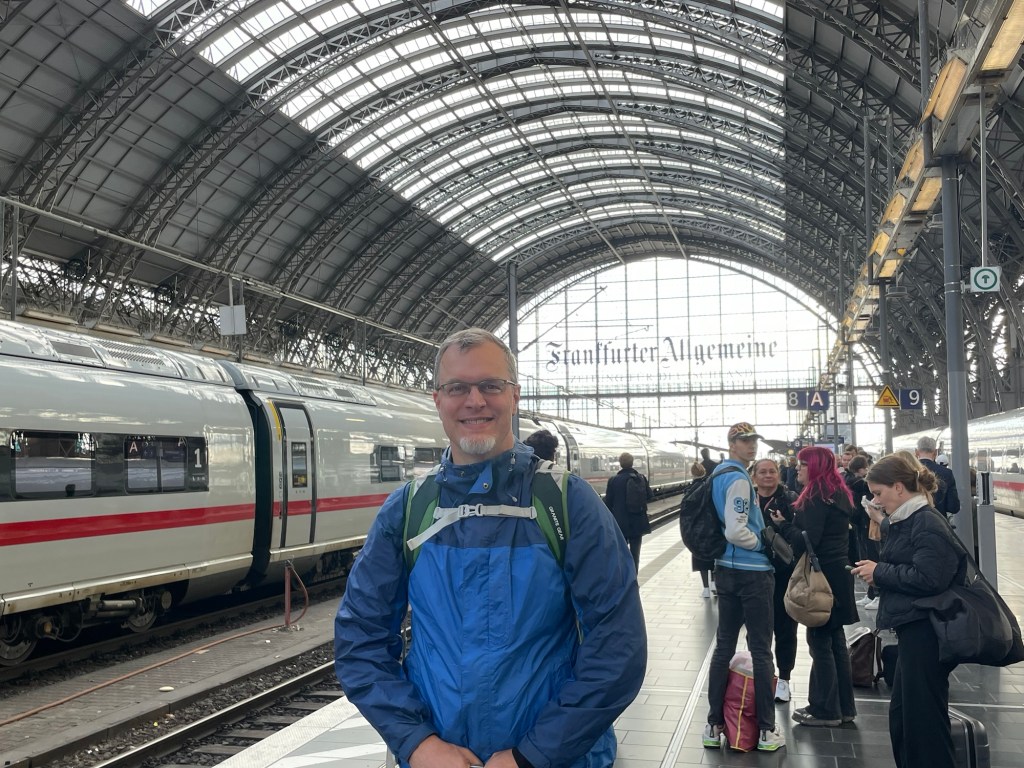
Changing trains in FrankfurtWe arrived in Hamburg after darkOur camper is Peace & Love, on the rightHow cozy! (It even comes with a guitar, a record player, and an assortment of 1960s records)
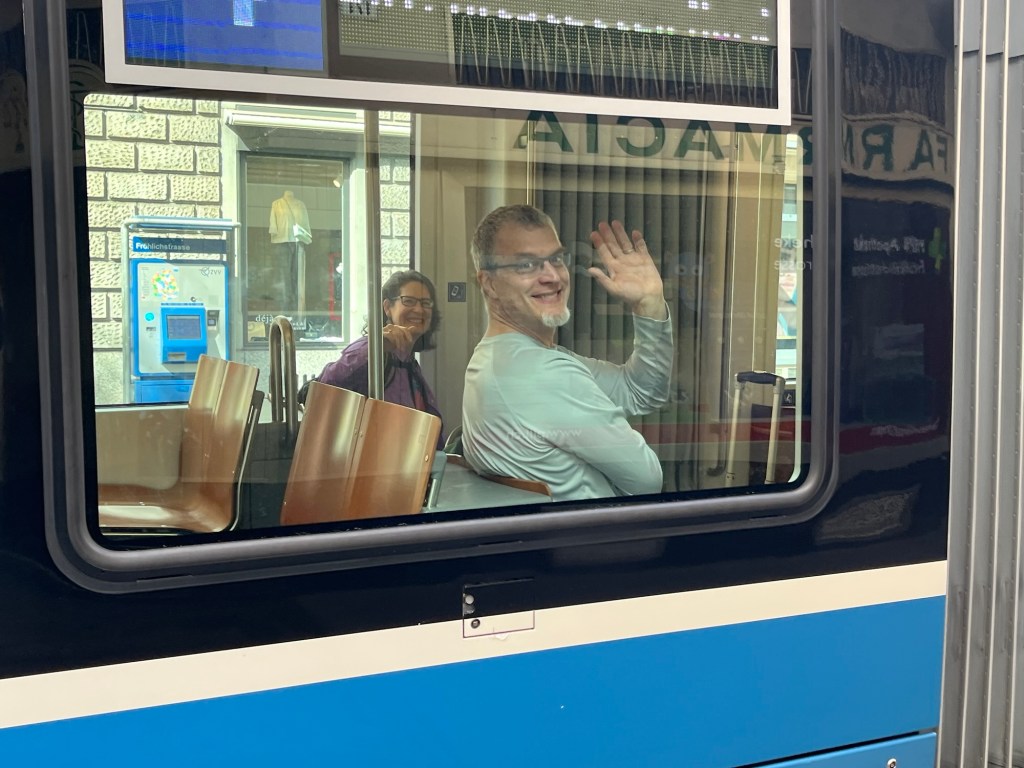
We said goodbye to Switzerland this morning and boarded the train to Germany. We are stopping in a few places where Susannah can meet up with former students and shadow them at their work. Our destination today was Darmstadt, a city slightly south of Frankfurt. Our hotel there is called the Moxy.
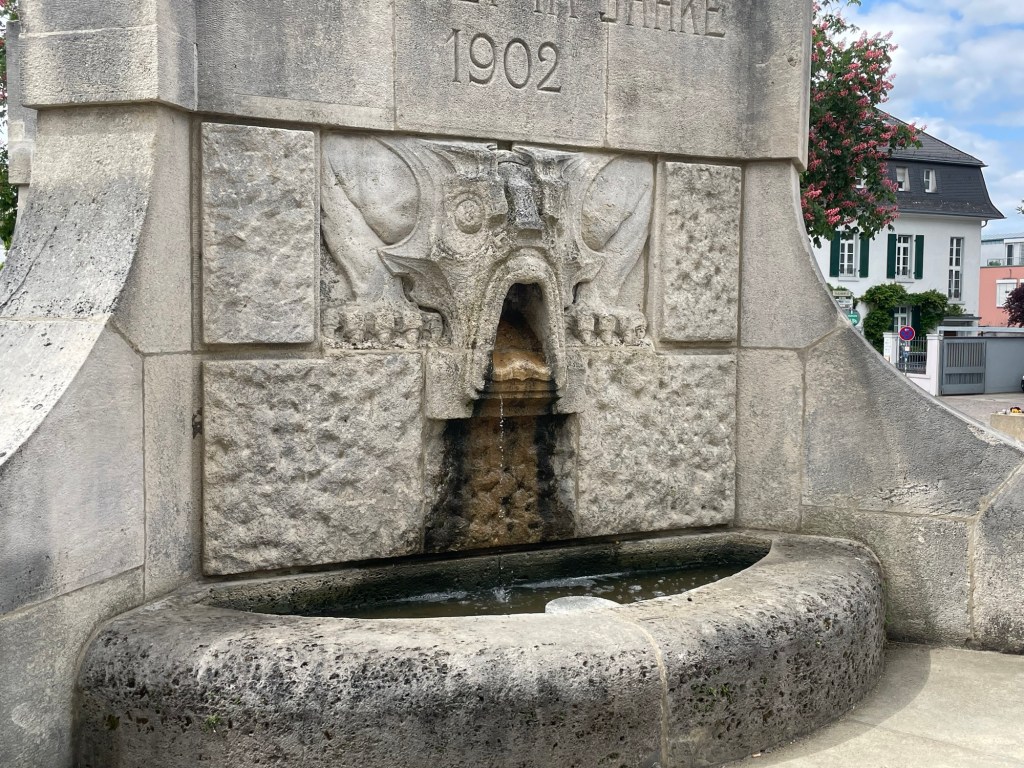
Some might accuse Darmstadt of being an unlovely place, and we might be a little hard-pressed to repudiate that claim. (Blame the Allied bombing campaign in WWII for its lack of many old buildings.) Be that as it may, we went for a walk after arriving in the late afternoon and managed to discover a few interesting and even charming features.
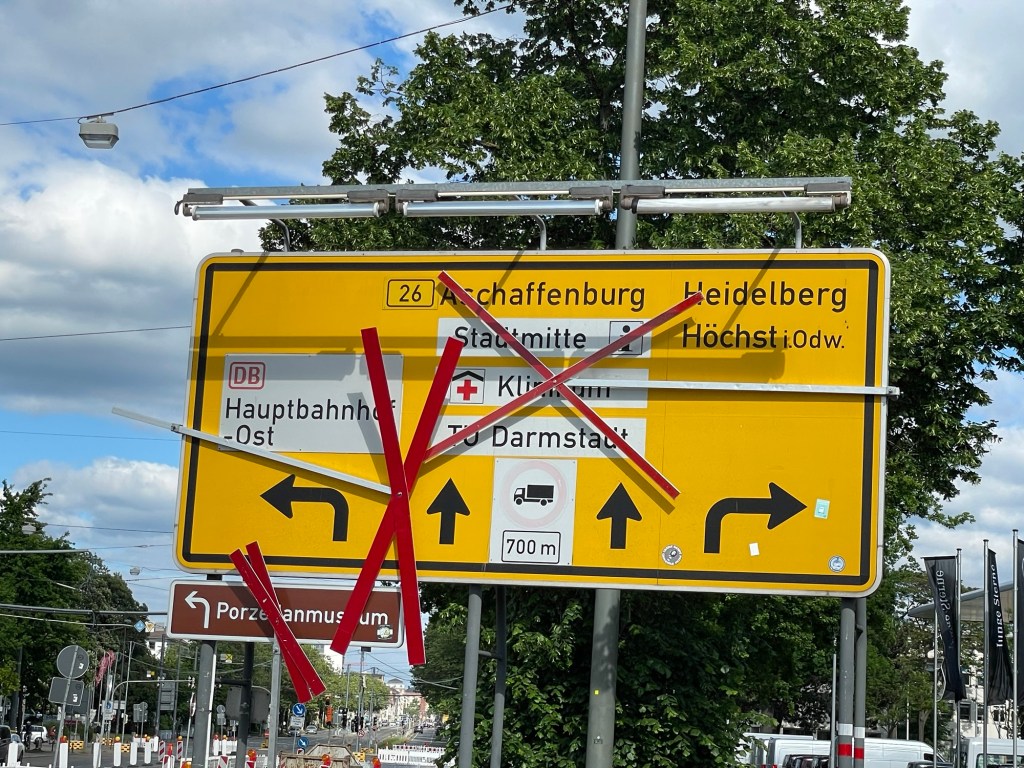
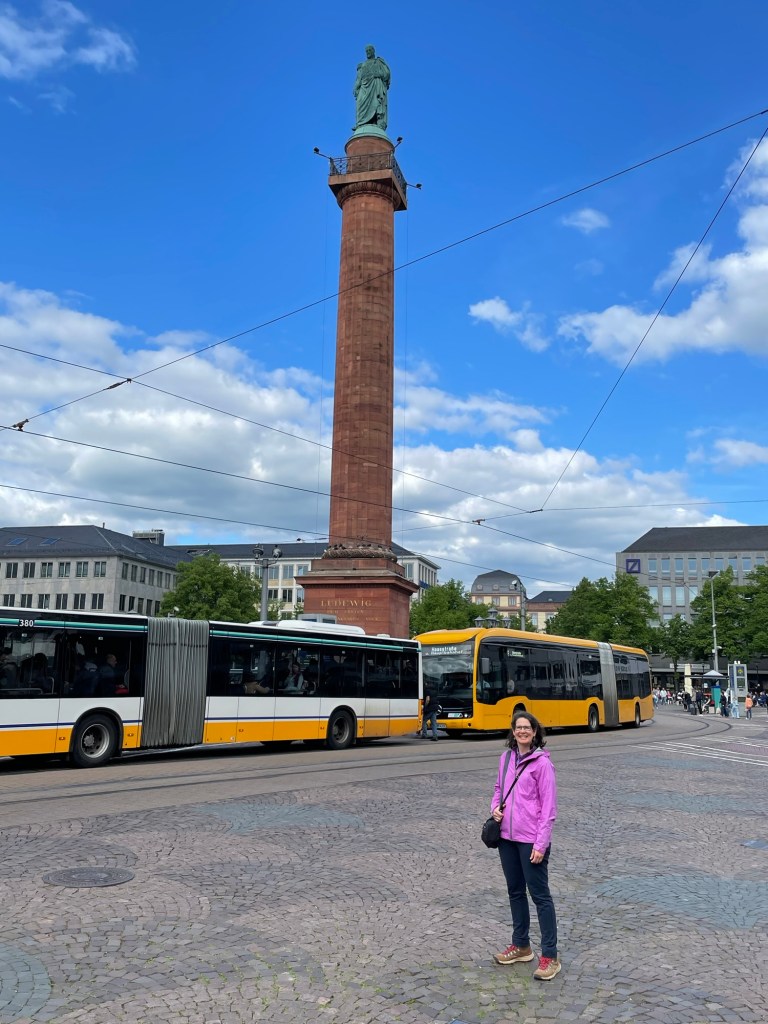
While this road is under construction, apparently it is important to keep the information on signage up to date.A pillar erected to honor Ludwig the First, Grand Duke of Hesse-Darmstadt, ostensibly as a tribute from his loyal subjects
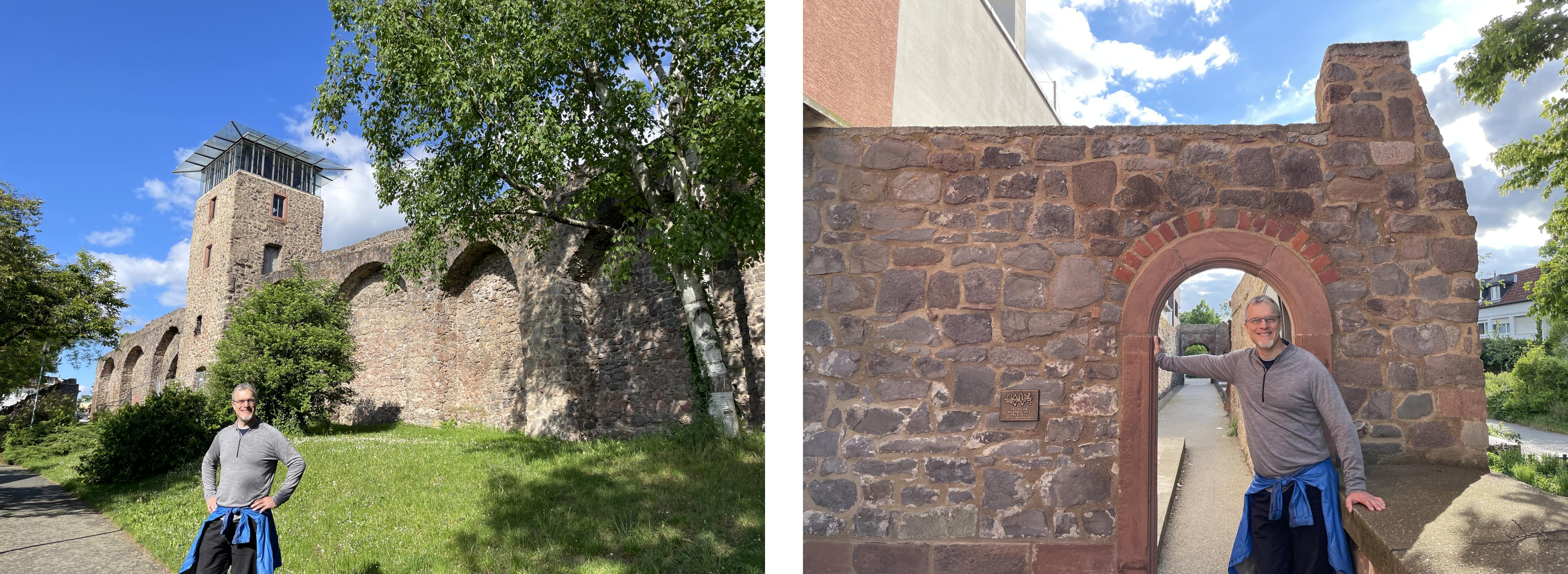
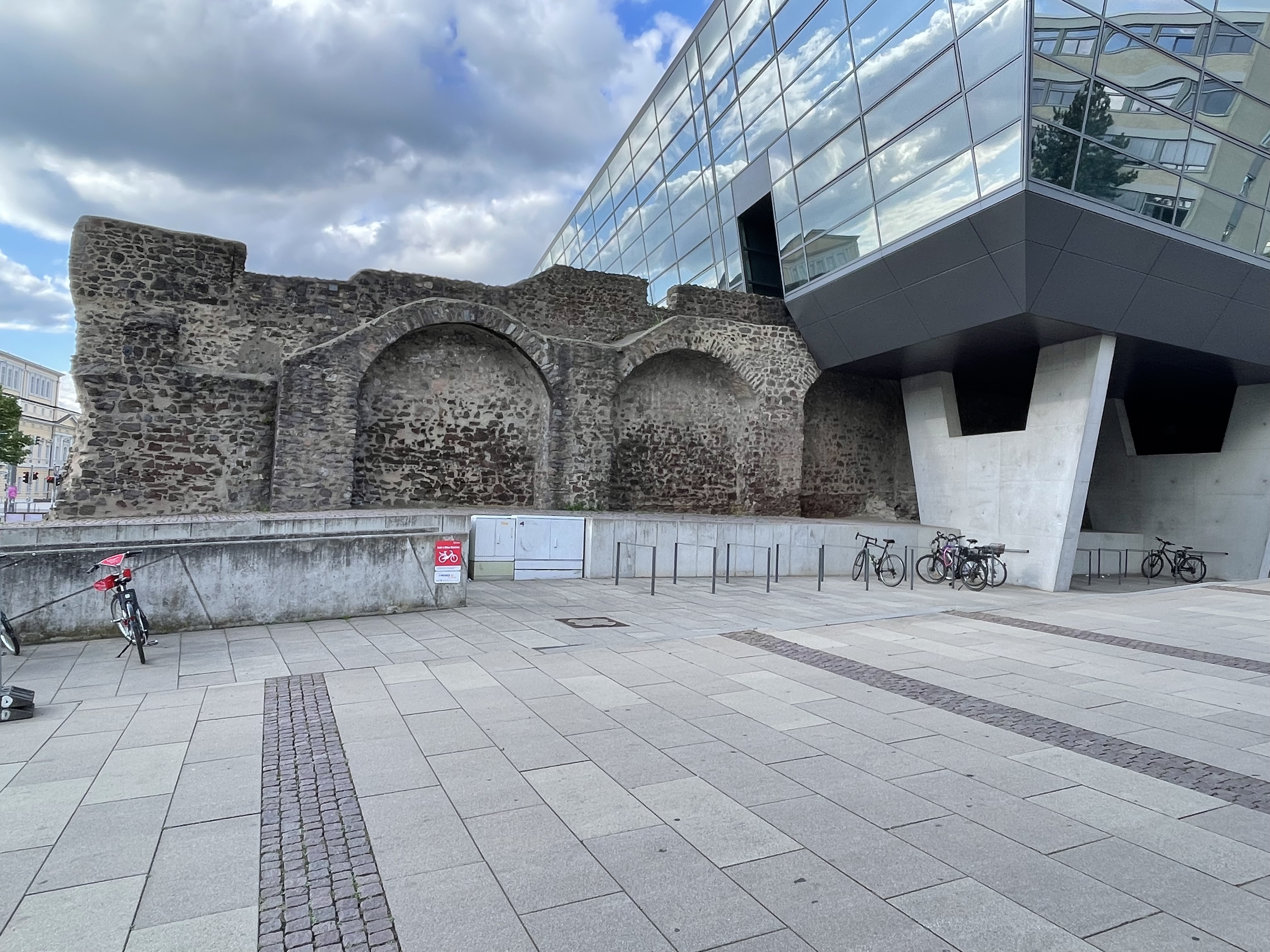
We were pleased to discover here and there some remnants of the old city walls that still survive despite the devastation of war. The locals clearly value them as well, since they designed a whole building to accommodate one such relic.
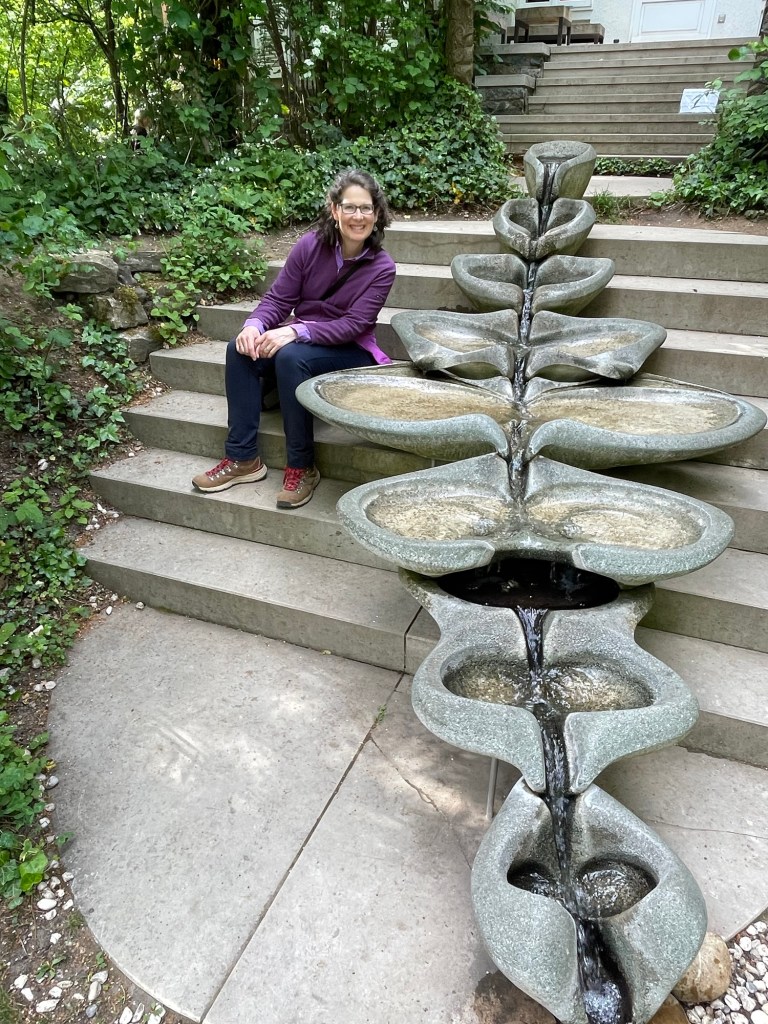
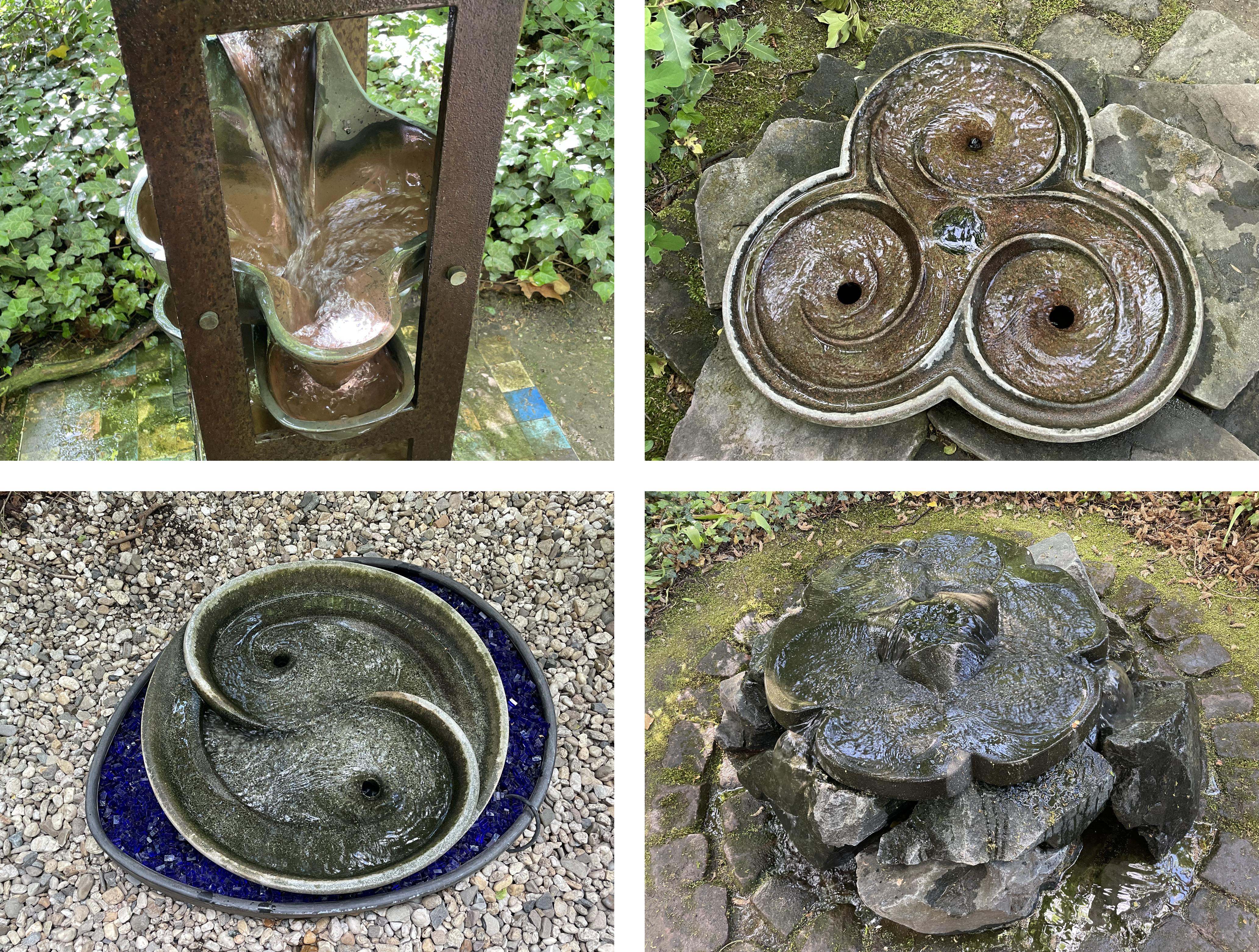
We also discovered a small but lovely garden, privately owned but open to the public, with a warren of cozily meandering paths punctuated by interesting and quirky sculptures. Many of these featured a theme of swirling water, and thus the whole place was called the Vortex Garden.
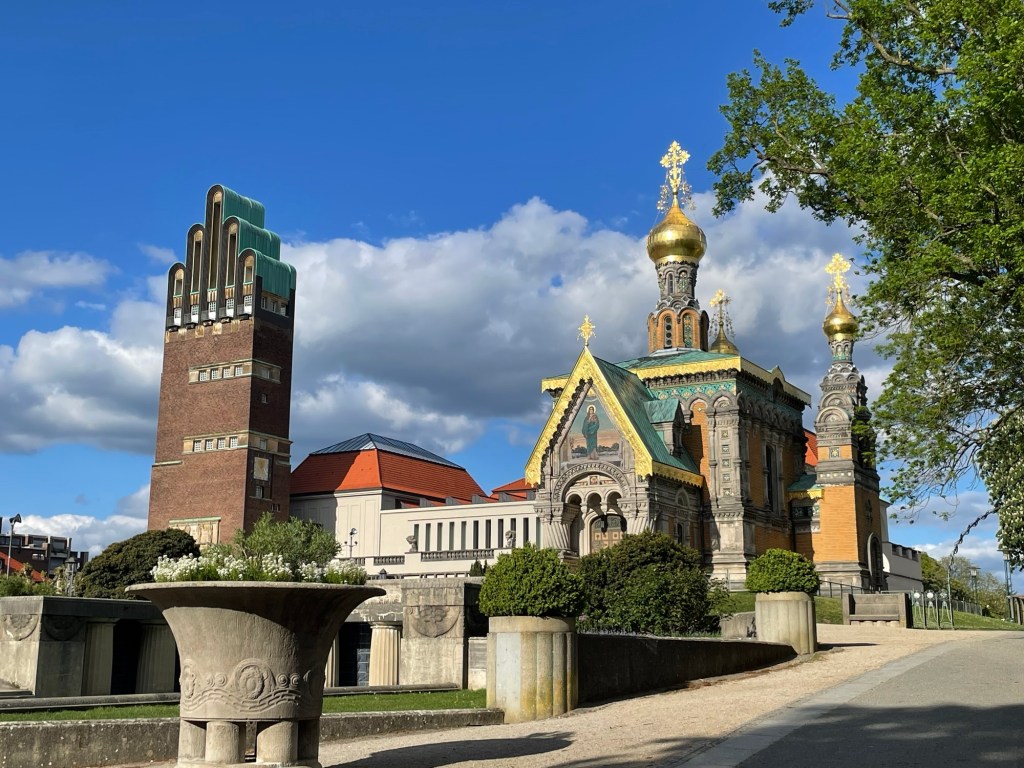
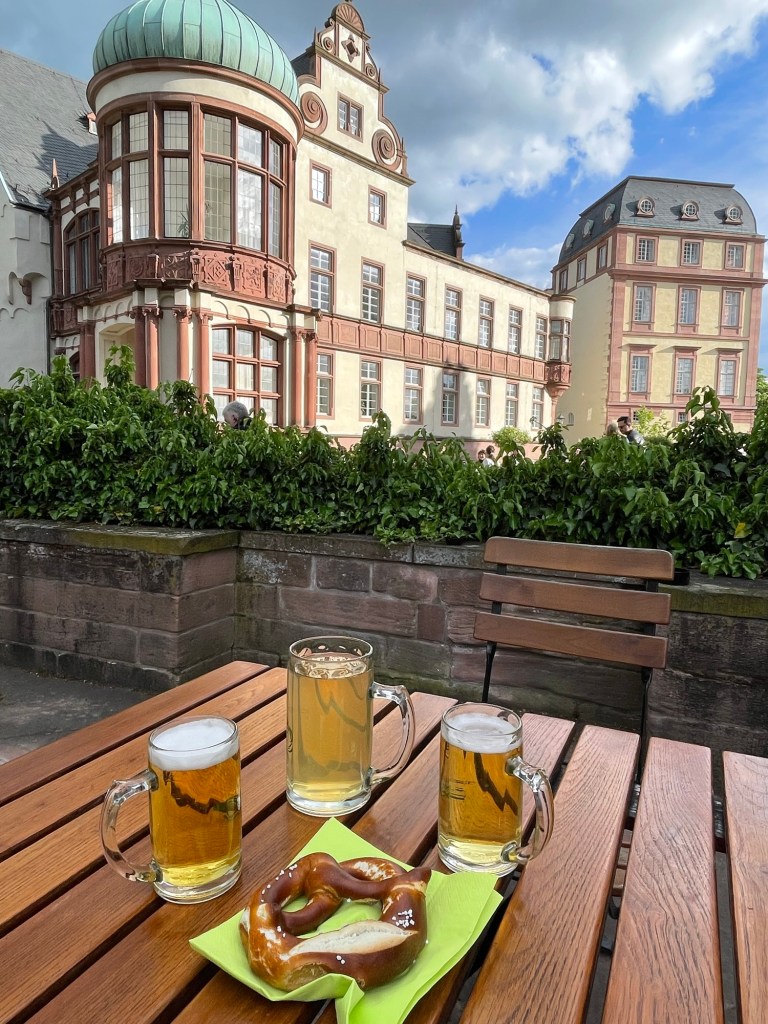
We also came across a number of interesting water features in the city outside the garden. Besides these, we saw the buildings of Mathildenhöhe and the Darmstadt Palace. The latter hosts a pleasant beer garden on its grounds, where we had a fresh pretzel with a toothsome crispy crust and a few half-glasses of different beverages. Nick tried the cider, which according to local custom is mixed with sparkling water for a refreshing treat. Finally, after we had finished our exploration we went for dinner at a restaurant with a Mongolian grill, which are hard to find where we’re from. All in all, a satisfactory day!
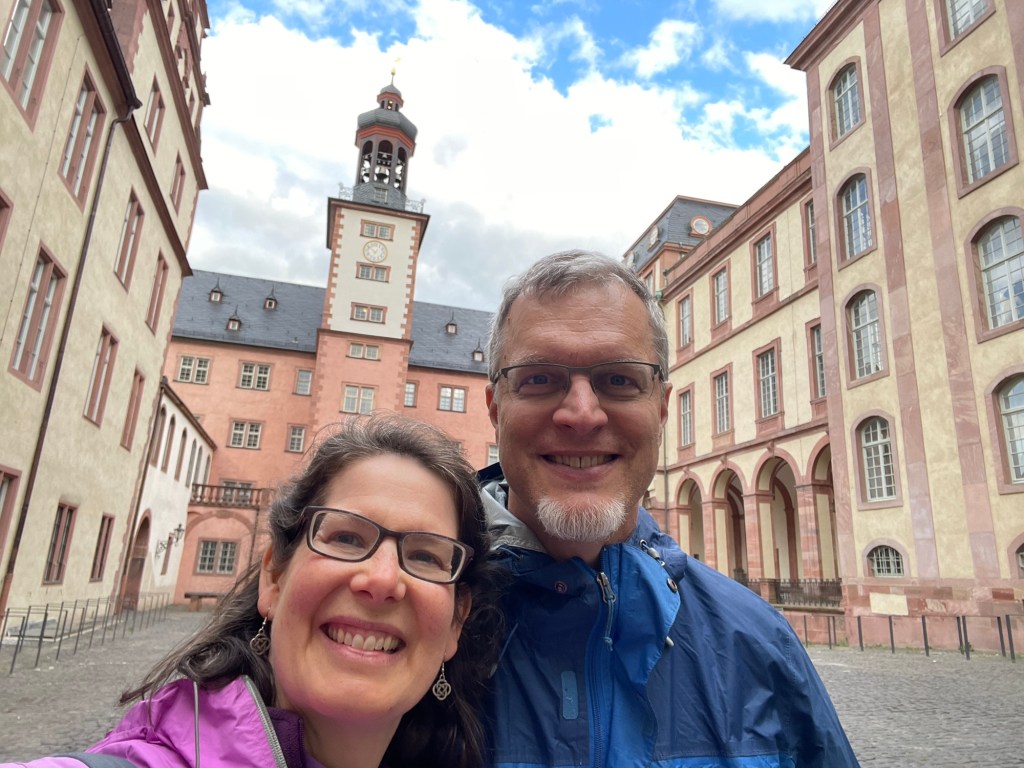
Clockwise from top left: surprise fountain in a pedestrian underpass, public lake with swimming and diving areas, fountains in city squaresMathildenhöhe Beer (small steins!), cider, and pretzels in the shadow of the Darmstadt PalaceCourtyard of the Darmstadt Palace. We could imagine carriages drawing up here for a nobles’ ball.





































































 Howes' Doings