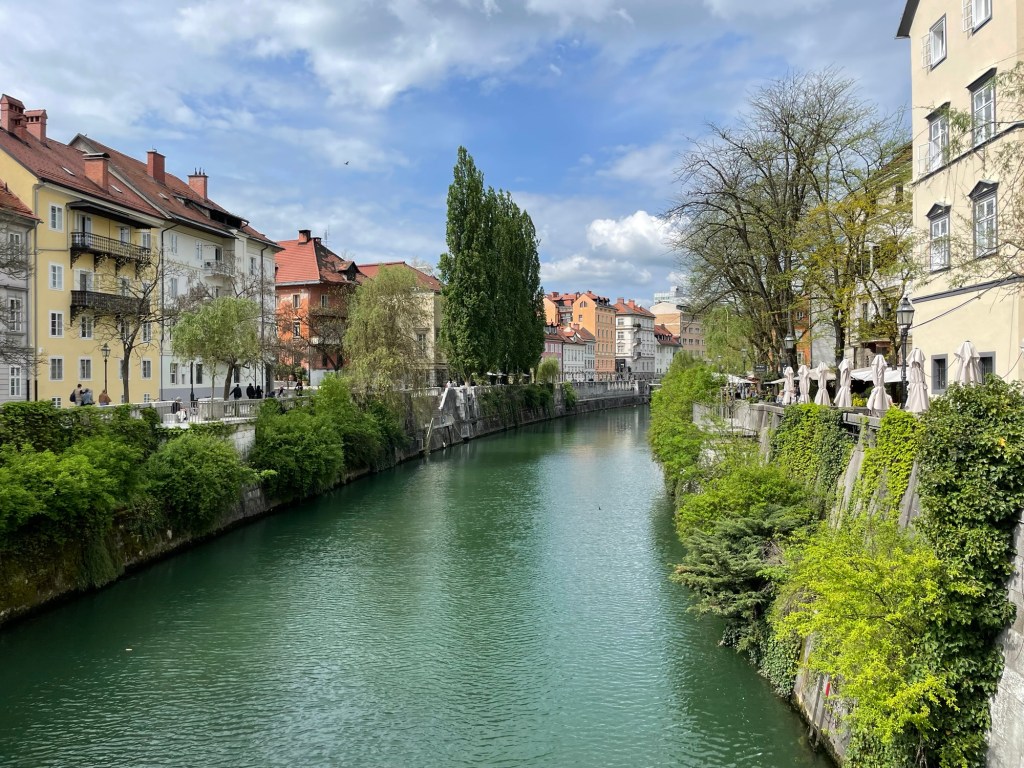
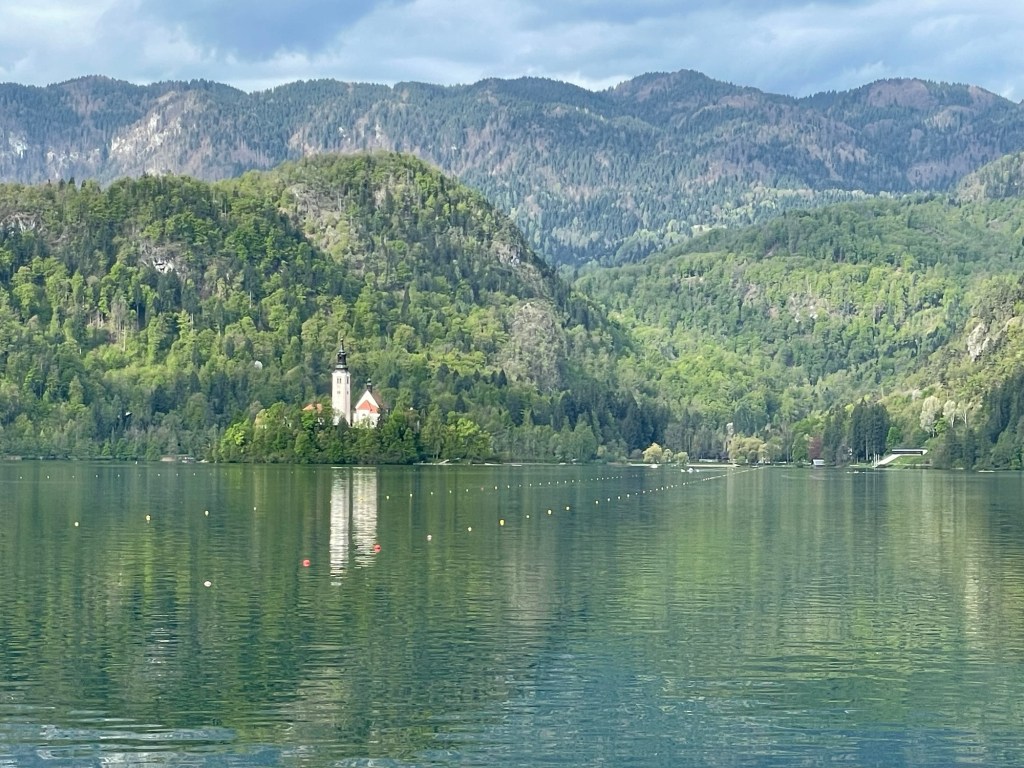
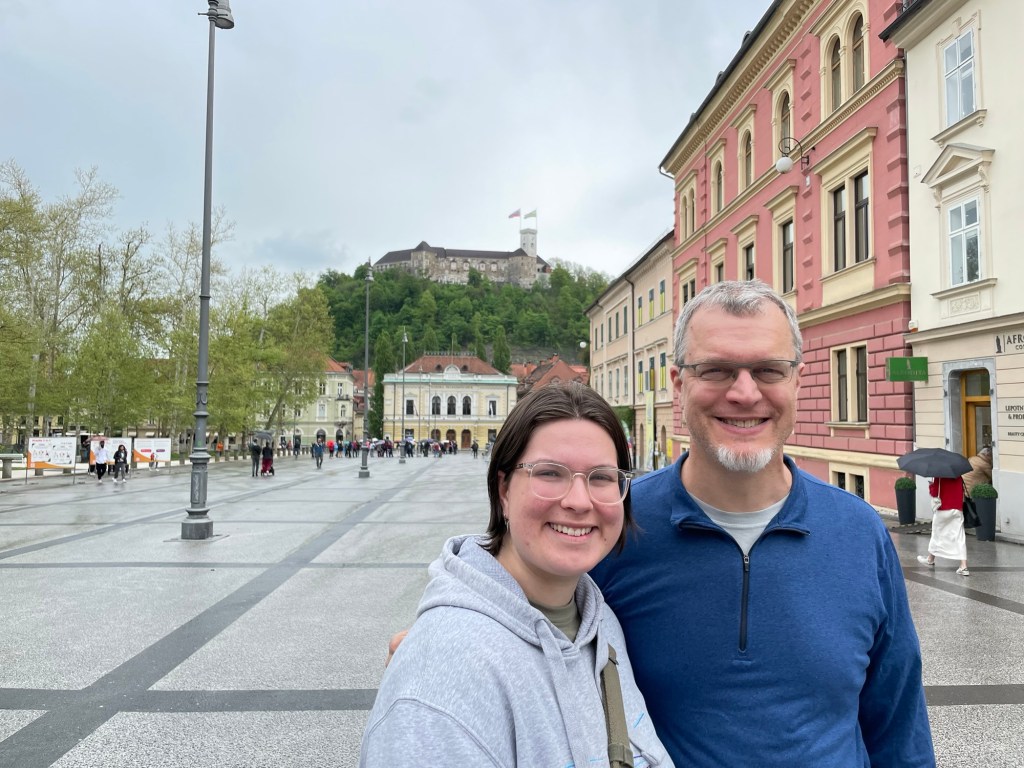
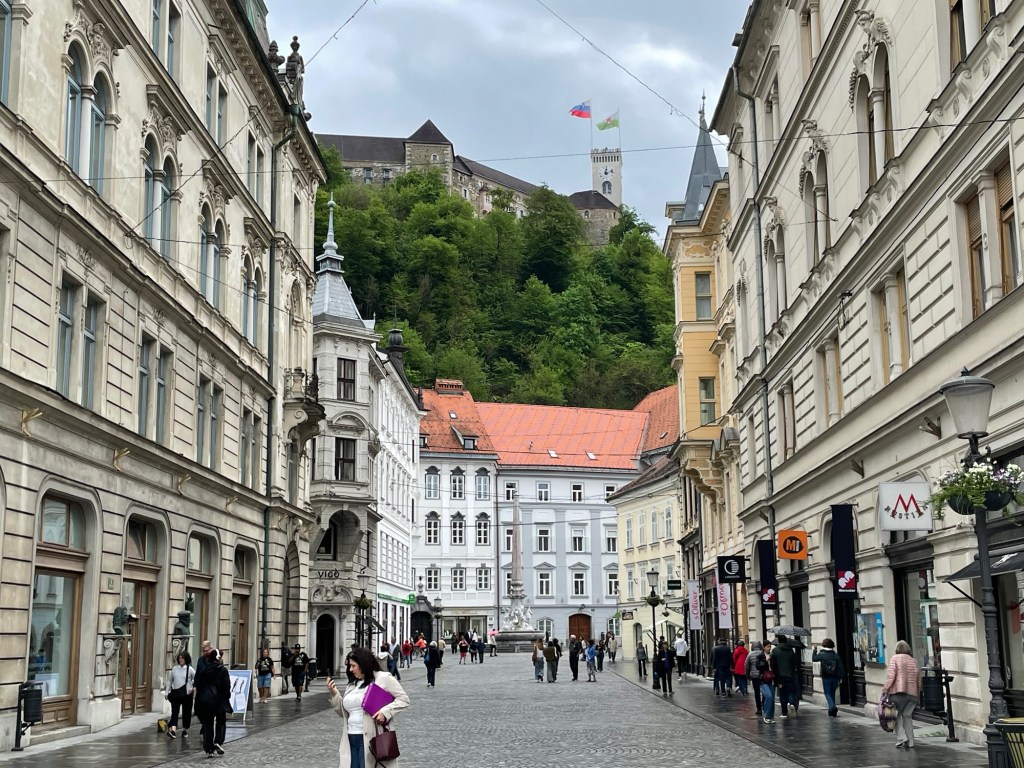
After a final morning walk around Lake Bled, we bid a reluctant farewell to its town and hit the road en route to Slovenia’s capital, Ljubljana. Rowan had previously visited the city with their study abroad group, and was able to guide us to their favorite sites and experiences. Although the castle that stands at the high point of the city looks picturesque from a distance, apparently there’s not much to see inside. Most of the interesting sights are instead centered around the river below.
Rowing course on Lake Bled – at the far end there are stands for spectatorsCongress Square in Ljubljana – our starting point in the cityThe Ljubljanica River runs through the old city
Ljubljana is known as the city of dragons due to a tradition that Jason (of Argonauts fame) came here in antiquity and slew one of the beasts. Over time, the association changed and the dragon came to be seen as the defender of the city. Dragons are celebrated in all the souvenir shops of the city, and have even been celebrated in the architecture: one of the city’s river crossings features four of the beasts in bronze, perched atop the bridge abutments.
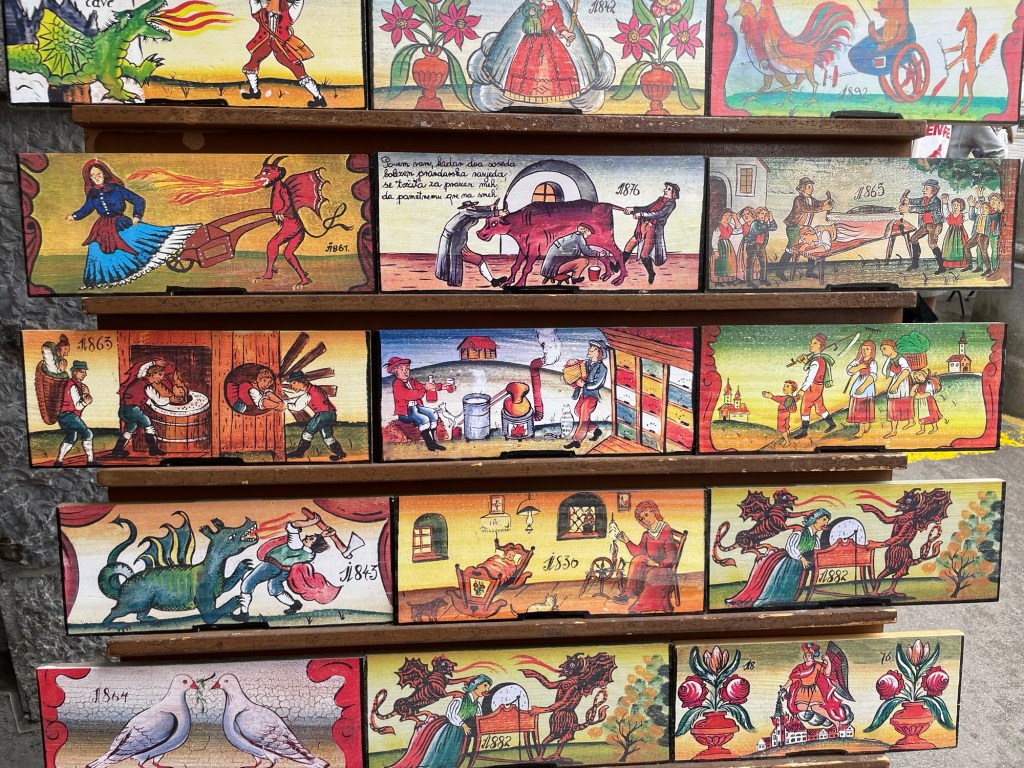
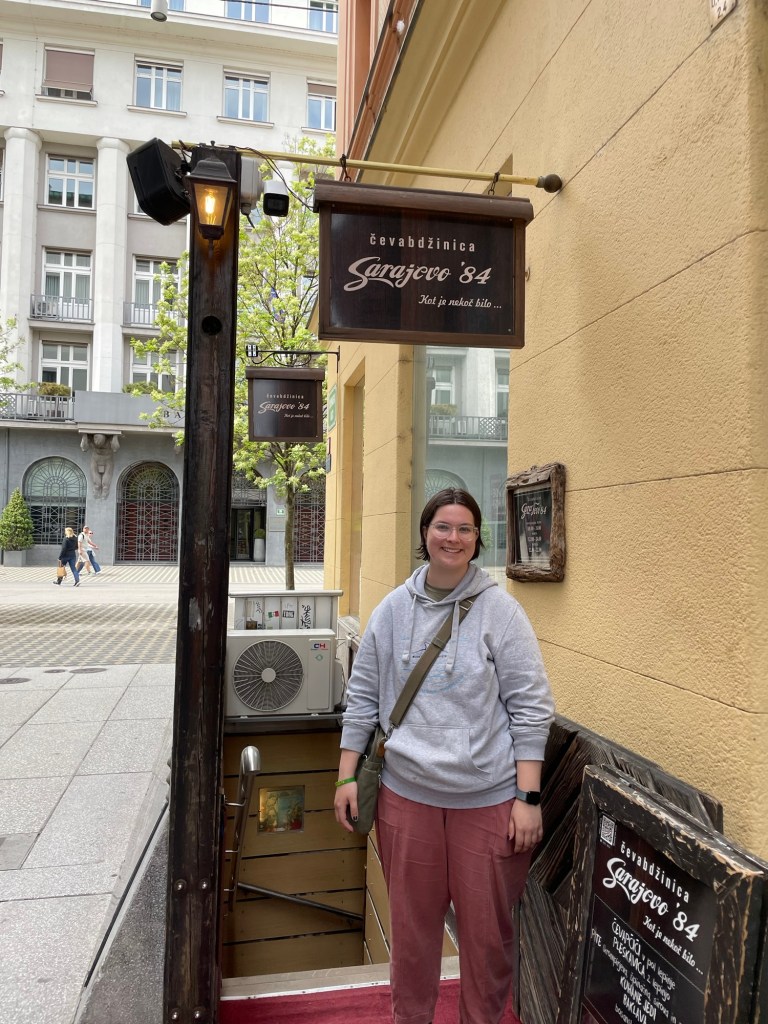
We include here a few other pictures from our visit. In a riverfront stall we came across this display of replica souvenir bee boards, which we photographed to make up for yesterday’s lack. (Alas, we still have no image of the “Snail chasing Tailors”!) On Rowan’s recommendation we also visited the popular restaurant Sarajevo ’84, which specializes in ćevapčići, a dish of grilled fingerlike meatballs served on pita-like bread, often with a soft cheese.
We could only stay in Ljubljana through mid-afternoon, as we still had further driving ahead of us to reach our lodgings for the night in Rovinj, Croatia. The route passes not far from the Italian border, and somewhat on a whim we decided to make a detour in order to see a bit of the city of Trieste. In hindsight this was not the wisest of plans; the roads around Trieste proved to be a lot like those around New York City — confusing, inconsistently marked, and arranged in such a way that any mistakes are very hard to correct. So in the end, we did see a bit of Trieste — only from the distant heights above the city as we drove along a highway filled with trucks, rather than strolling around the grand canal after popping briefly into the city center, as we had fondly imagined. Live and learn. In the end we crossed three international borders during our trip — from Slovenia into Italy, Italy back to Slovenia, and then from Slovenia into Croatia. Sadly, nobody stamps passports any more when you cross borders in Europe these days — good for efficiency, less good for sentimental collectibles.
Border station heading into Croatia
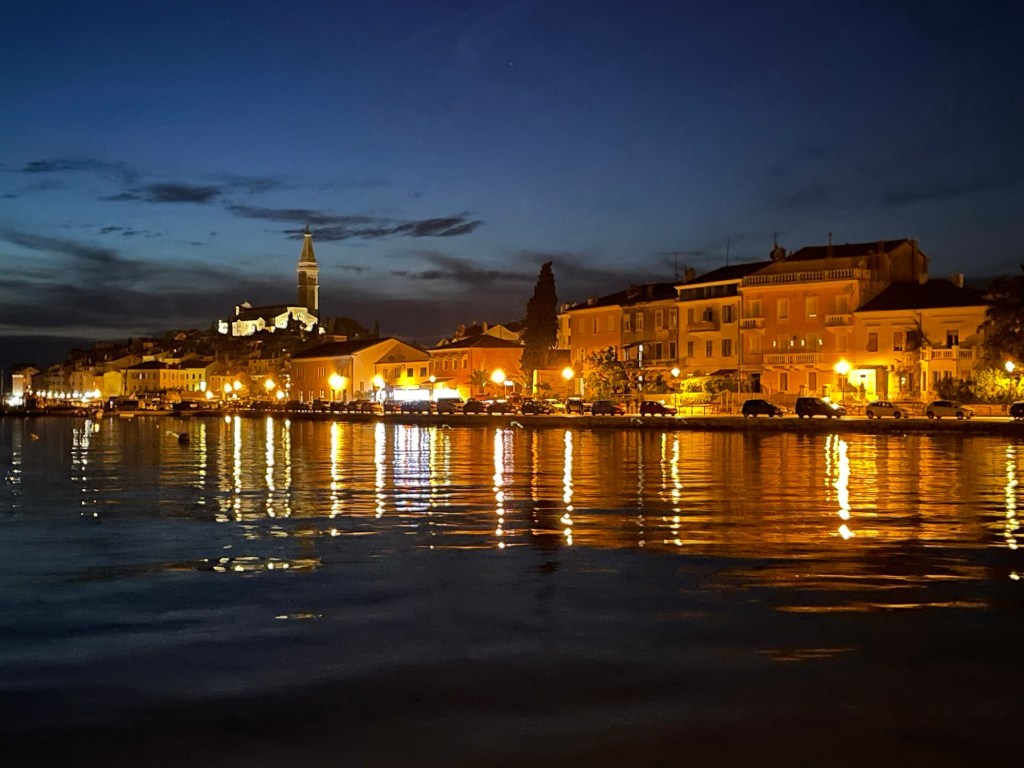
When we finally arrived in Rovinj, our host Francesca had to meet us at a parking lot outside the old city because cars are not allowed anywhere near the street where we are staying. She kindly brought an electric cart to help shuttle our luggage, and off we went. Our rooms overlook the marina, and are located on the street next door, with access to the sea via an arched alleyway. We had dinner at one of the waterfront restaurants, across from the old city center with its tall tower. After dinner we wandered around for a bit until it began to get dark. Tomorrow, our real exploration of the city will begin.
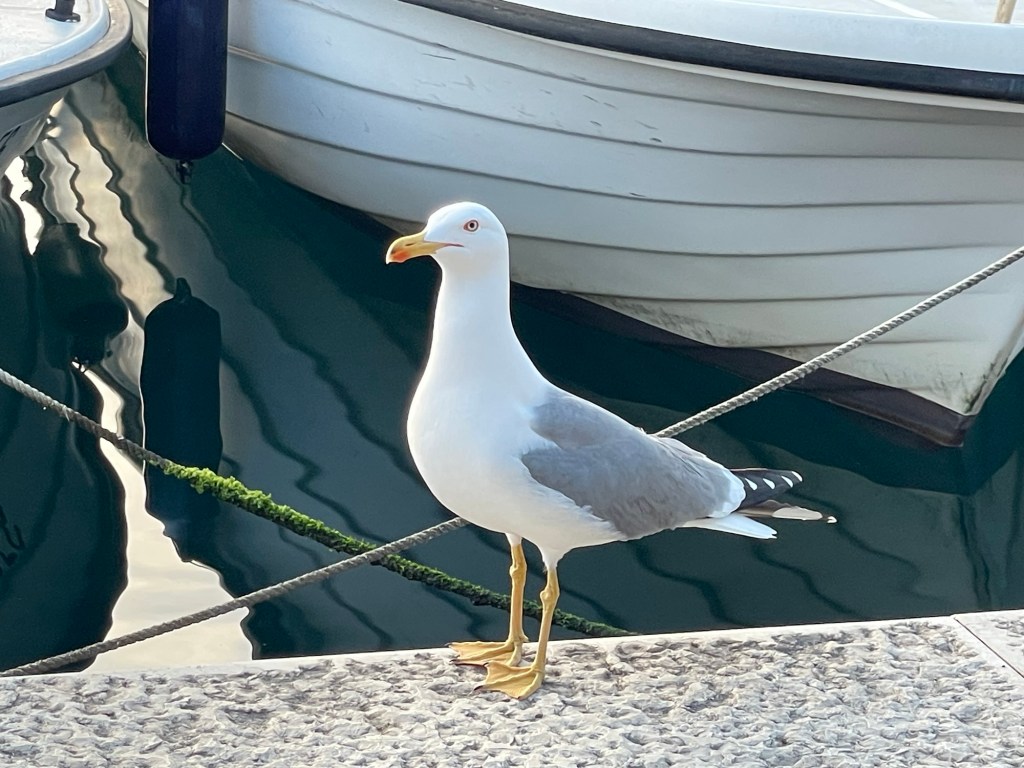
View from our living room windowOur address on Carera UlicaOur local gateway to the AdriaticPricey but delicious dinner along the waterfront – and the restaurant even has its own wine label!Bird of the day – we’re by the sea, after all!
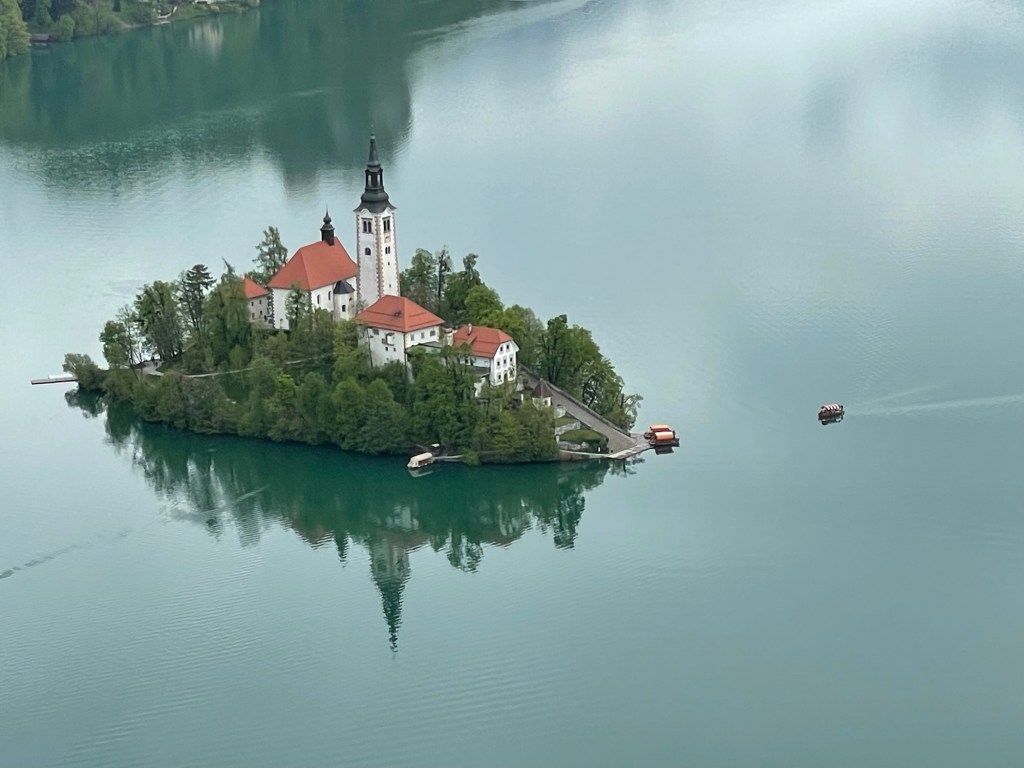
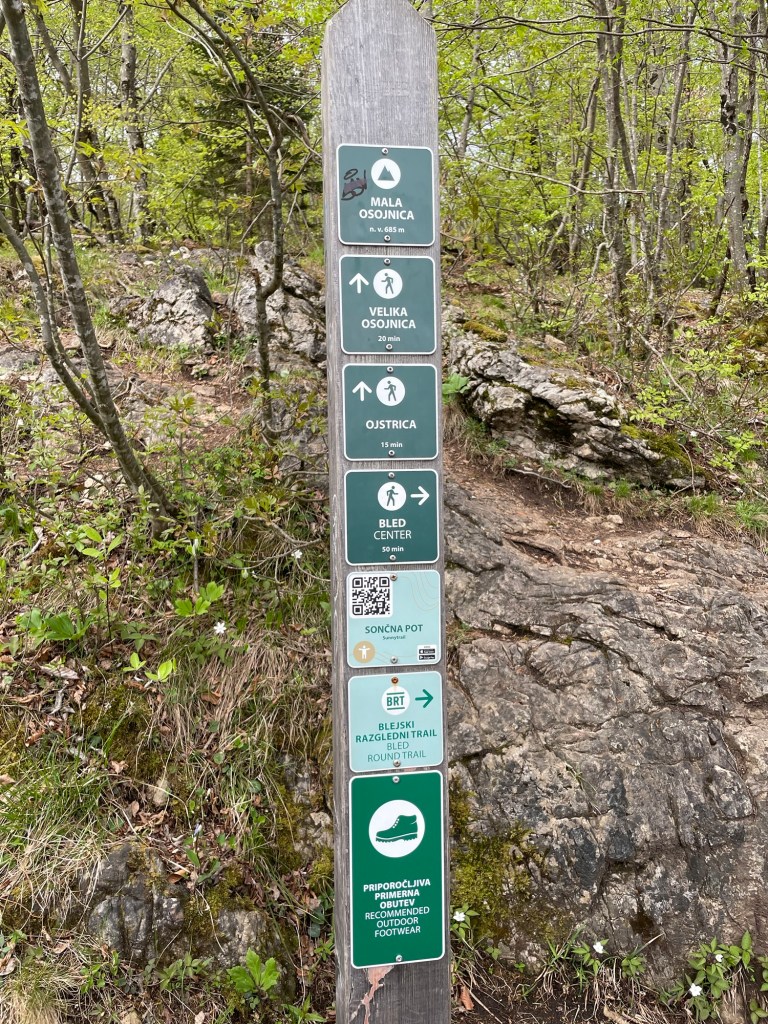
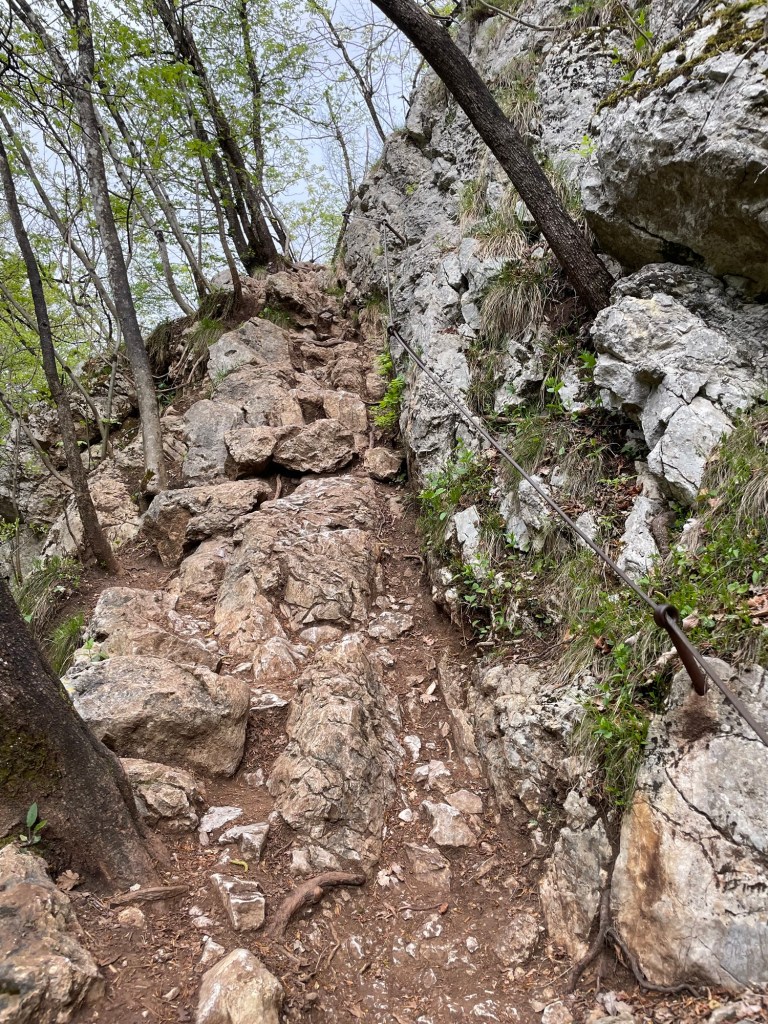
Today we planned a more relaxed pace than yesterday’s blitz of all the main Bled attractions. We decided to visit some of the local museums in the surrounding towns, focusing on aspects of life in times past. But before all that we did take time for a small morning hike up one of the hills at the end of the lake, just to see everything from another viewpoint. We actually ended up at two different lookouts, since we originally missed the turnoff for our intended destination (Ojstrica) and instead found ourselves at Mala Osojnica. With sharper eyes out on the way down, we found the missed trail and climbed Ojstrica as well. Which view do you like the best?
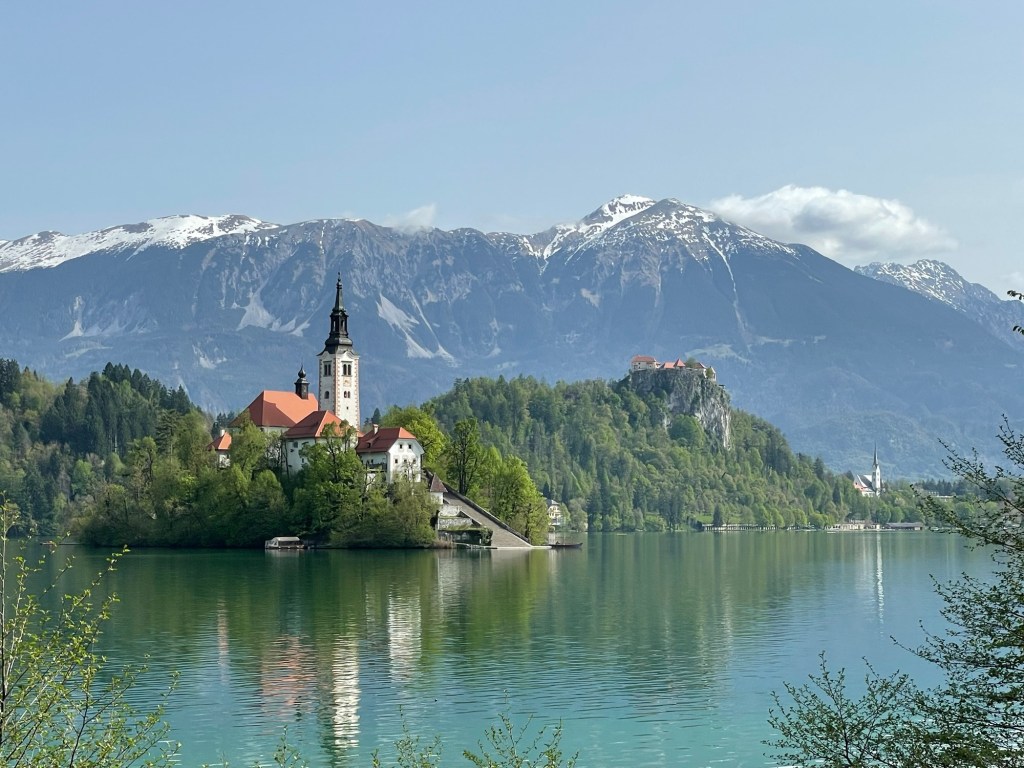
Bled Island from Mala OsojnicaMore view from Mala OsojnicaThe view from OjstricaGood thing we brought our hiking boots – would be hard to imagine doing this hike in slippers!The trail we missed on the way up, much easier to find as we descended
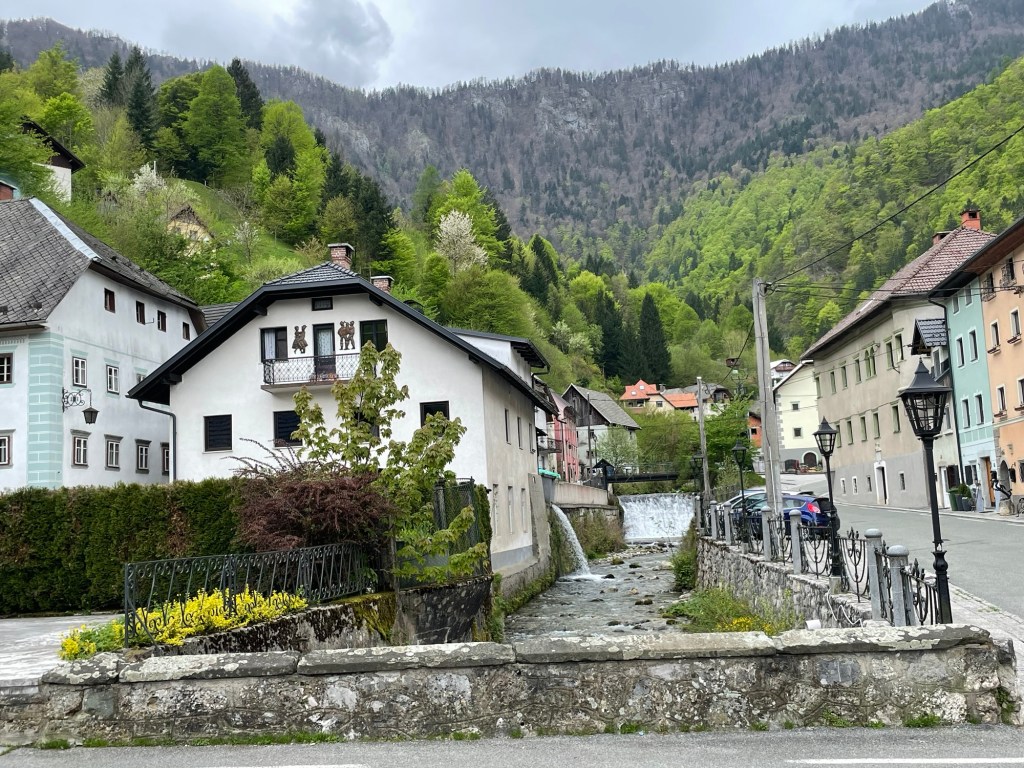
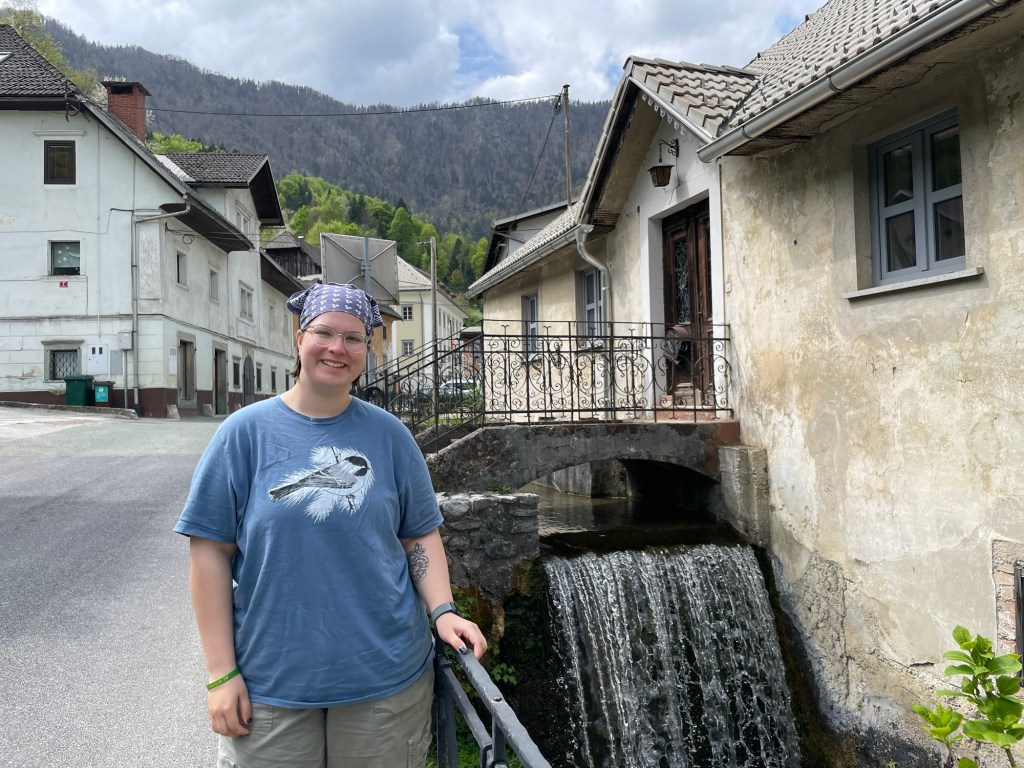
Taking once more to our rental car, we set out for the village of Kropa, which had long been at the center of the local iron mining industry. The buildings here are clustered closely around a fast-moving mountain stream, which provided power for the smelting and ore processing operations. The importance of mining gave those involved with the trade special rights by royal charter, and allowed for a relatively prosperous middle class to grow up in the region. Even within this area of relative freedom there was a pecking order, of course. The prosperous iron traders owned the houses, living on the upper stories while the ground floor was given over to business. The smelters were a step down in rank, and those who worked as blacksmiths were at the bottom of the social ladder, forced into shared accommodations where each family was allocated just a single table for living space, and had to use a shared kitchen.
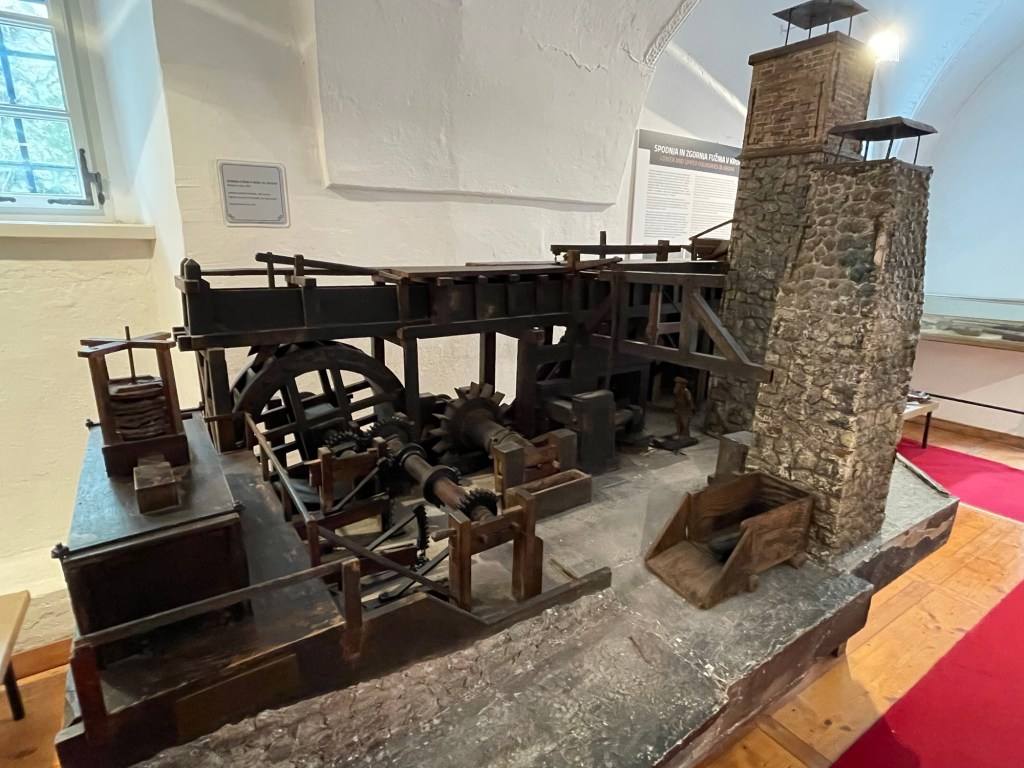
Inside one of the buildings in Kropa we found a museum (not without difficulty since it was hardly advertised from the outside) dedicated to the local history of ironworking. Iron goods were traded southwards into Italy, helping to support the needs of the Venetian navy. Over time, the area became particularly known for producing nails of high quality, used for everything from boots to railroad ties. They were produced in a wide range of standard sizes, with defined prices for each. A skilled smith could make as many as 2000 nails per day.
Diorama showing early iron smeltingA more advanced smelting operation with a blast furnace
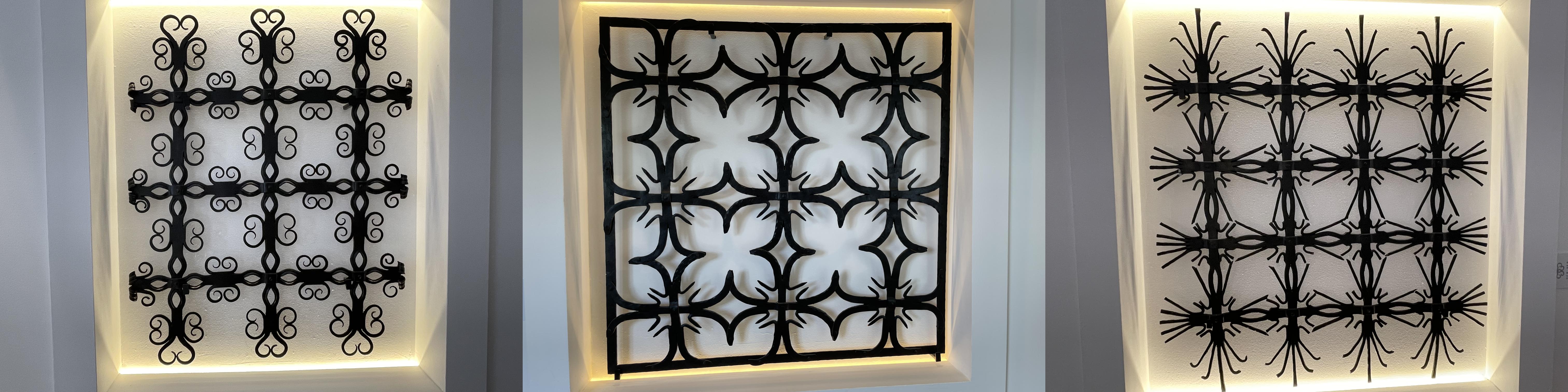
The iron trade collapsed in the mid-1800s as the local ore deposits ran out and the beech forests (used to make charcoal) were all cut down. The ironworking knowledge rooted in the area began to die out. However, efforts to establish a new specialization in ornamental and artistic ironwork have borne fruit, and now artists from the area are known for working in the medium.
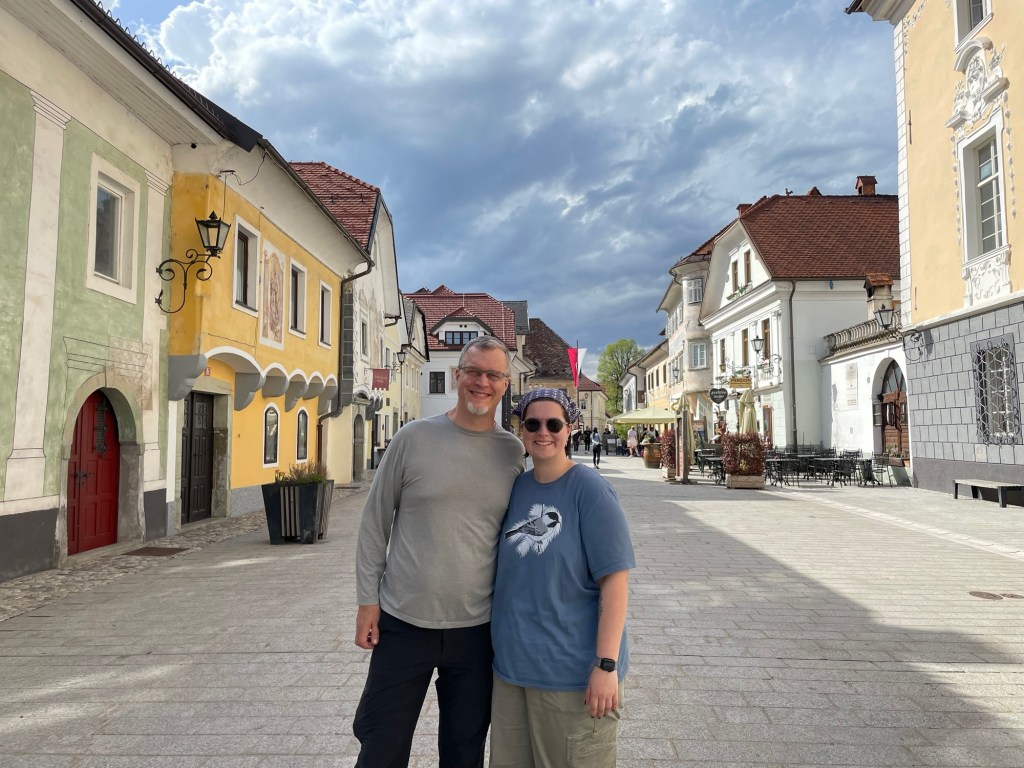
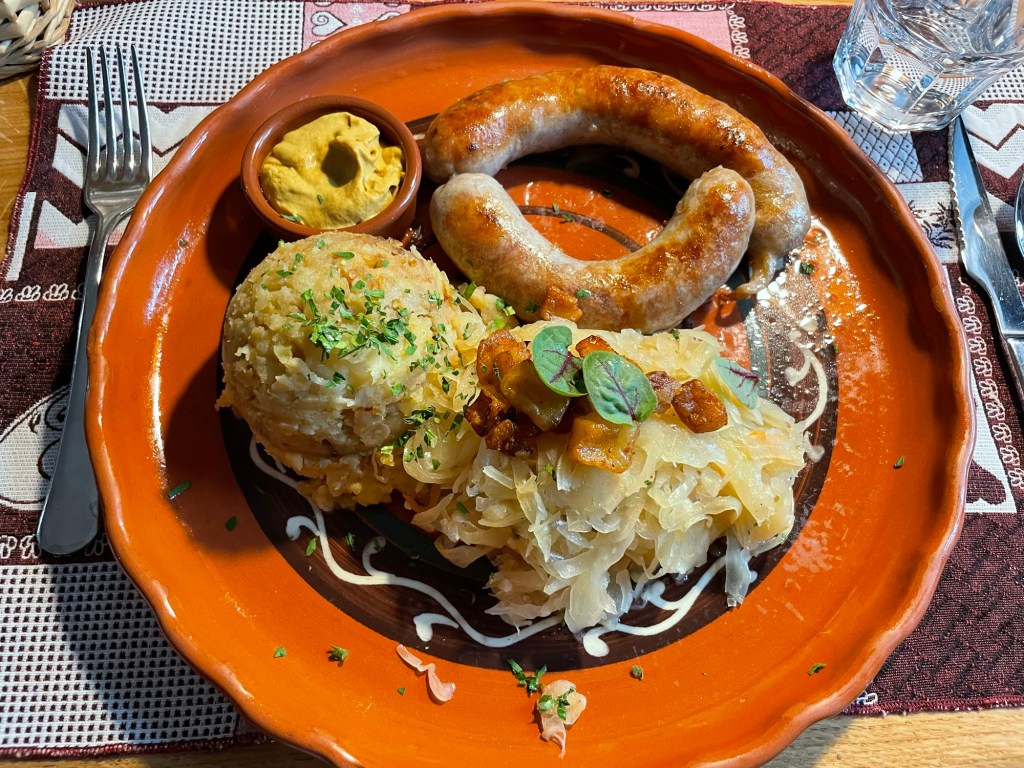
Leaving Kropa behind, we made our way via winding roads to the market town of Radovljica. The town square here featured old houses decorated with frescoes, featuring both religious themes and trompe l’oeil. They were a little faded, which along with the grandly proportioned yet oddly empty village hall gave the impression that the town’s best days were perhaps behind it. That didn’t stop us from enjoying a delicious meal of local specialties, including sausage, sauerkraut, and potatoes. The food and decor would be at home in any Alpine country, and the restaurant played music by a polka band all through our lunch.
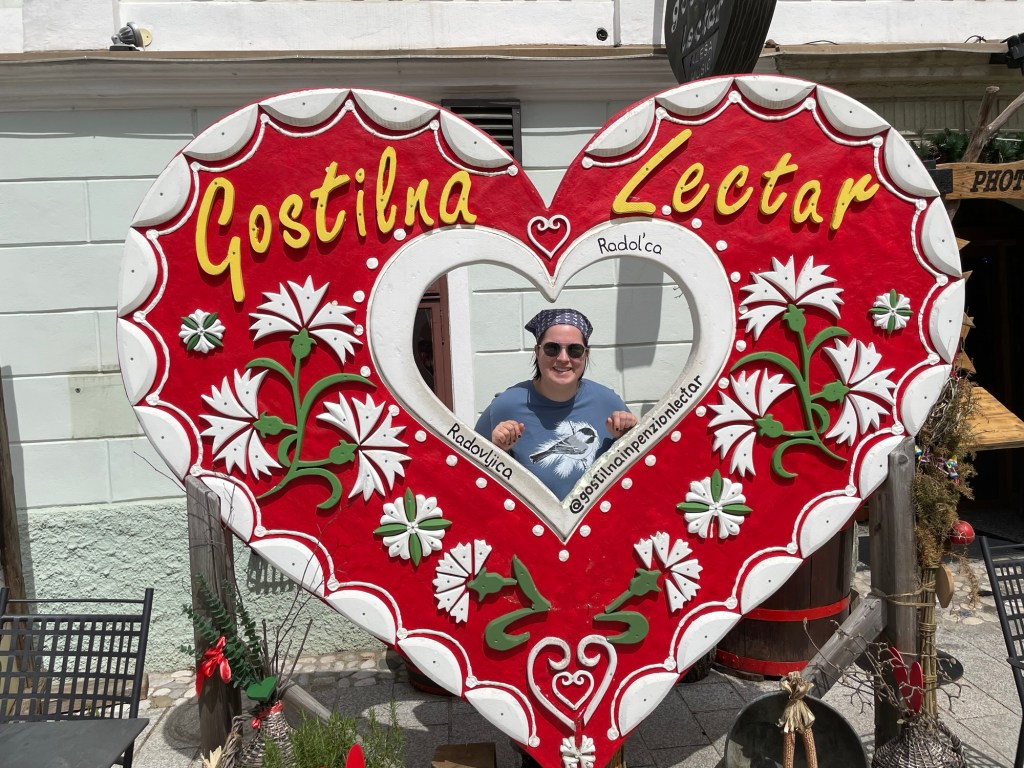
Photo op outside the lunch restaurant, also known for its gingerbread heart-shaped cookies
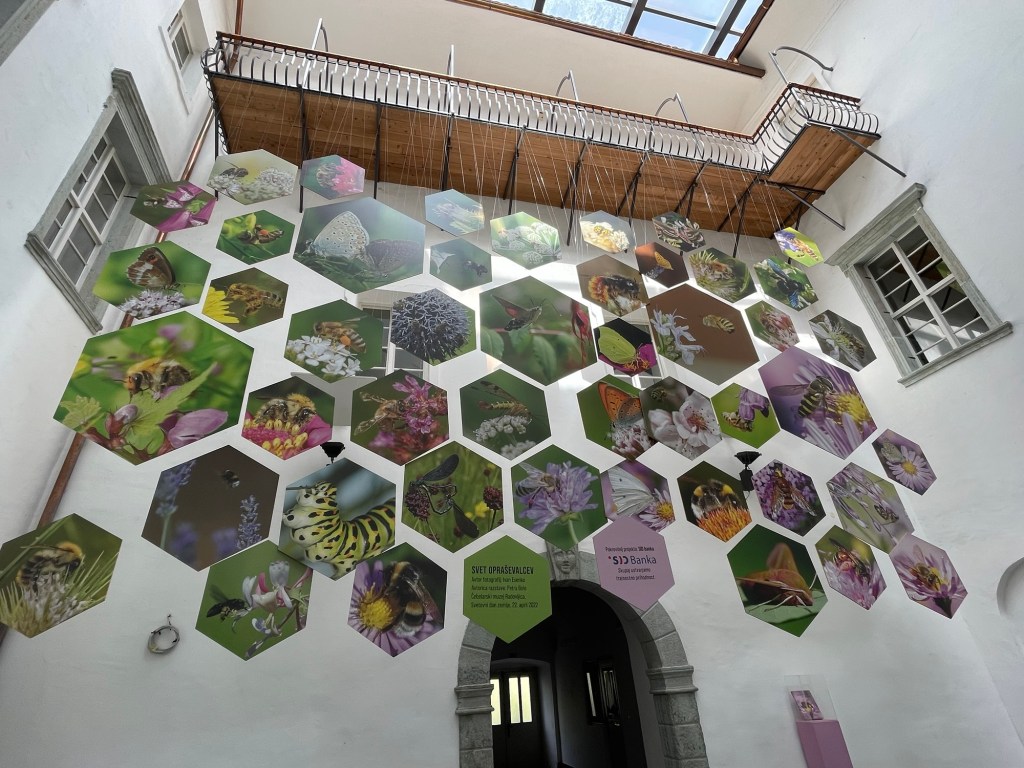
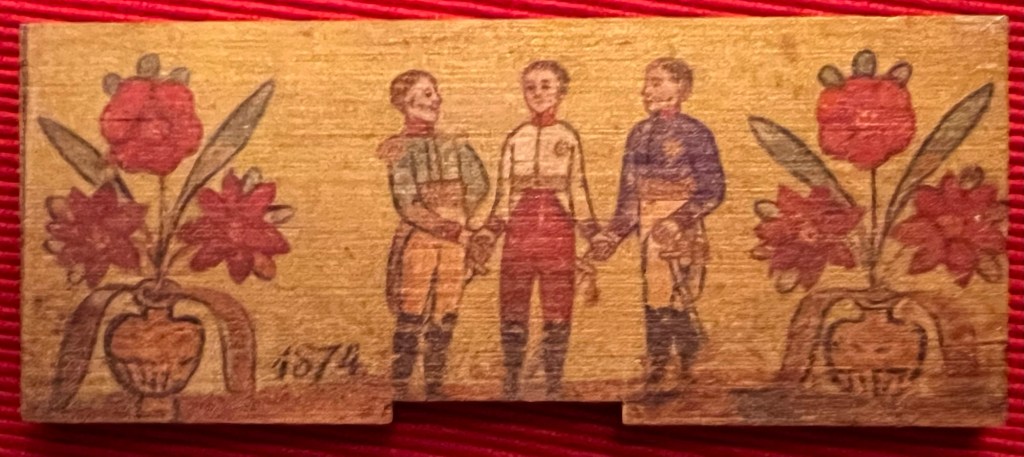
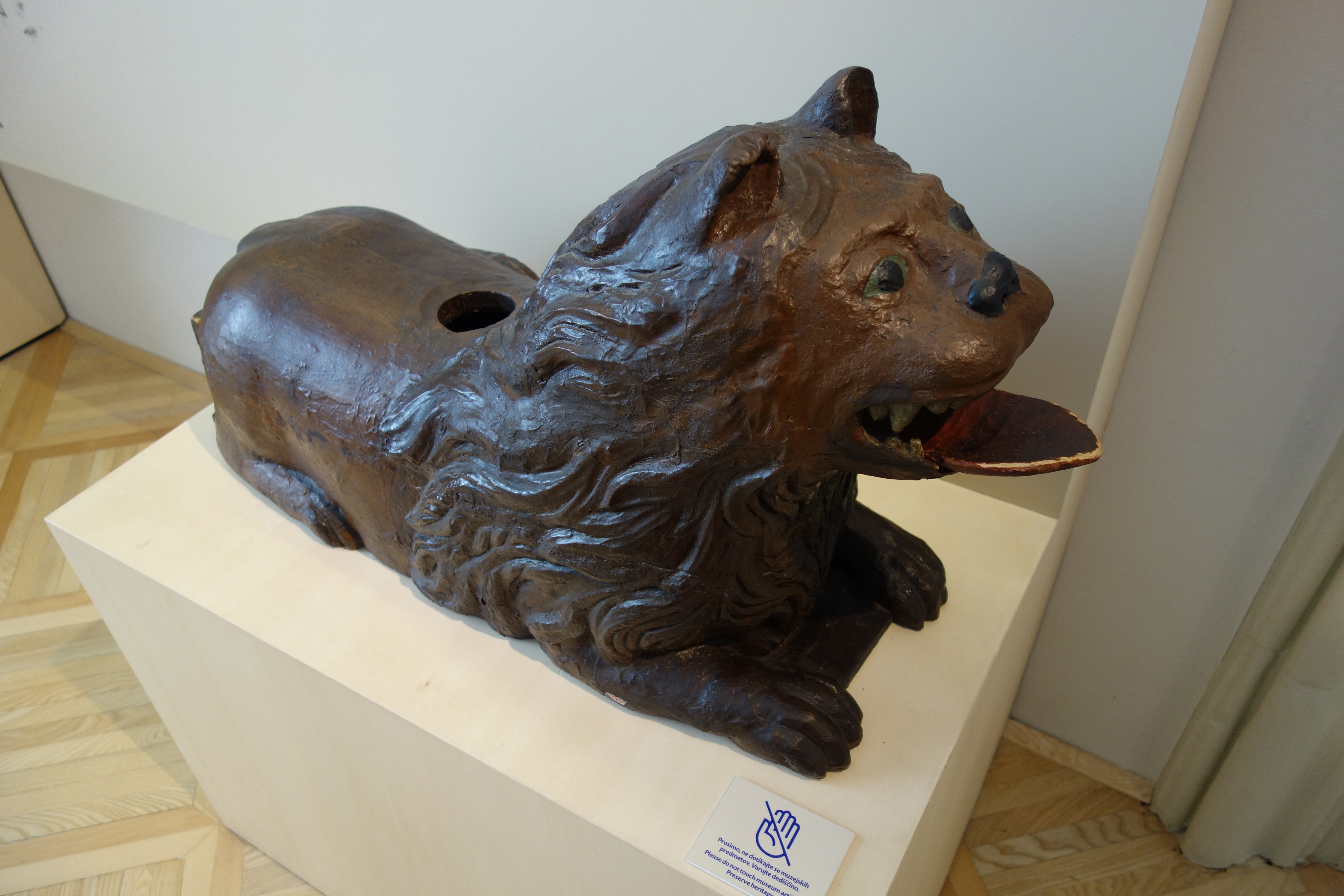
The main attraction we were here to see was the Museum of Apiculture. Beekeeping is a local specialty, based on the Carniolan honeybee, a biddable local subspecies. The hives here are kept in flat boxes that can be stacked on top of and next to each other. To help the bees to identify their homes amongst all the neighboring hives, a tradition has developed of installing artistic bee boards for the front of the hives. These are covered with painted scenes, often whimsical, sometimes depicting historical events or scenes from fairy tales. Nick’s favorite was “A snail chasing tailors,” featuring a giant snail pursuing a man with shears up a tree — sadly we did not get a picture of this one. (We would love to hear the story behind it!) Below you can see another sample depicting the 1815 “holy alliance” between Russia, Prussia, and Austria. Much rarer are hives disguised as sculpture, such as the lion we saw in the museum. Bees fly out through the hole in its back, and possibly also through the open mouth.
We close out today’s entry with a few bonus pictures featuring items we thought might be of interest.
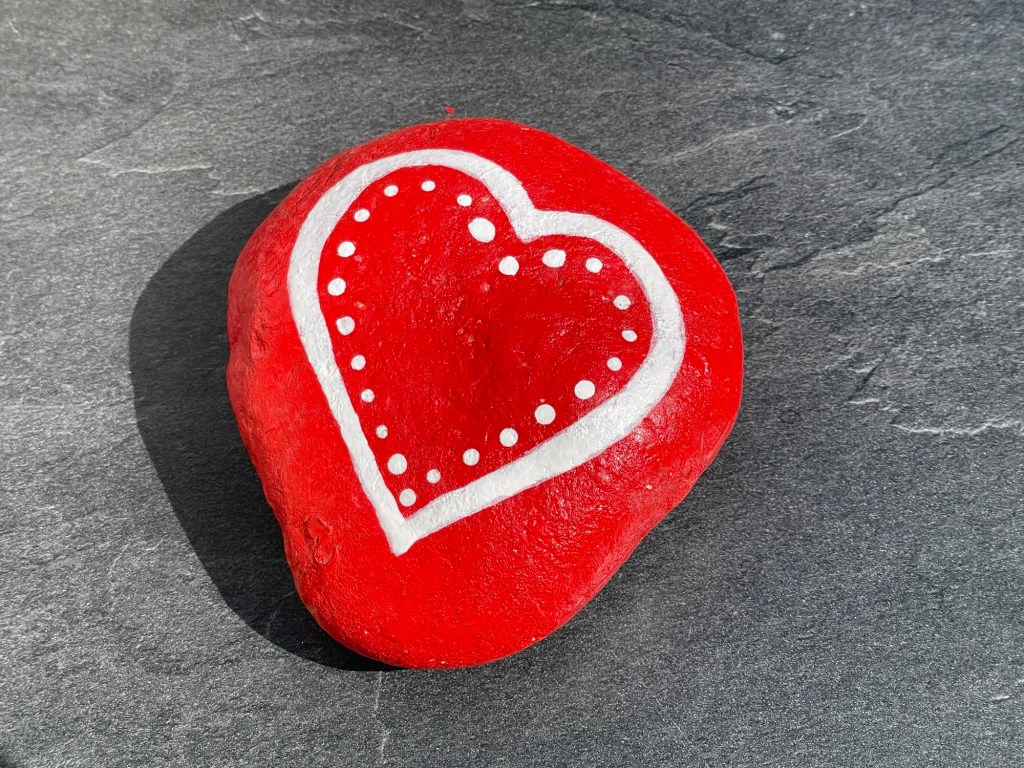
Hearts abound in Slovenia, typically in red. The English word “love” is part of the country’s name, and is often highlighted in a different color on signs.Rowan’s elderflower lemonade from dinner. Slovenia lemonade is not very sweet and often seems to feature additional flavors mixed in. (Note the red and white hearts again)Snail of the day — we found this fellow clinging to our car windshield in the morning. (Lucky thing we’re not tailors!)
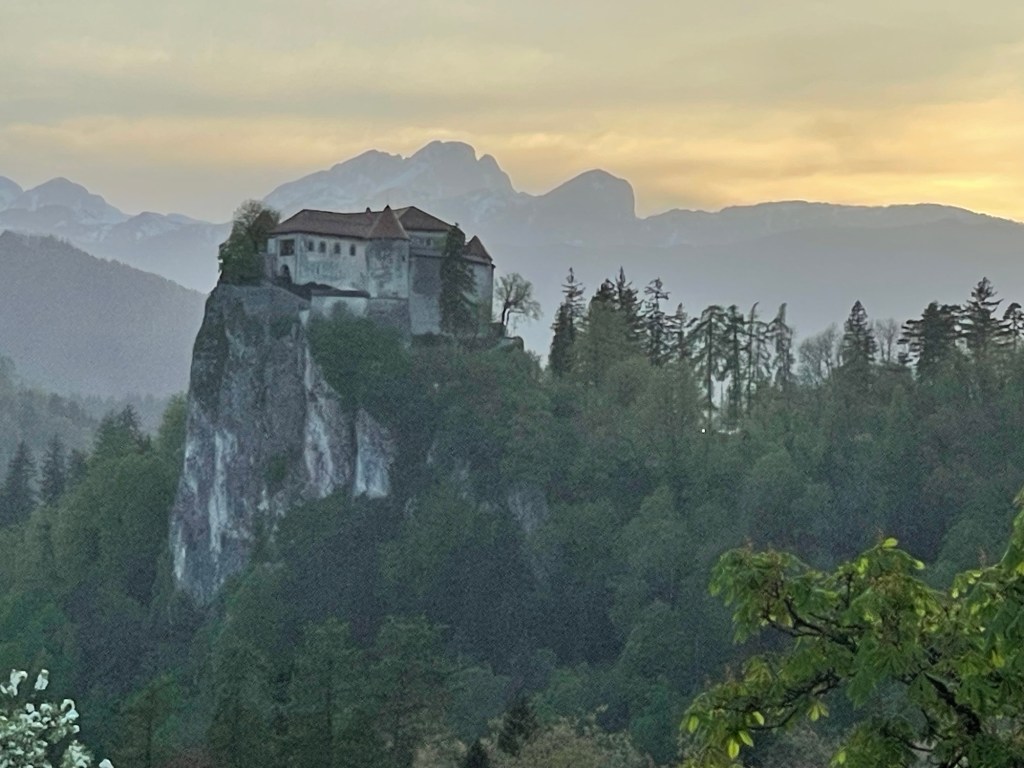
After our castle-view dinner yesterday, we continued our drive into the evening to arrive in the town of Bled after dark. Although we could see Bled’s eponymous castle lit up by floodlights from the window of our lodging, we didn’t truly get a sense of the place until dawn the following morning. It perches on a rocky bluff, overlooking the lake and the town below.
Bled Castle seen from our balcony
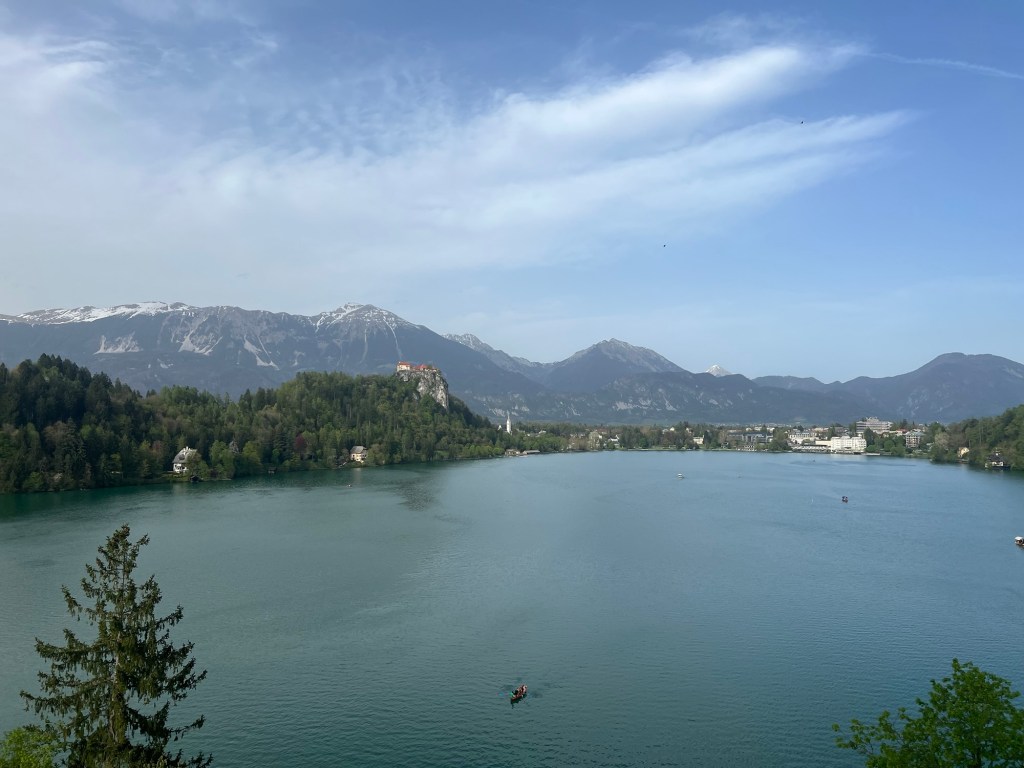
Bled is blessed with a combination of natural beauty and manmade enhancements that blend seamlessly into a harmonious whole. Archaeological excavations reveal that it has been drawing visitors for millennia, offering a valley of fertile flat land with the castle mount in the center to provide both early warning and a place of safety in case of threat. The island that rises from the lake also attracted visitors, with evidence that it was a site for pagan gatherings in early days. Since the spread of Christianity it has served as a pilgrimage site sacred to St. Mary. You can see the layout of the region in the bronze relief map below. The town lies at the bottom end of the lake, the castle is to the right, and the island lies at the top. Behind it all, the foothills of the Julian Alps keep silent watch.
With the promise of a bright and balmy day, Nick & Susannah decided to go for a jog around the lake first thing in the morning. This proved to be a popular choice, as we saw many other runners. There are paths running the full way around, and each new stretch offered different views that demanded to be photographed, so that we made slower progress than we had intended.
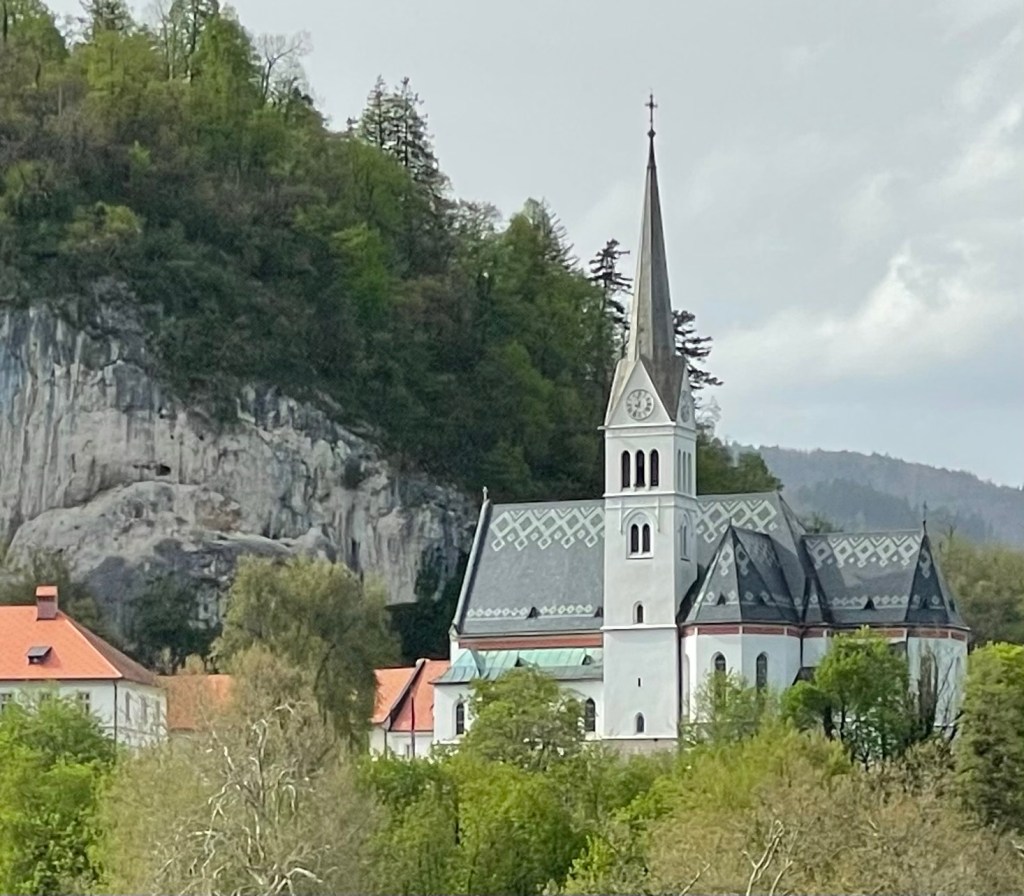
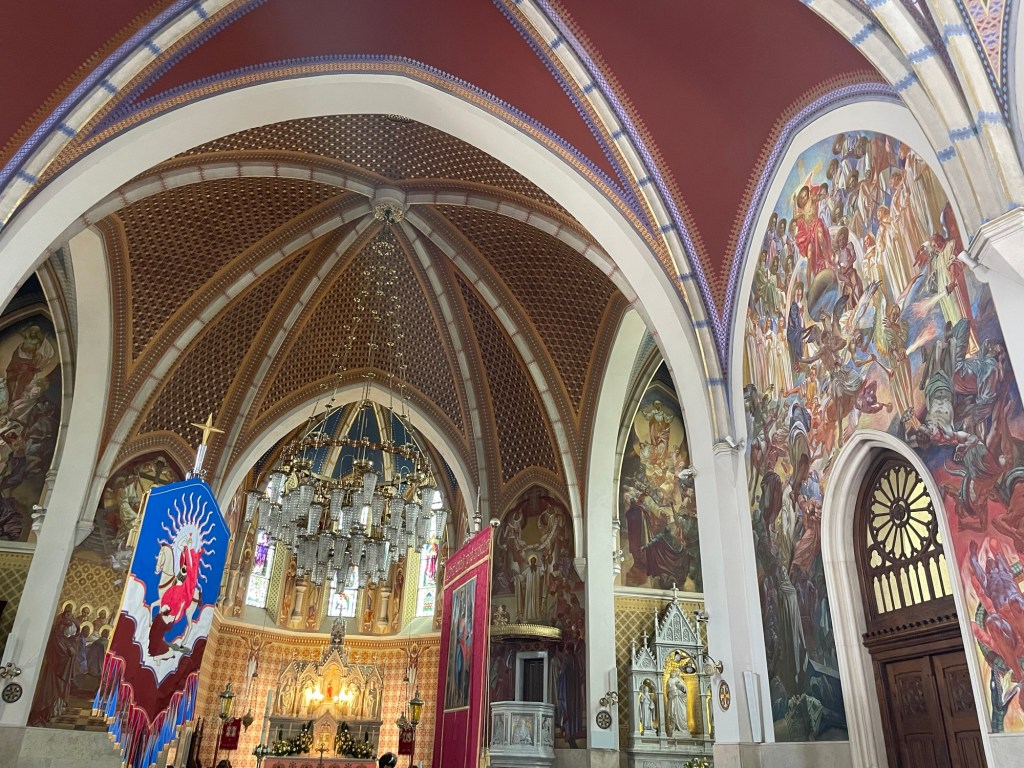
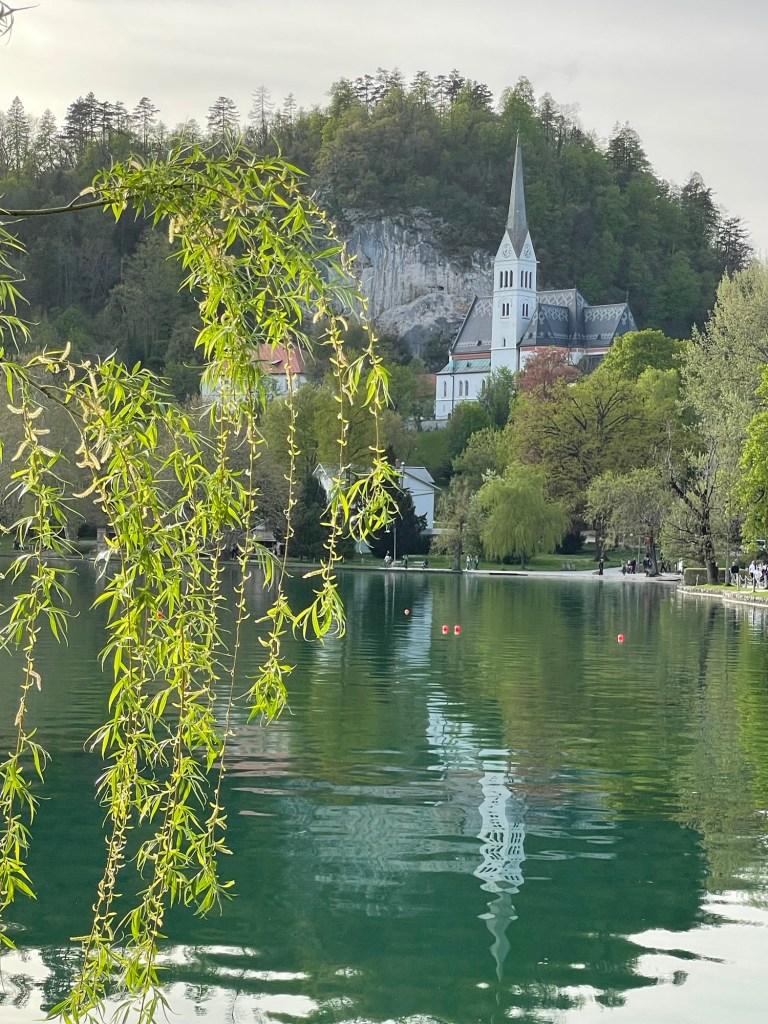
After breakfast at our lodging, we set out to see the first of the town’s famous landmarks: Blejski Grad, a.k.a. Bled Castle. Along the way we passed by St. Martin’s church, a fine specimen of local religious architecture with an intricately patterned slate roof. Although the windows are decorated with stained glass, the real stars of the interior decor are the many colorful frescoes that cover the walls. Among other themes, they depicted each of the phrases from the Lord’s Prayer. The aisles also held colorful banners suspended from poles.
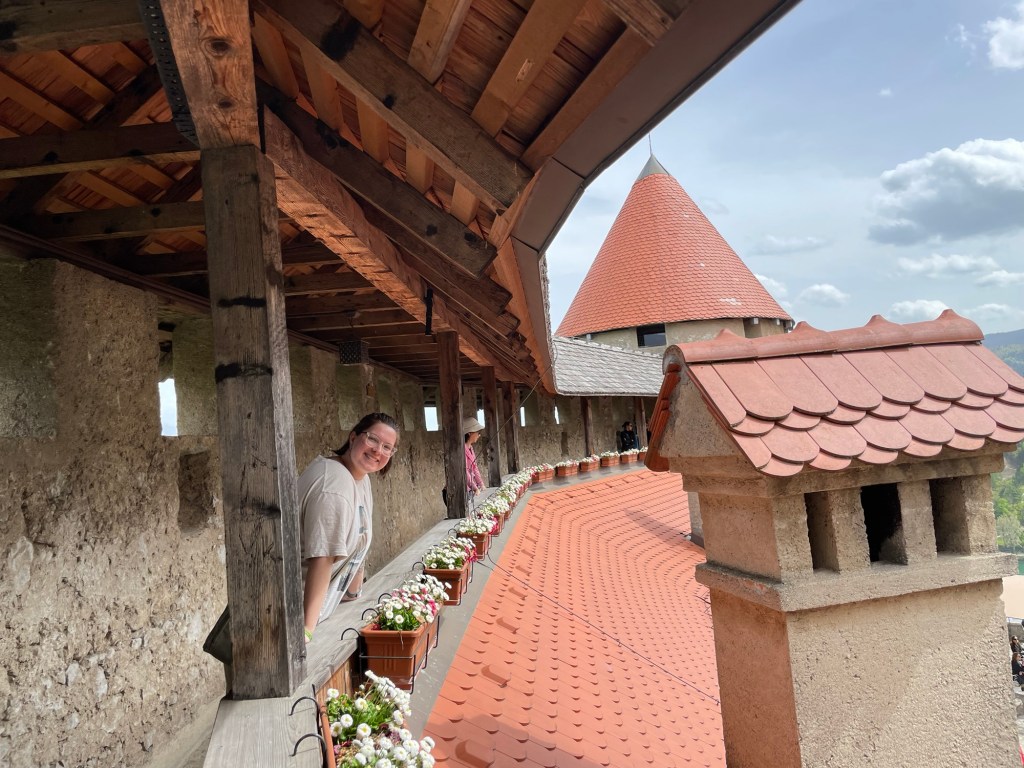
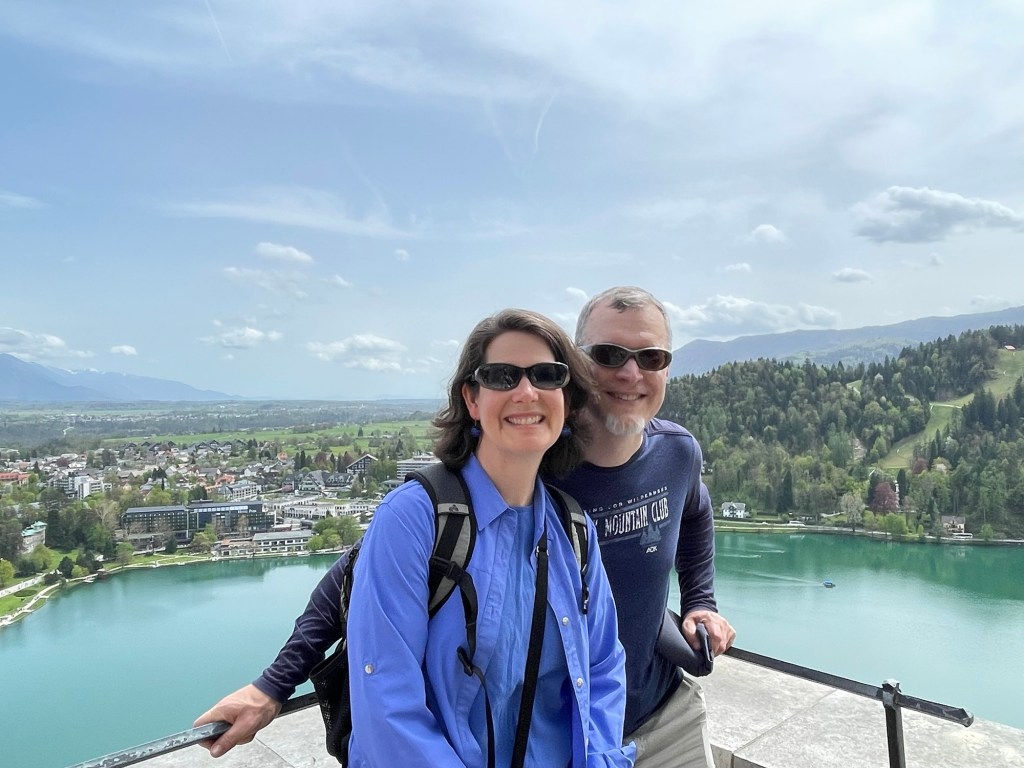
From the church, a short but steep hike brought us to the castle gates. Although there have been fortified settlements on the promontory since prehistory, credit for the building of Bled Castle in 1011 goes to Bishop Albuin of Brixen, who had had been granted feudal ownership of the region seven years prior and wished to consolidate his holdings. His success is attested to by the fact that the bishop’s successors continued to rule over the area for the next eight centuries. The castle was remodeled multiple times over that period; the current incarnation is in the Baroque style with some modern embellishments. The views remain fantastic in all directions, but particularly out over the lake.
Can you find Nick in this picture?Read below for more about the boats on this lake…
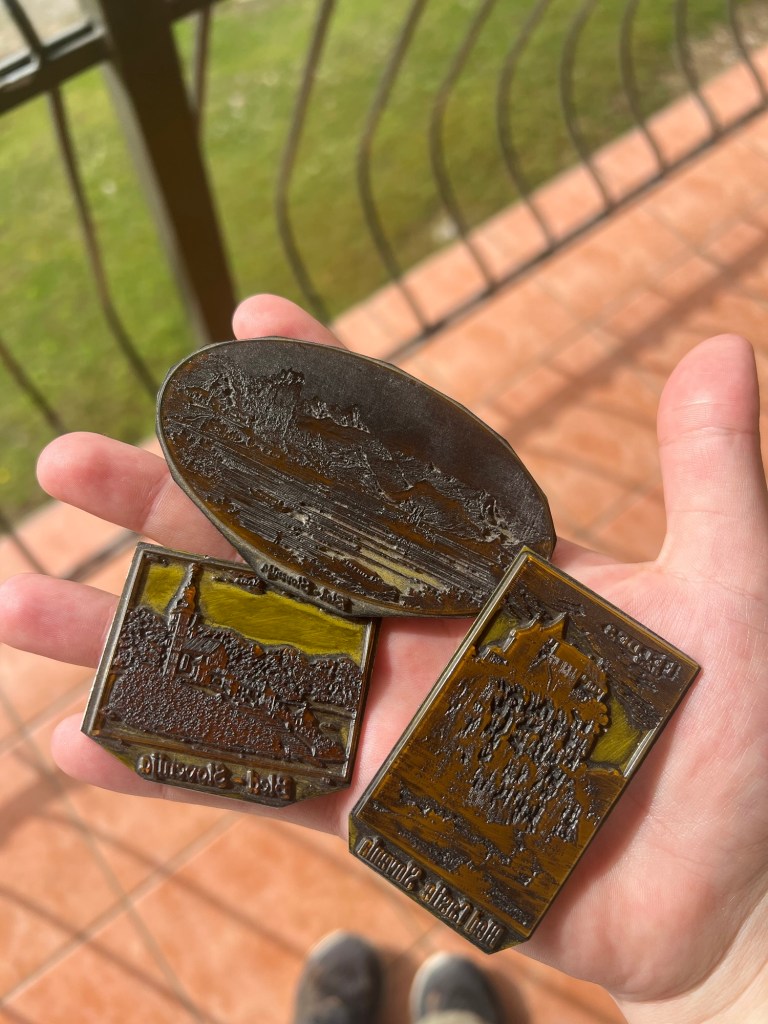
Unlike Predjama Castle, at Bled there has been little attempt to portray the lives lived by former inhabitants. Rather, the buildings have been adapted as a sort of combination museum and mini-mall, with a restaurant, cafe, and several small businesses. Our favorite was the print shop, which offered replicas of famous early works published in Slovenian, in addition to bookmarks, woodcuts, and other items. The printer there was very friendly, and at our special request shared with us a few of the older worn-out plates that had been retired from active use.
First book printed in the Slovenian language
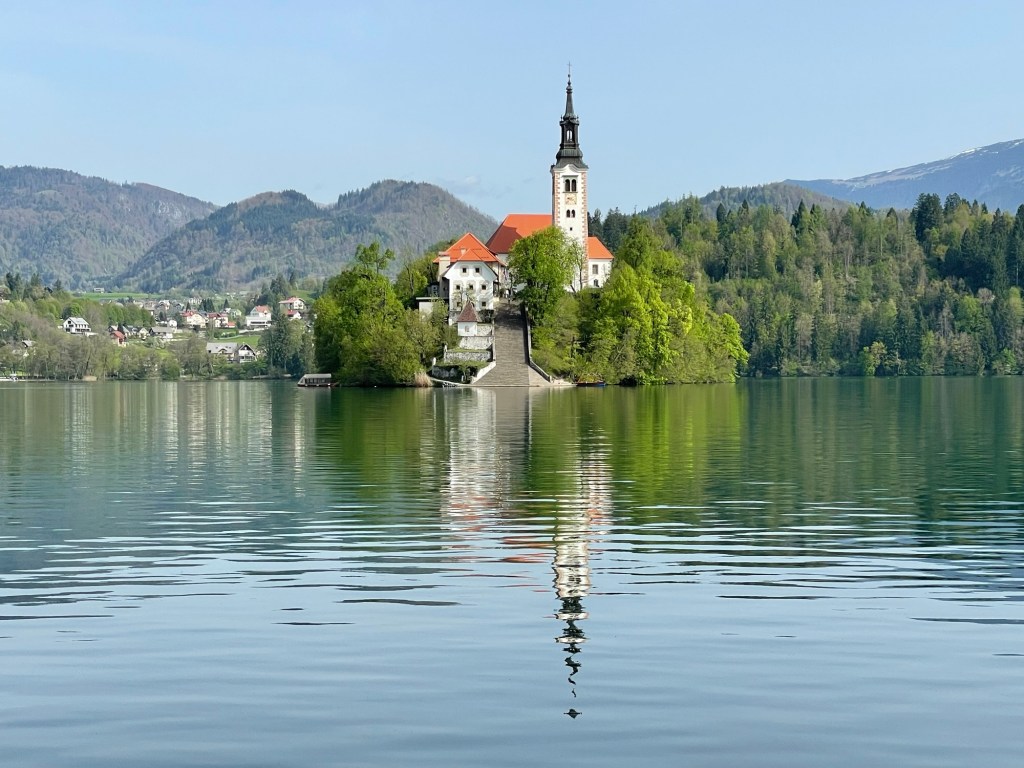
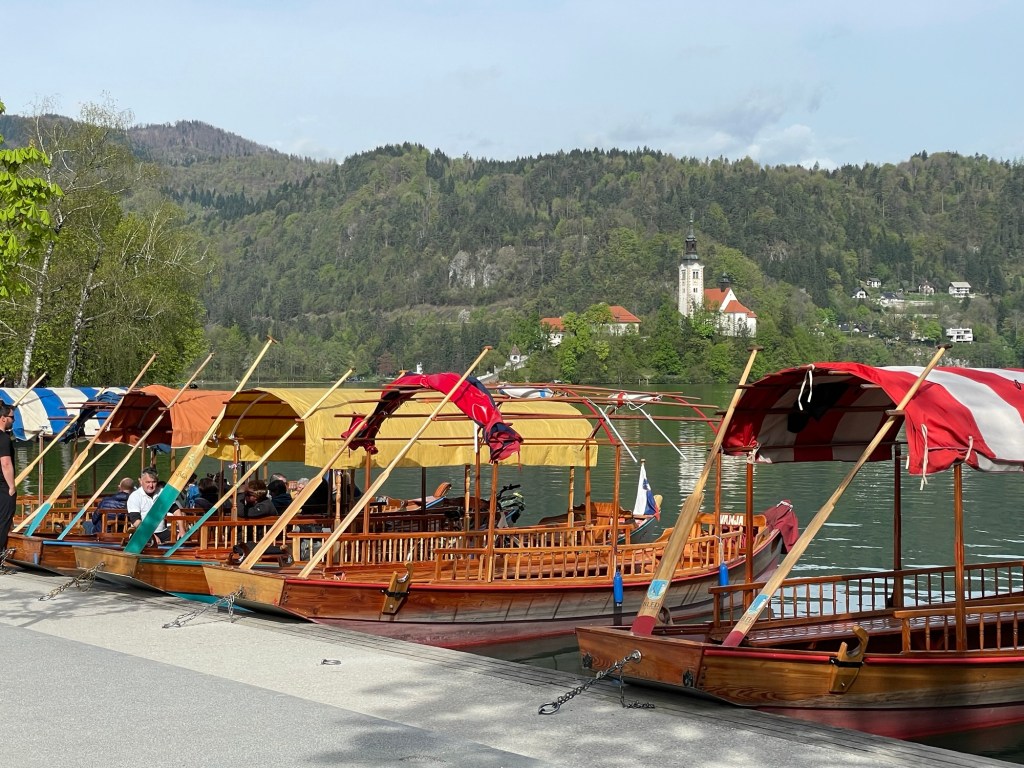
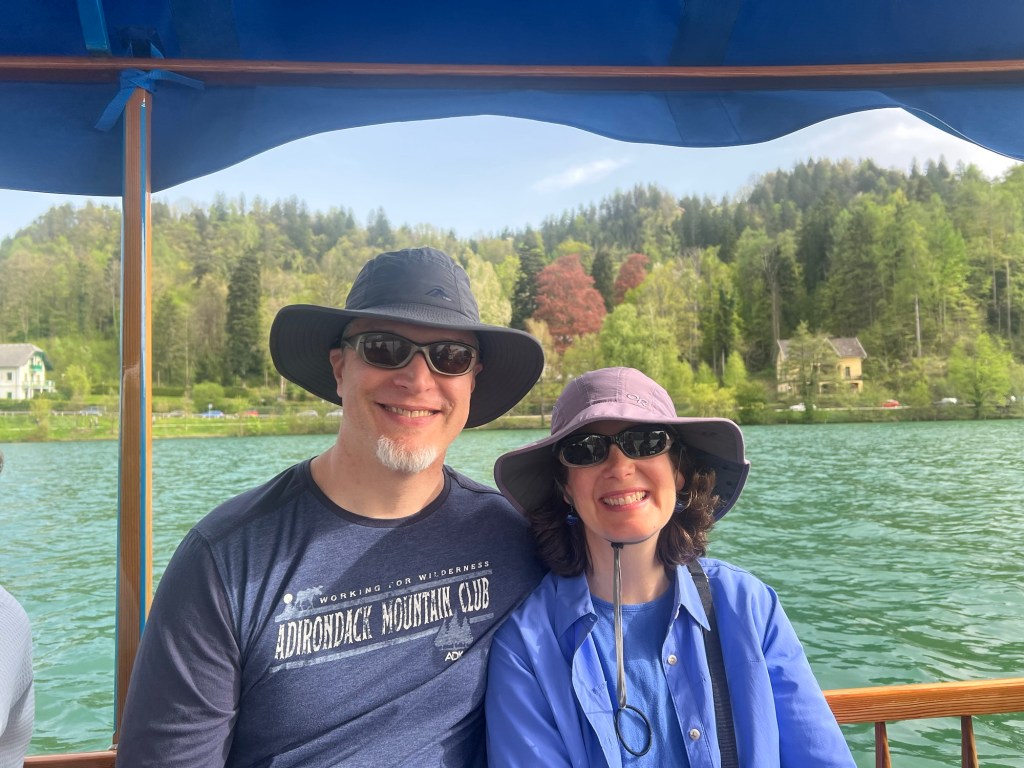
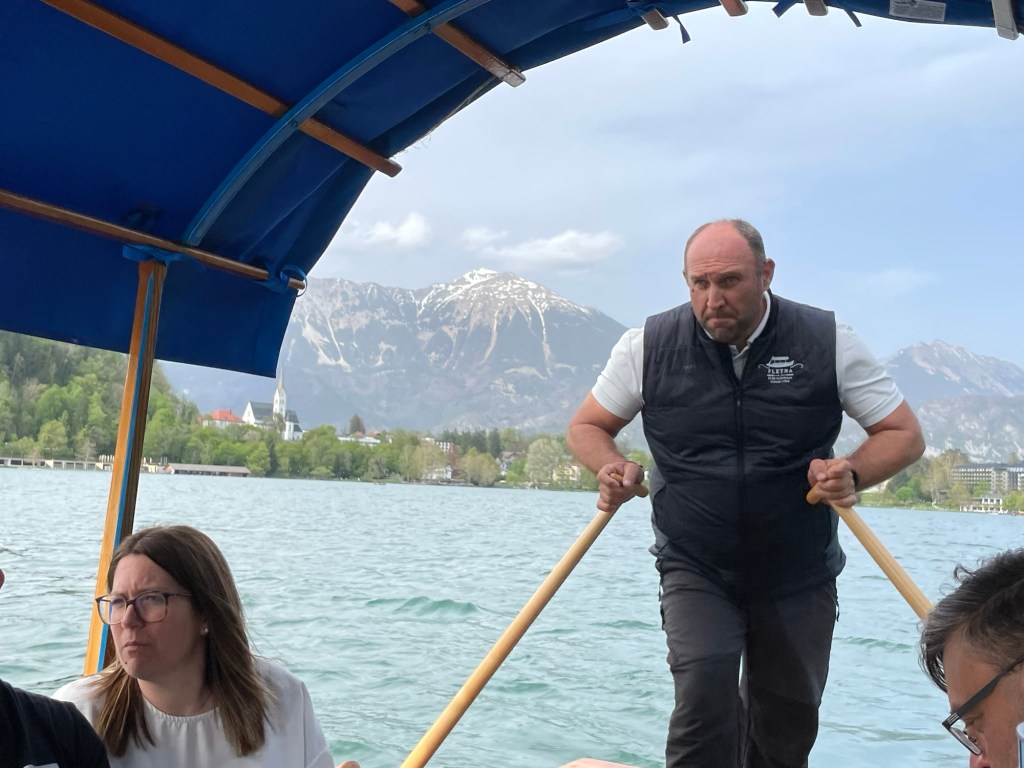
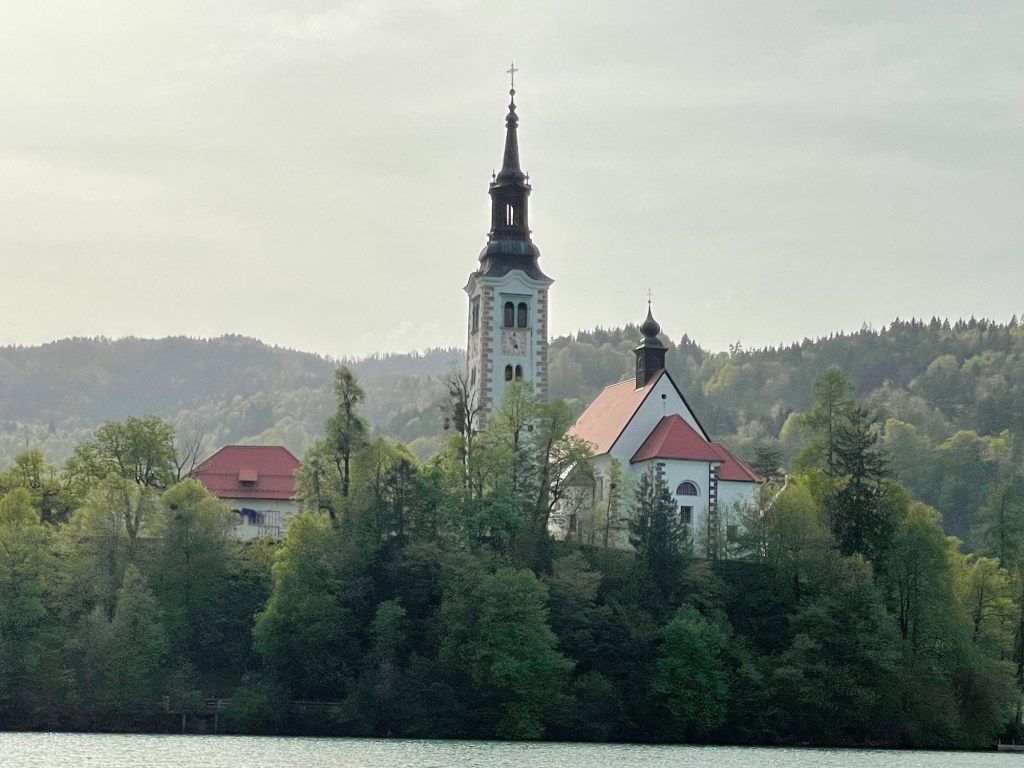
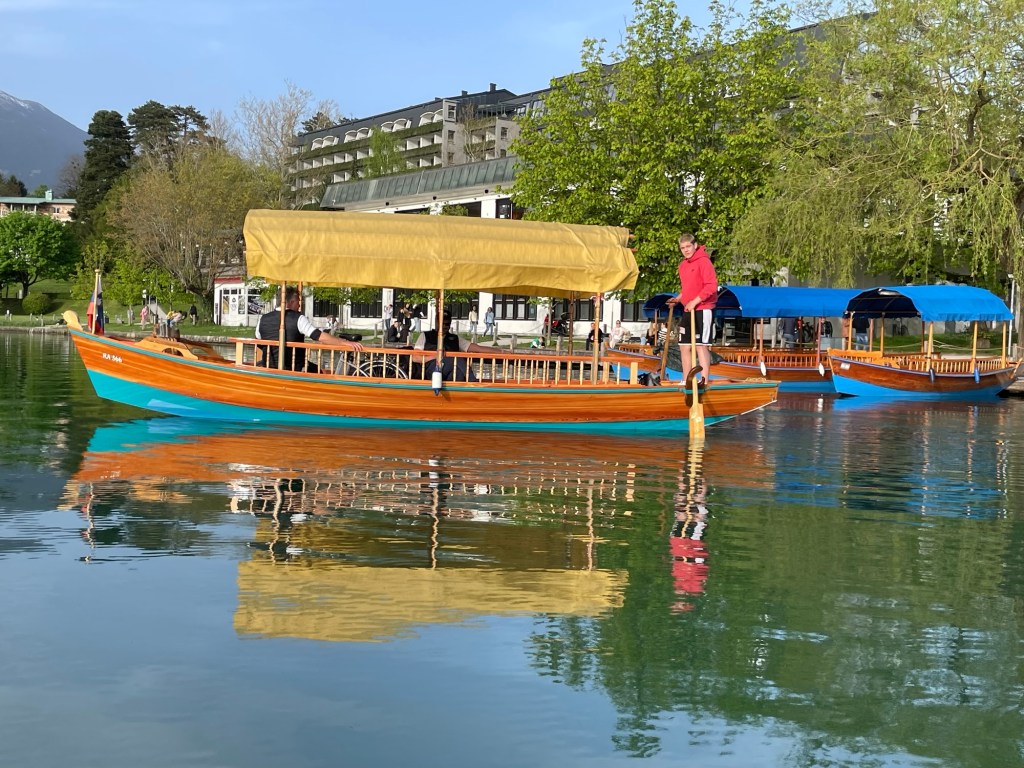
Our visit to the castle took into the early afternoon, so after a late lunch we headed back into town for our last essential Bled experience of the day: a trip to the island where the Church of the Mother of God on the Lake stands overlooking the waters. Traffic on the lake is strictly controlled: during the middle ages twenty-three families were granted the right to ferry pilgrims across the water to the island, and their descendants remain in charge of the business to this day. Gasoline motors are not allowed. Although you can rent your own rowboat by the hour, the majority of visitors take the pletna. These are rowed boats of a specialized design endemic to the area, able to carry up to eighteen passengers at a time and propelled by a single oarsman using double sculls. Though it seems awkward to look at, they move surprisingly fast using this system. The boats have no schedule; instead they take passengers until they are full and then depart. Ours sported at least four or five native languages amongst its passengers: we heard English, Italian, Croatian, German, and Slovenian. From the water, we had excellent views of all the local sights as we traveled the length of the lake.
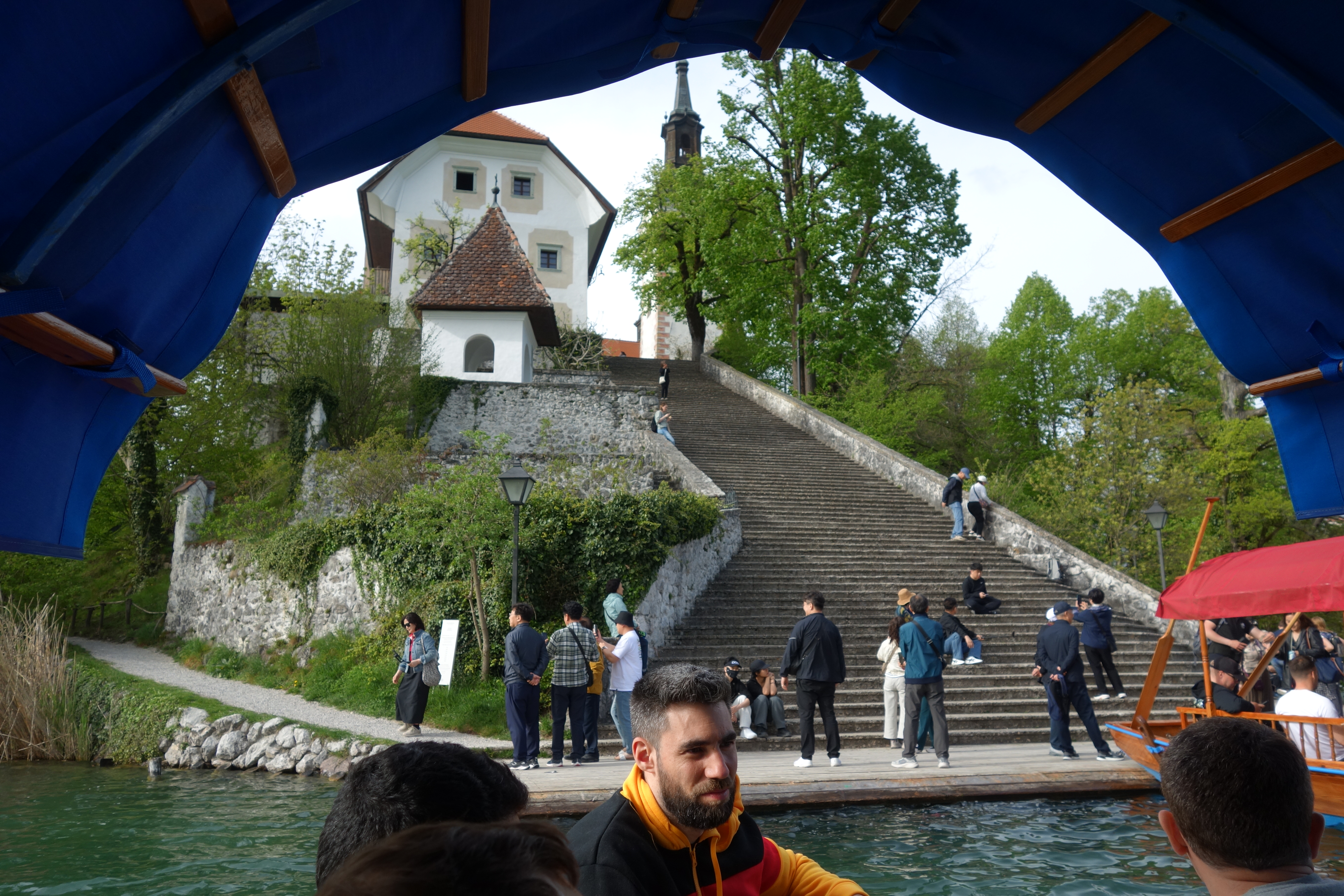
A line of pletna boats waiting for passengersView down the lake toward Bled townClosing in on the islandBoats wait at the island landing while passengers explore
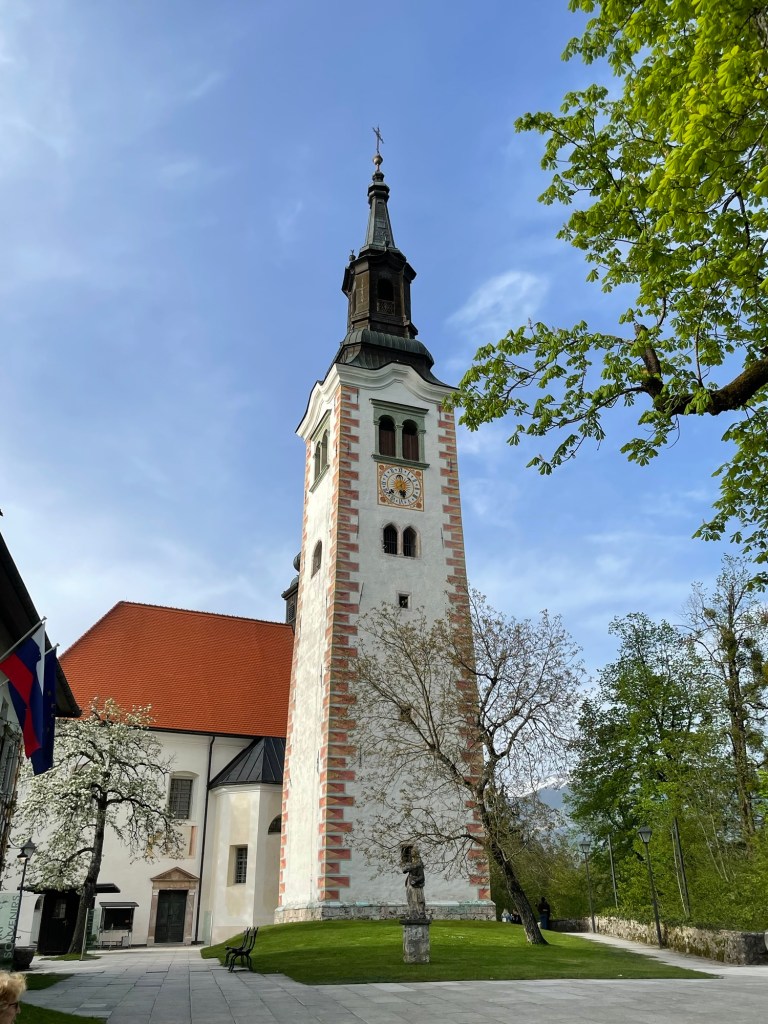
The pletna land on the island at the base of a dramatic series of stone steps leading up to the church and clocktower. Climbing the steps is supposed to bring good luck, or perhaps it is ringing the bell of the church — we heard different stories. A popular local legend tells that a lady of the castle, in mourning for her husband killed by bandits, commissioned a large bell to be cast and placed in the church. However, tragedy struck as the bell was being transported to the island: the boat capsized, and the bell sank to the bottom of the lake, where it can still at times be heard tolling away in mourning for the lost husband. This sad story somehow made its way to the ear of the Pope, who commissioned a new bell and had it installed to replace the one that was lost. Today, those who ring the bell and make a prayer to St. Mary may have their wishes granted. Not wanting to miss our chance, we all took a turn on the rope.
Susannah’s training in change ringing back at Smith served her well today!
The tall tower next to the church holds a mechanical pendulum clock with a complex mechanism that tools the quarter hours, half hour, and hours, each with a different ring. It had grown rusty and inoperable, and was only recently refurbished within the last ten years. Climbing the tower allowed us to see the workings, and also gave elevated views across the lake.
Besides the church and tower, we also visited a small museum and made the short circuit of the island’s shores. The building that now houses the museum was originally built to accommodate the many pilgrims who used to flock to the island for the Feast of the Assumption in mid-August. These days pilgrims may still visit, but nobody stays on the island overnight. Our own time was limited because our boat operator was waiting to take us home, so we boarded the pletna once more for the trip back to town. The day was near to ending by then, so we spent some time on the waterfront admiring the beauty of the landscape in the late afternoon sunlight.
Sunset over the Alps — still the view from our balcony
After a delicious breakfast at our B&B just outside the national park, we hit the road again. Destination: Slovenia. Our path took us cross country on tiny roads for the first part of the journey, as we made our way to the larger highway that crosses the border. The buildings in this region have an Austrian feel to them, at least from our perspective — perhaps the Slovenians imagine the influence goes the other way!
Today being Easter Sunday, we weren’t sure how many places would be open for business. We carefully saved some extra food from the day before, just in case. As it turned out, we needn’t have worried — the tourist business carries on regardless. Both of the major attractions we hoped to visit were operating, along with all the restaurants and souvenir shops surrounding them.
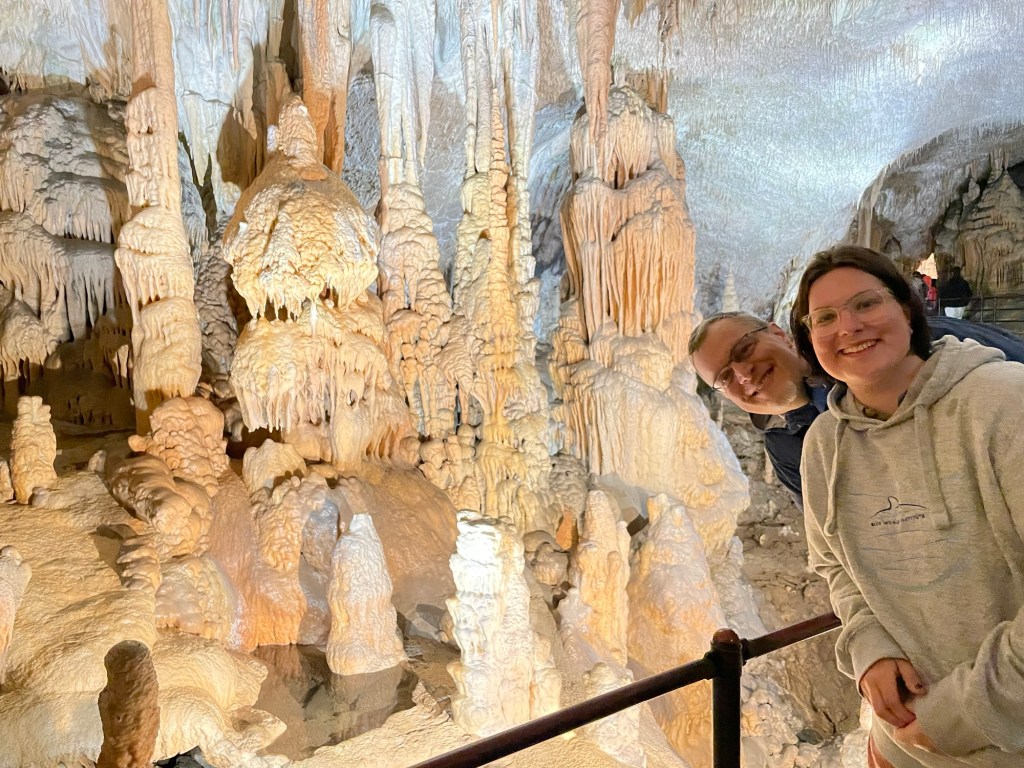
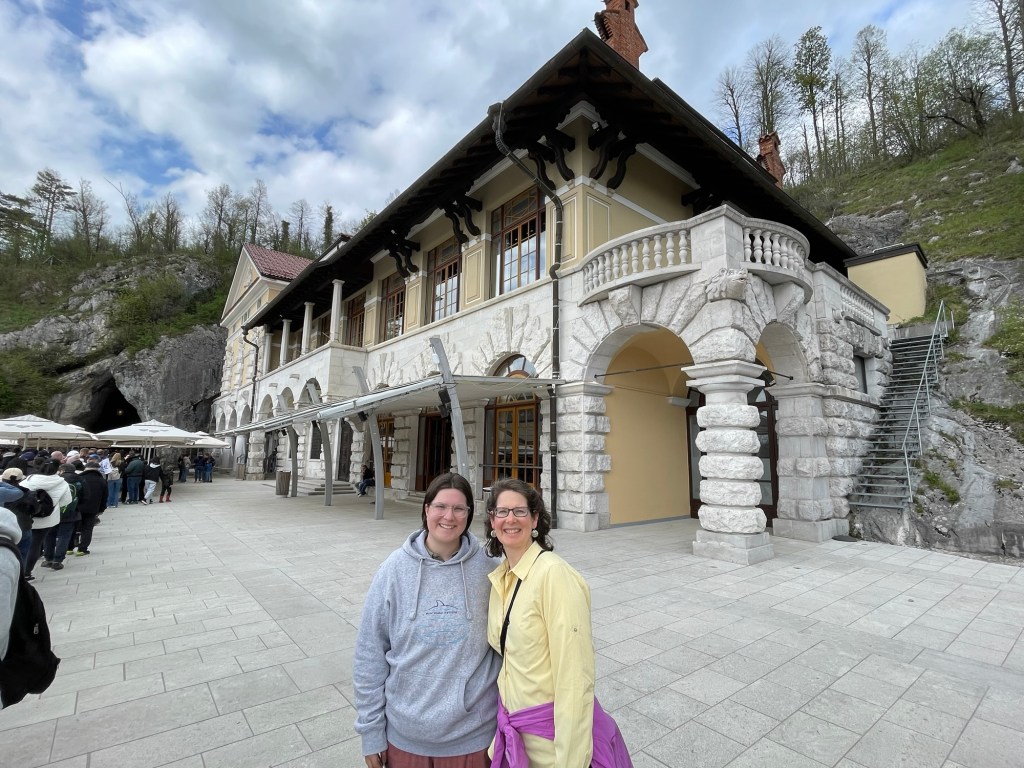
Our first destination was Postojna Jama (cave), carved out by the local river that disappears underground at this location. The entrance has the look of an old-fashioned train station, and in fact the first part of the visit is a 3.5 km ride on underground train cars, whizzing through gallery after gallery of impressive underground formations, mixed with the occasional connecting tunnel where the rock hangs down just barely overhead.
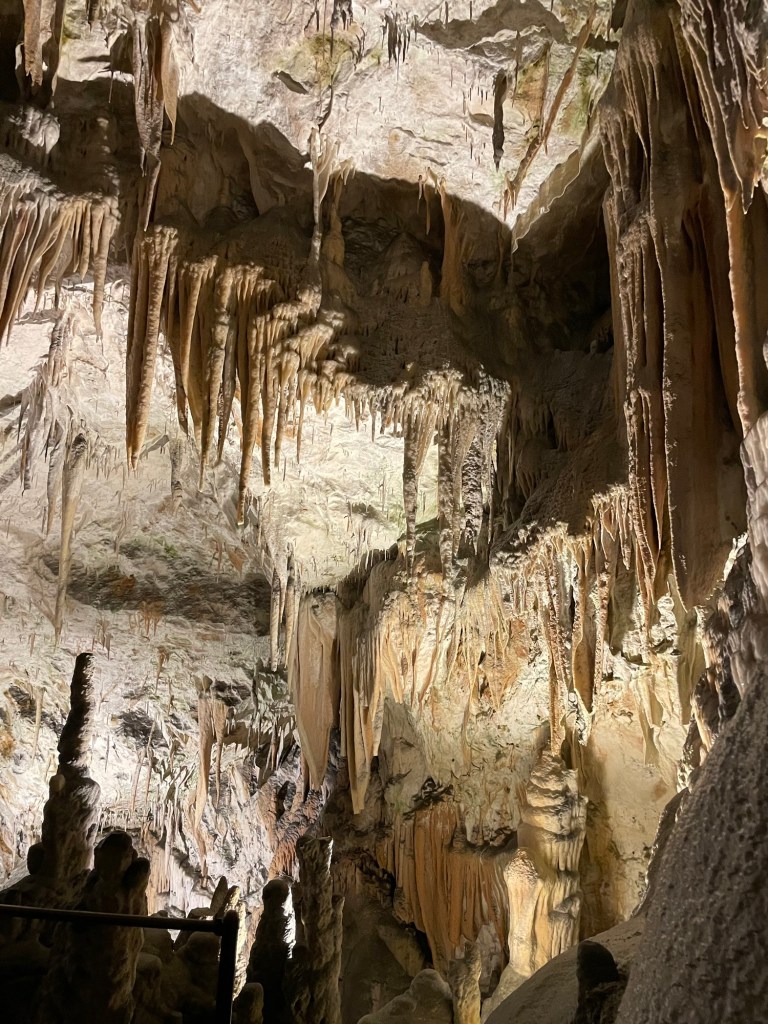
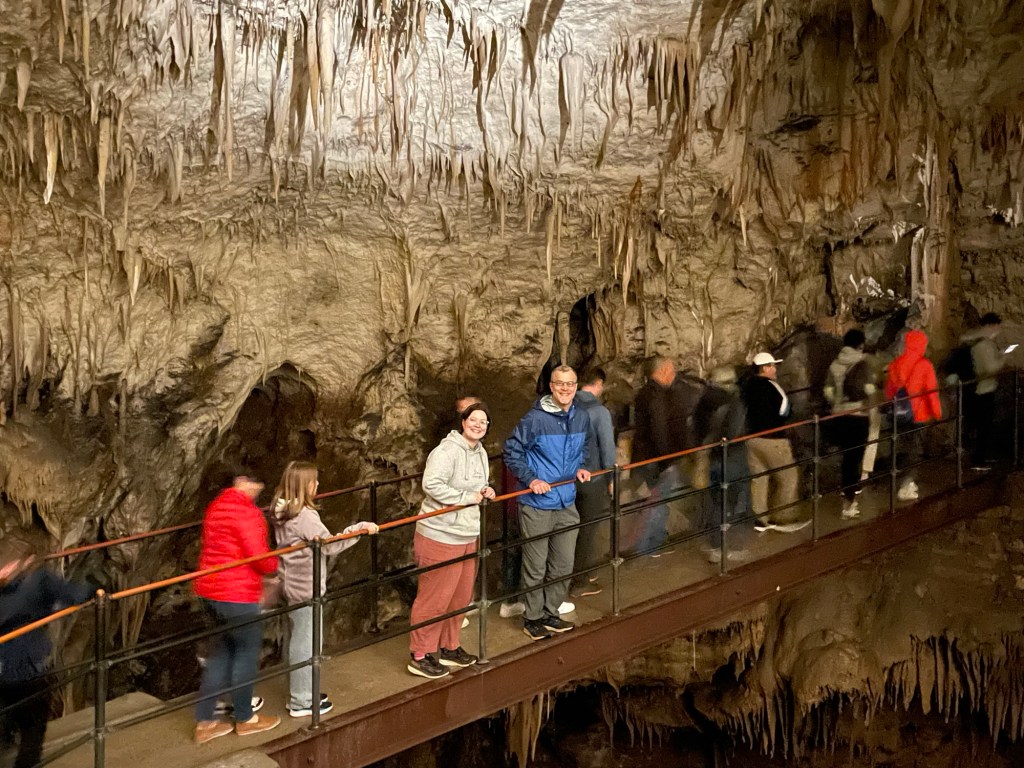
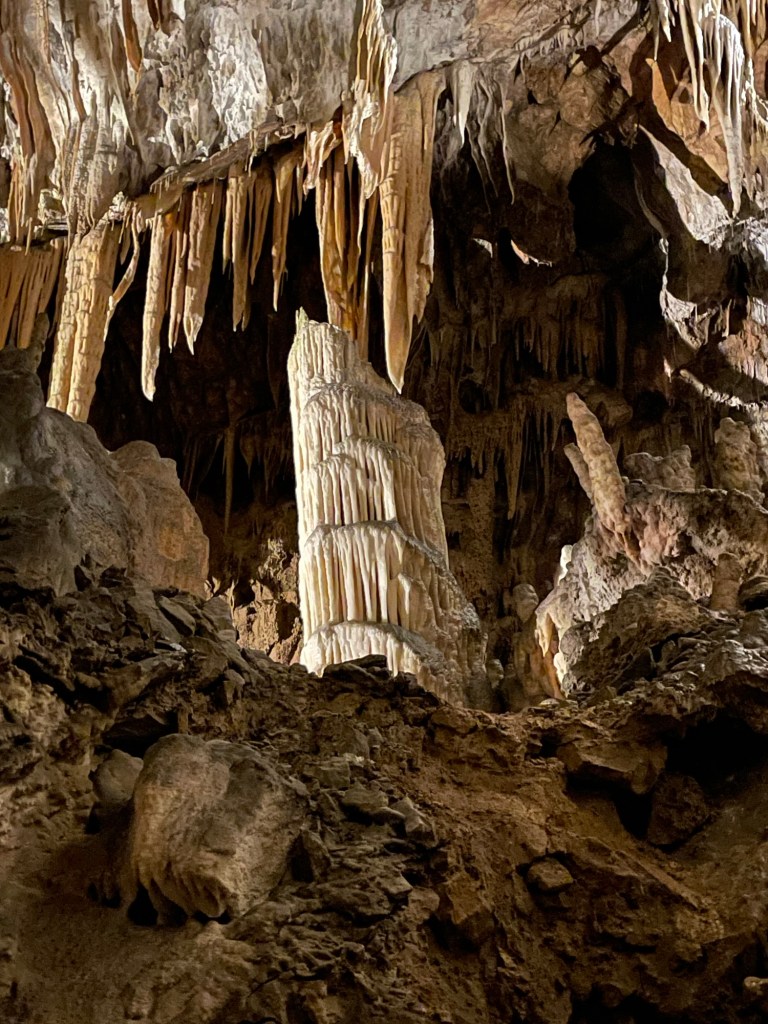
The cave has been known since the 1700s, and has drawn tourists for many years. Today the train is only the start of a smoothly functioning operation that shuttles hundreds of visitors through every hour. Perhaps the machine is too well oiled: although the underground sights were impressive, our English tour group was very large, and the guide walked quickly at the front. In order to have much chance of hearing her commentary, you had to hurry along to keep up. Not much time for lingering, but we did manage a few pictures!
The “Tower of Pisa” — and you thought it was in Italy!
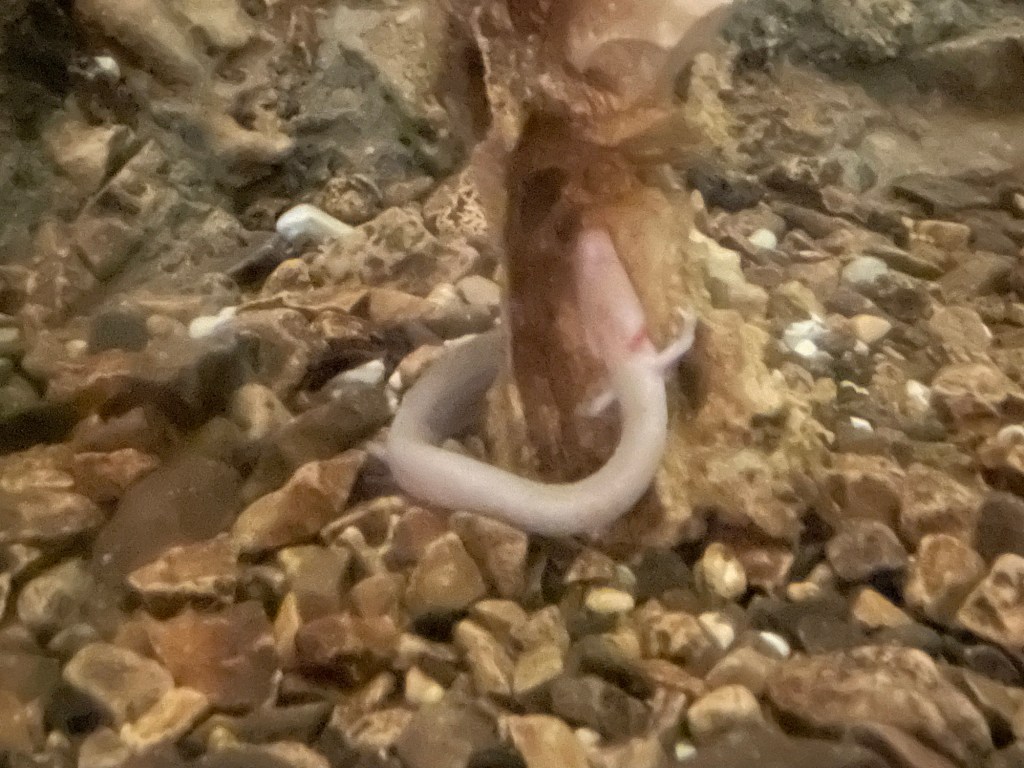
Besides its decorations in stone, this cave also boasts a zoological wonder. The olm has been known since at least the 1600s, when stormwaters occasionally washed dead specimens out of their subterranean homes. The first people to find them mistook them for dragon spawn, taking them as proof that larger mature beasts lived in the deep places underground. Today we know them as a type of cave salamander, related to the axolotl of Central America, which can live up to 100 years and show remarkable powers of regeneration when injured. Water pollution has unfortunately endangered their survival as a species, so the cave operators have begun a program to study, breed, and preserve the olm. We saw a tank where several of the creatures live as part of this effort.
This is one of the olms we sawA high-resolution photograph from the explanatory materials.
Postojna Jama is host to yet another distinction: the world’s only post office 160 meters below ground, in operation since 1899. After a few tourists sent postcards bearing news of the sights they had seen there, the cave owners convinced the Slovenian postal service to set up a branch within the “Ballroom,” the largest open space in the cave system.
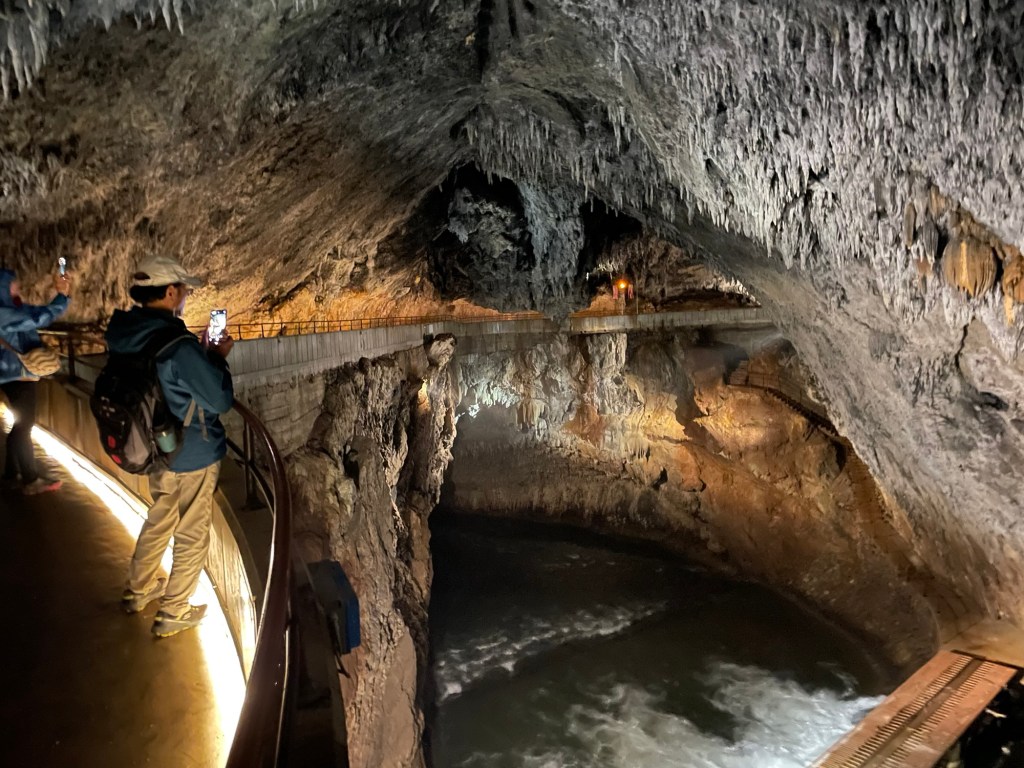
On our way out we passed above the course of the Pivka River, now running underground and excavating new caverns for future visitors to enjoy one day.
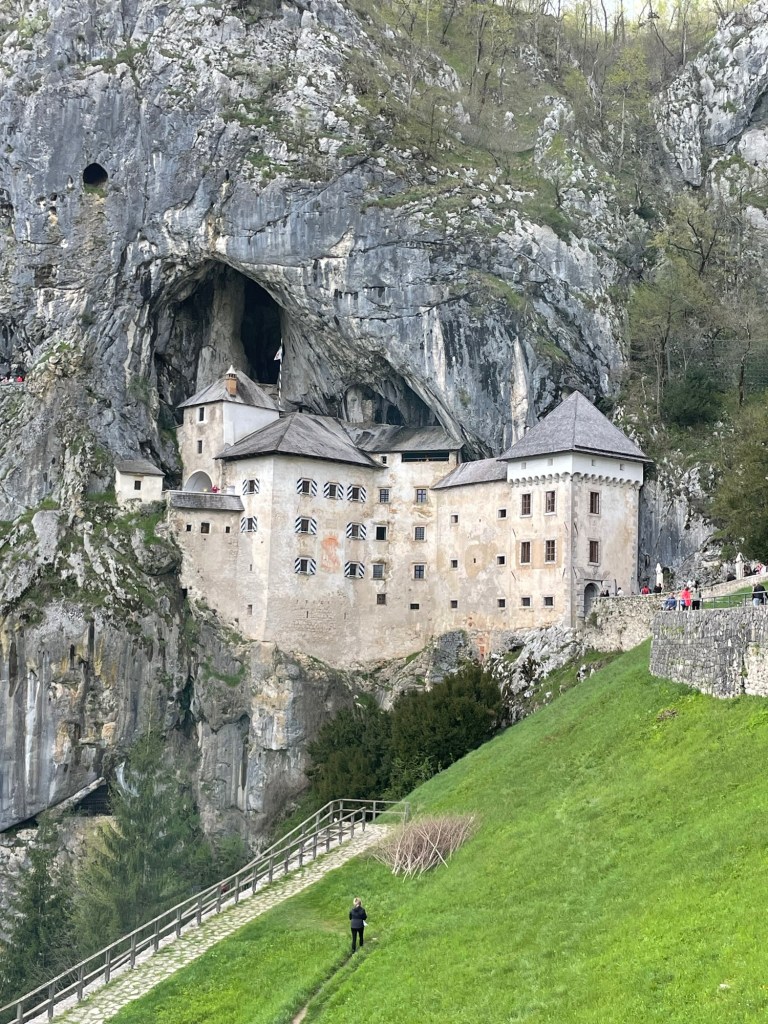
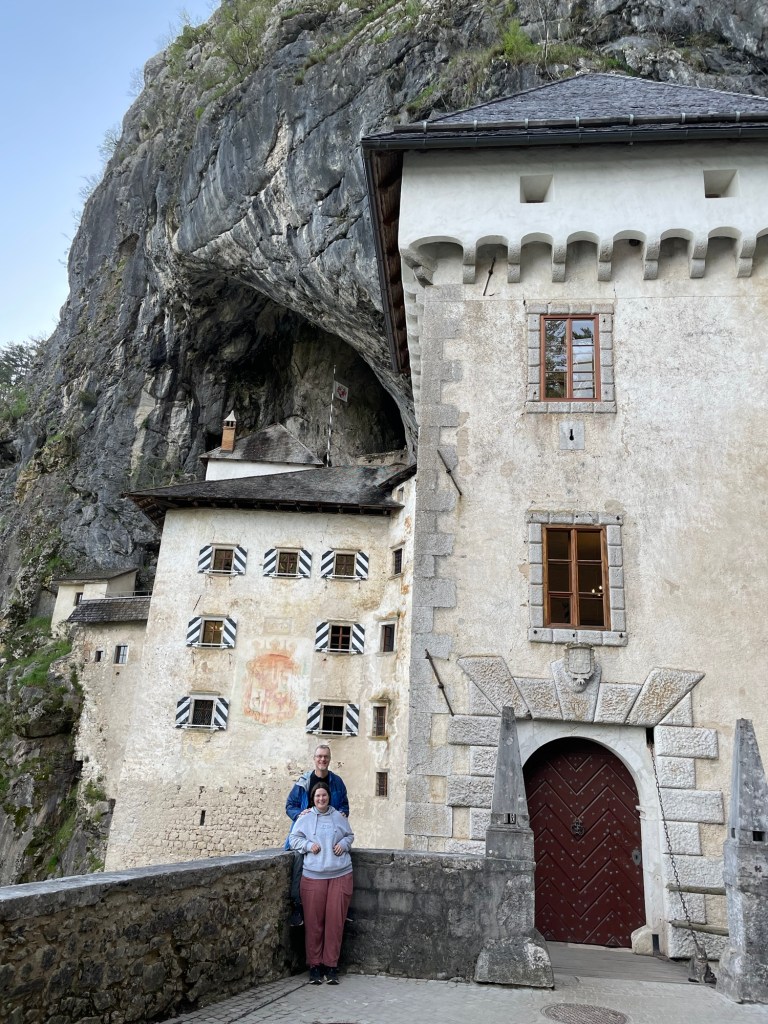
Not far from underground post office there can be found another unusual sight: a stone castle built into a cave. Predjama Castle has been fortified since at least the 13th century, although the current structure dates only to the 1500s. It stands at the mouth of a cave system that provides not only extra space for storage and housing but a secret exit used to bring supplies in during sieges.
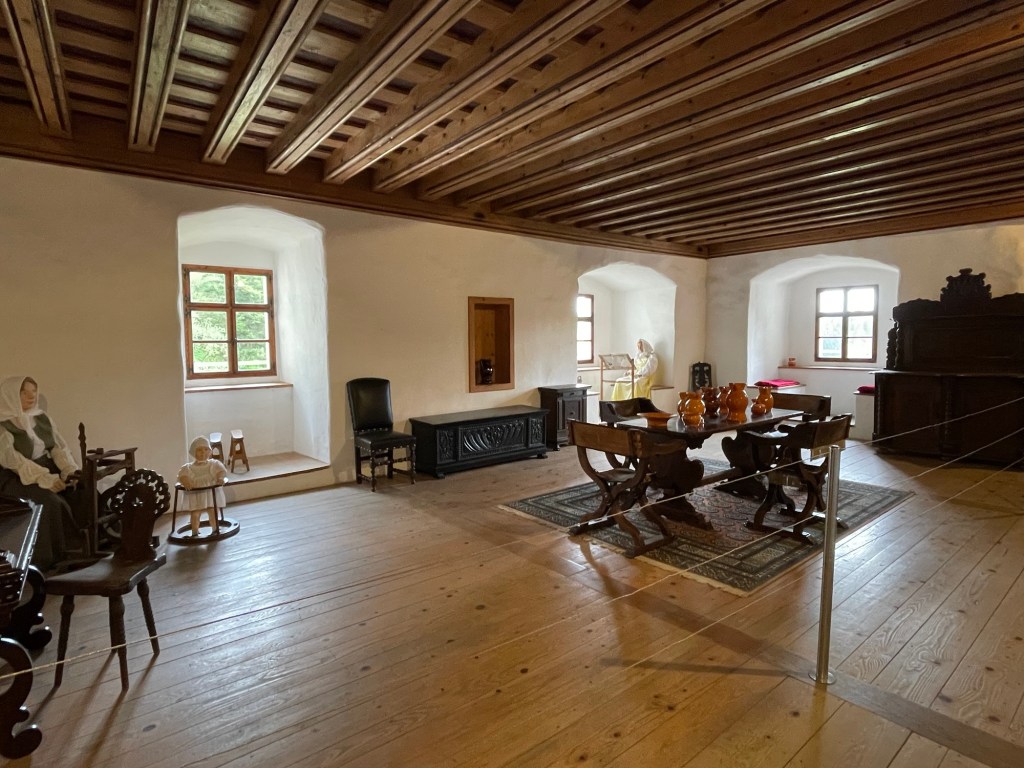
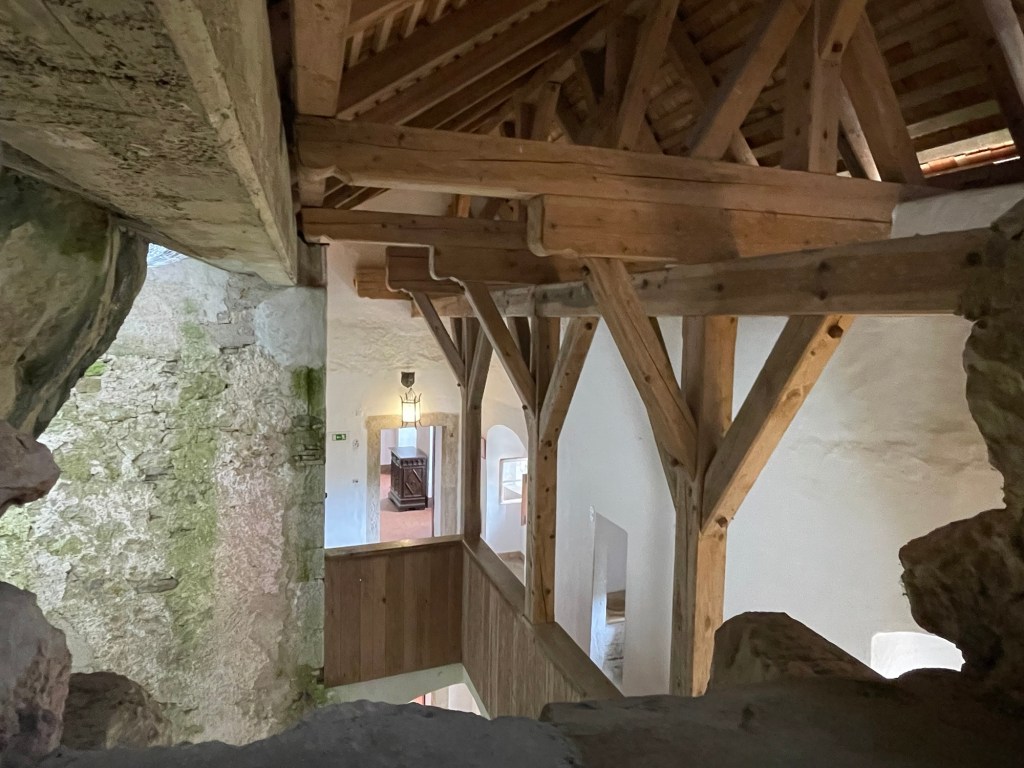
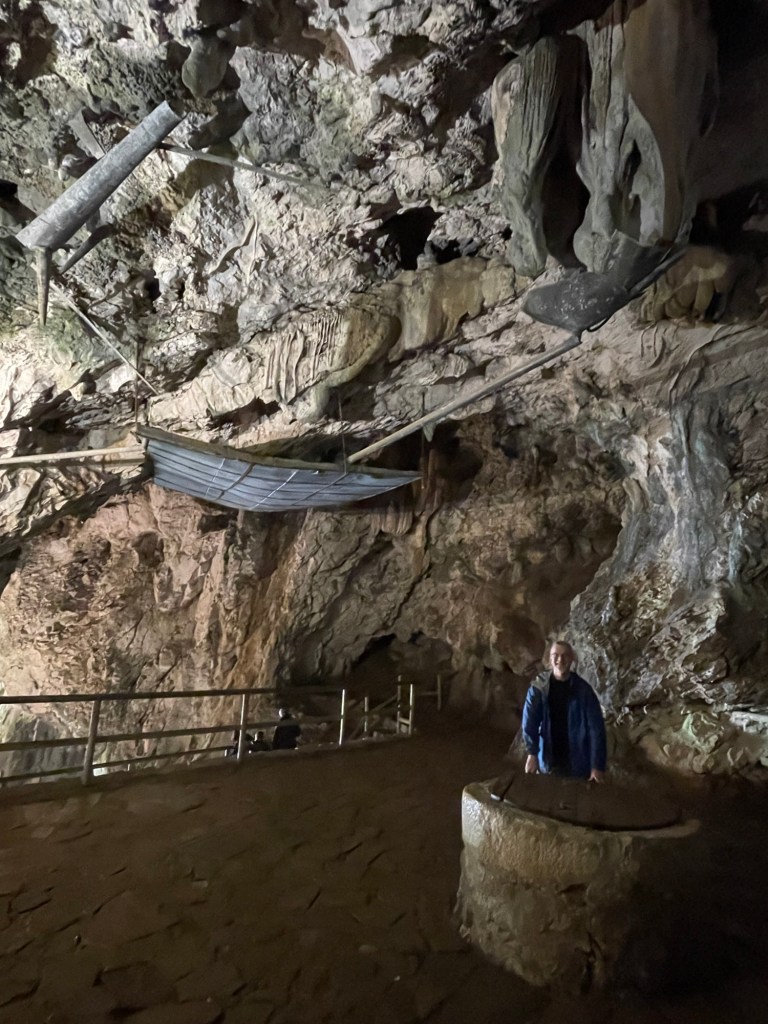
The castle layout is delightfully quirky inside, making the most of the combination of natural and manmade features. The kitchen fireplace is vented through a natural chimney in the stone, while the living areas feature large window seats for light and air. To ensure an unlimited supply of fresh water, the builders rigged up a seemingly precarious system of drip pans and piping to gather natural seepage within the cave. Thus collected, the water is routed throughout the castle via carved stone channels that presage modern plumbing. The castle also features beautifully restored post and beam roofing, a collection of arms and armor, and scenes reenacting earlier life within the castle.
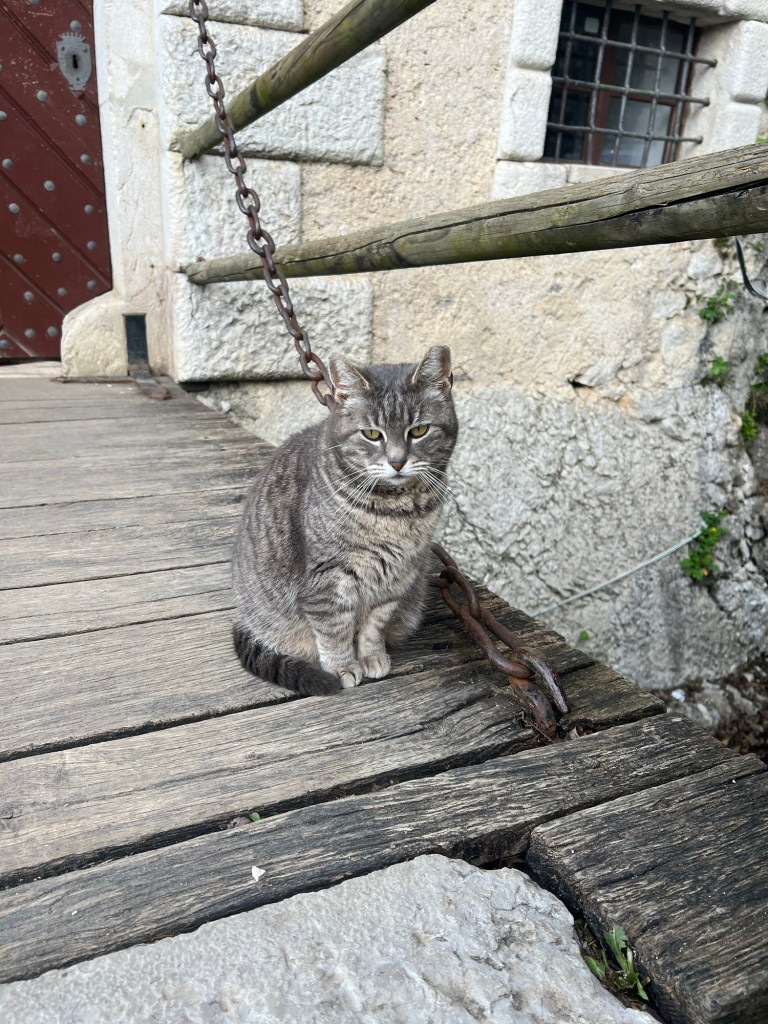
The main dining hallHallway to the terrace. The round stones are trebuchet and cannon shot found on the premises.View from the upper terraceGallery between the entrance tower and the main castleThe armoryAccess to the rear cavesNote the water collection system overheadSecret exit (some climbing involved), which eventually emerges at the top of the cliffDiagram of the entire cave system. The lower caves are closed to the public until high summer, to avoid disturbing the breeding season of the local bats.Rowan was pleased to make the acquaintance of this castle catEntrance tower with door and drawbridgeLocal legend has it that this lime tree was planted by one of the 16th century local lords in honor of his wife. Recently damaged by vandalism, it has been carefully pruned and is beginning to grow back.Getting into the spirit of castle life
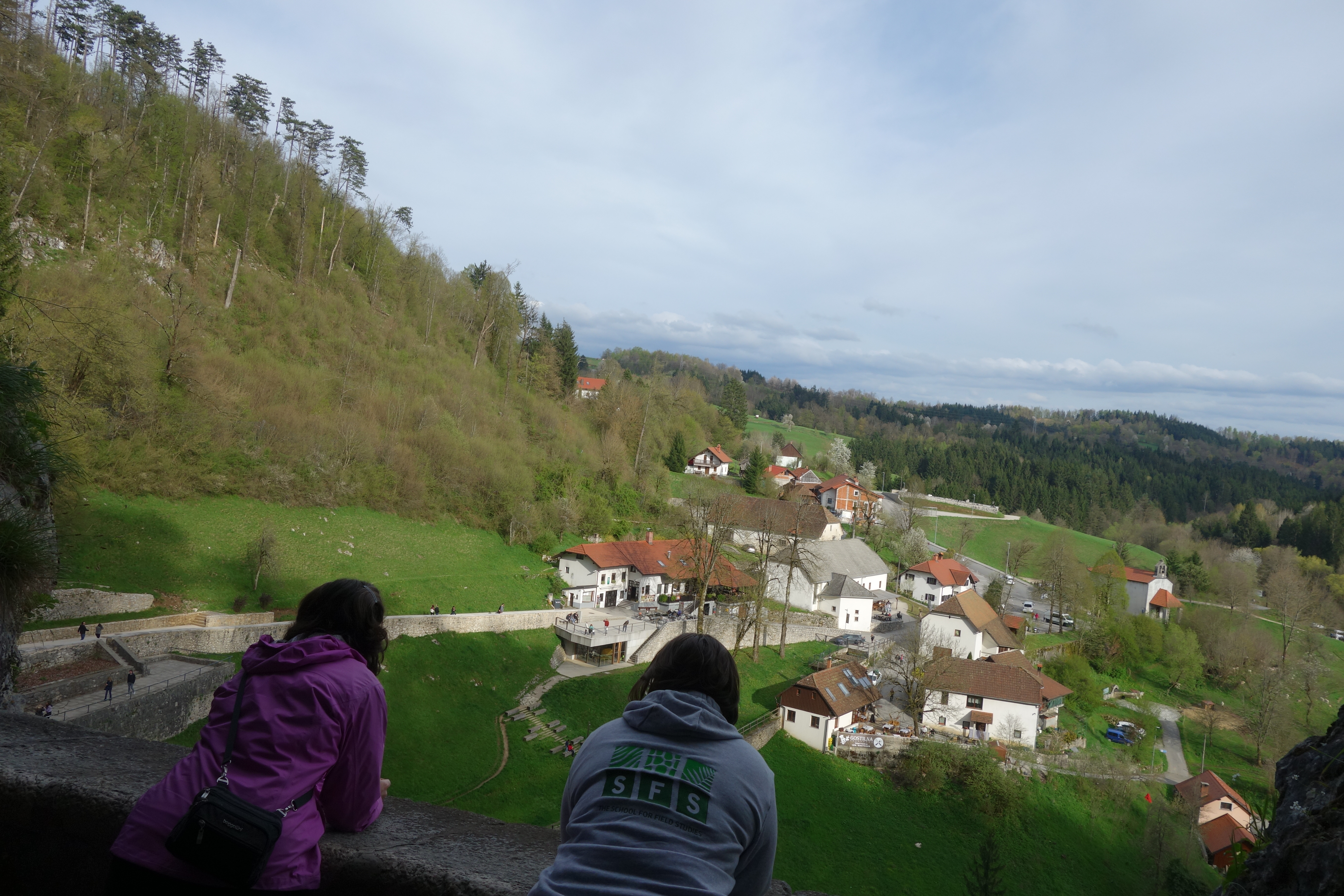
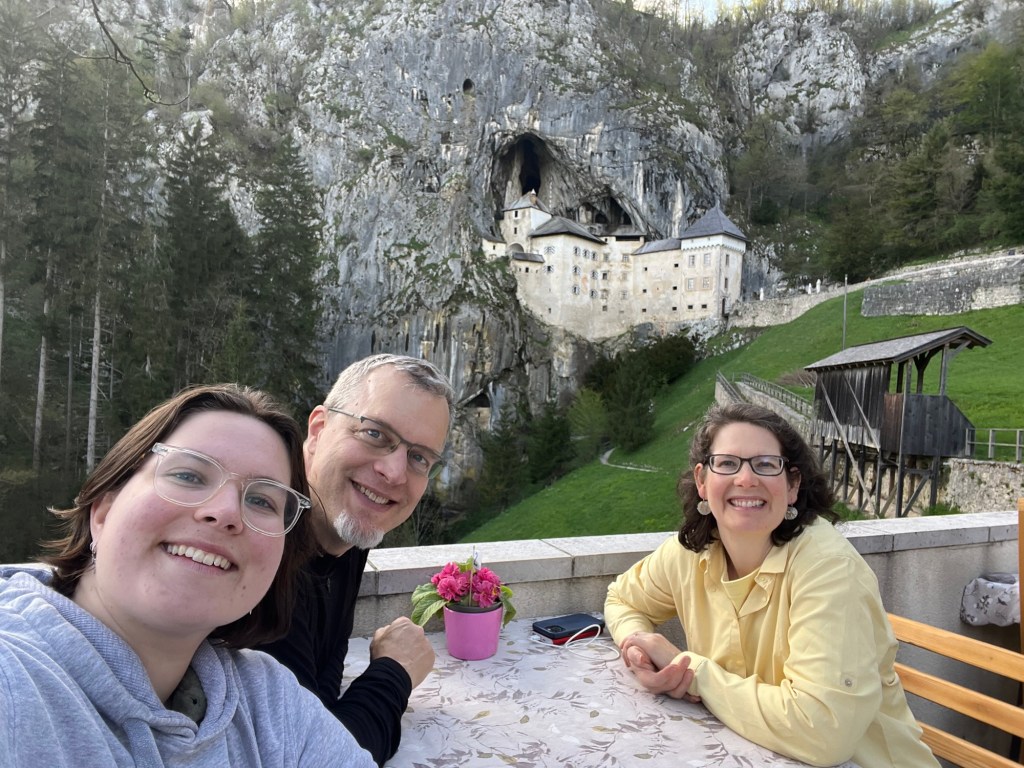
Although we had intended to travel onwards immediately after concluding our castle visit, we could not help but be drawn in by the local restaurant with the fabulous view. So we stayed for dinner, and dined on local fare including traditional Slovenian dumplings and a layered dessert cake made with poppy seed paste and served warm, called gibanica.
Our rental car was all alone by the time we finished our meal, but it too had a great view of the castle!













































 Howes' Doings